











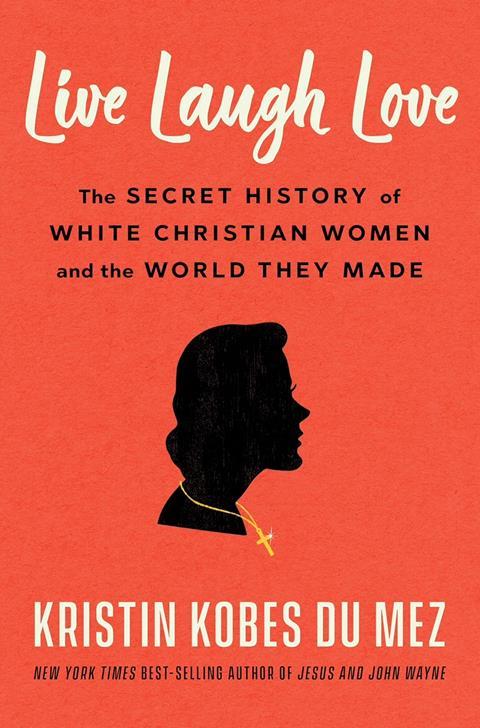
Kristin Kobes Du Mez follows up her bestselling Jesus and John Wayne with a sweeping and unsettling examination of the women who shaped and were shaped by white American evangelicalism. Live Laugh Love could be an academic prelude to The Handmaid’s Tale, says our reviewer

When Jesus and John Wayne: How white evangelicals corrupted a faith and fractured a nation was released, it quickly raced up the New York Times bestseller list. Kristin Kobes Du Mez comprehensively examined how a subsection of the American church idealised a form of militant masculinity and was regularly referenced in deconstruction spaces.
After writing about white American evangelical manhood, it seems that examining their female counterparts was the next logical step. Live Laugh Love: The secret history of white Christian women and the world they made does exactly that, looking at key female figures from Elisabeth Elliot to Erika Kirk.
The women who shaped white evangelicalism
The book begins in the mid-1800s, tracing the life of author and speaker, Hannah Whitall Smith and her book The Christian’s Secret of a Happy Life (Baker). It then leads on to Christian women who took concepts like ‘New Thought’ (the belief that positive thinking produced positive results) and married it to faith, creating the seeds for the prosperity gospel.
It transitions into the 20th century by way of Elizabeth Towne, whose pamphlet Fascinating Womanhood (published anonymously in 1922) espoused that women needed to cultivate femininity to attract a man. Kobes Du Mez then continues with a list of influential figures and their role in creating the present day American Church culture. While comprehensive, the focus shifts so often that these names start to wash over the reader at some point. That is, until we get to Elisabeth Elliot.
This book could serve as an academic prequel to The Handmaid’s Tale
The story of Jim and Elisabeth Elliot is a well-known one in Christian circles. Working as a missionary in Ecuador, Jim was one of five people who were killed trying to witness to the Waorani people. It was Elisabeth ‘Betty’ Elliot who cemented Jim’s legacy by not only being one of the first to write an account of his mission, but later living among the people who murdered her husband.
She went on to be a prominent speaker and author, writing not only about her husband and experience as a missionary, but also about traditional Christian gender roles.
Behind the scenes
What the public rarely hear is Elisabeth’s own wrestling with some of her theological positions. Her writings also question the futility of her husband’s sacrifice; as a widow and single mother, Elisabeth could not stomach the “hollow clichés” given to her by Christians, and wasn’t shy about sharing her doubts.
Nonetheless, she was steered back to more conservative theological ground and went on to become a darling of American evangelicalism. Elisabeth was married twice after Jim died, both husbands were abusive.This is just one story that Kobes Du Mez shares to highlight the disparity between the famous writings and the actual lives of these influential women.
The conclusion she draws is that if your life is filled with suffering because of how men treat you, and you are told that this is explicitly God’s will, then you need to readjust your entire theology to make sense of circumstances beyond your control.
Competing themes
Live Laugh Love covers the history of white Christian women in America exhaustively, almost to a fault. For international readers, it can feel like we’re reading over the American audience’s shoulder; a cacophony of figures who never became household names here in the UK.
In many ways, it feels like three books, all fighting with each other for attention.It examines the intersection of Christianity and a very specific form of capitalism aimed at white women.
It talks about how conservative Christian women were positioned against the second wave of feminism in the mid-20th century. And it takes us into the mind of women who somehow find it in themselves to advocate for Trump, a man who is actively trying to take away their own rights. It could serve as an academic prequel to The Handmaid’s Tale quite easily.

























No comments yet