












Ahead of the US mid-term elections, where more than 60% of white evangelicals are expected to vote in favour of Donald Trump, Elaine Storkey examines what scripture says about leadership, truth and power
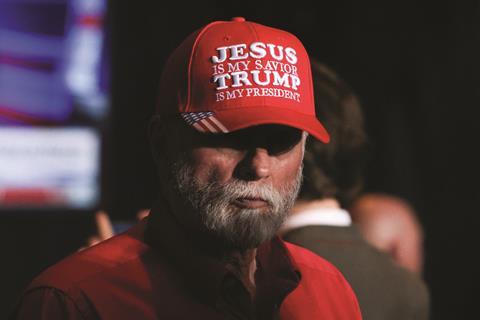
With the US mid-term elections happening this month, I’ve been enjoying a visit from an American Christian friend and hearing her reflections on the theological and political tensions between evangelicals. Coming from the same Christian tradition, we share an integrated theology of evangelism and social justice and believe our calling includes prophetic challenge to those in power. She is questioning why so many of her fellow American evangelicals support a regime that she views as inept, untrustworthy and unchristian.
It’s a question asked not only by Christians. Many journalists, psychologists, peace-workers and scholars wonder about it too. Eighty-one per cent of white evangelical Protestants voted for Trump in 2024. Some fringe supporters may have turned away from him since then – citing his incessant offensive and incendiary postings on social media, war with Iran, high cost of living, corruption and false claims. Fewer are swayed by his rhetoric today than in past years. Nevertheless, the majority of white evangelicals have stayed loyal to the MAGA cause. Why?
One answer is that their politics and theology coincide in many areas. They identify Trump’s pro-Israel, pro-life stand as being on God’s side, along with his opposition to Islam, immigration and transgender ideology. Trump’s personal morality matters less. It’s because of his policies that he’s seen as the leader God sent to restore America.
White evangelicals who oppose Trump are in the minority. Yet their appeals to biblical theology as grounds for their objections are far more thorough. They correctly see biblical teaching as engaging with the whole of life: with truth, justice, peace, compassion and personal ethics. And they see very little of these in Trump’s presidency.
Dissonance
Firstly, there’s a huge dissonance between Trump’s self-aggrandisement and Jesus’ teaching that true greatness in leadership comes from humble, selfless service to others rather than from power-seeking, status or control: “Whoever wants to become great among you must be your servant…whoever wants to be first must be your slave” (Matthew 20:26-28). Jesus washed His disciples’ feet. The loving servant-leadership advocated in the Gospels is patient and kind, not envious, boastful or arrogant (see 1 Corinthians 13:4).
Trump’s coarseness to questioners and opponents doesn’t fit either. Jesus warns against insulting others. The words that come out of our mouths originate in our hearts – evil thoughts, false witness, slander – and they defile us (Matthew 15:18-19). Anyone using derogatory speech against another is subject to judgement (Matthew 5:21-22). Christians are told to keep our tongues from evil and our “lips from deceitful speech” (1 Peter 3:10), focusing instead on things that are true, noble, right, pure, lovely and admirable (Philippians 4:8).
Many MAGA evangelicals accept false claims without question
Neighbourliness is also missing from Trump’s portfolio. Jesus teaches hospitality to outsiders as part of neighbour-love, identifying himself as a stranger: “I was a stranger and you welcomed me” (Matthew 25:35-50, ESV). Paul, similarly, urges believers to clothe themselves with “compassion, kindness, gentleness and patience” (Colossians 3:12).
Exploiting public office to make money or gain wealth is particularly wrong. Bribery ($5,000 each if the Republican party win?) perverts justice and is strictly forbidden (Deuteronomy 16:19). So is “dishonest gain” (1 Timothy 3:8). Paul insists the “love of money is a root of all…evil.” Desiring riches draws us away from faith (1 Timothy 6:9-10). Jesus says money obsession is idolatrous: we “cannot serve both God and Money” (Matthew 6:24).
Truth and lies
Trump’s construction of his own ‘truth’ has released what The Washington Post called a “tsunami of untruth” over the USA. In 2020, factcheckers identified more than 30,500 of Trump’s statements to be false or misleading.
Trump has not “brought prices down”, “stopped eight wars”, “won the 2020 election”, “defeated inflation”, gained a “decisive victory” in the Iran war, given $350bn to Ukraine’s defence, or increased America’s standing worldwide. Yet many MAGA evangelicals seemingly accept these false claims without question.
Don’t follow the crowd
With such incongruity between evangelical teaching and Trump’s leadership, evangelical support of Trump seems little to do with biblical theology. Other spiritual/psychological forces may be involved. The Bible itself warns us against herd mentality. Crowds are dangerous: they pressure people to conform and compromise. Ancient Israelites were told not to enable injustice by siding with a crowd and saying what others say: “you shall not follow a crowd to do evil” (Exodus 23:2, NKJV).
Psychologists show how oft-repeated lies and slogans in a crowd or community produce familiarity, which then becomes ‘truth’. The Hebrew equivalent was false prophets who prophesied lies in God’s name, giving crowds “false visions, divinations, idolatries and the delusions of their own minds” (Jeremiah 14:14). Peter too warns that manipulative, greedy leaders spread destructive heresies and exploit their followers (2 Peter 2:1-3).
Crowd manipulators offer endearments, assurances and slogans. They construct narratives of shared victimhood, create enemies to oppose, make promises that will never be kept. Echo chambers isolate people from encountering dissenting views so misinformation can freely circulate. Crowd members place their hope, trust and identity in the leader, who uses it to keep himself in power.
By the time the truth becomes obvious, individuals have vested too much of their identity to renounce their allegiance. No wonder Jesus warns that the broad and easy road to destruction is crowded, while few find the narrow gate leading to life (Matthew 7:13-14).
Jesus was regularly followed by crowds. He fed them, healed them, loved them and taught them about God’s kingdom. Yet ruthless religious leaders were able to manipulate those crowds to do evil. The same people who welcomed Jesus as conquering king into Jerusalem (Matthew 21:9) later shouted “Crucify him!” (Matthew 27:22-23; Mark 15:12-13).
All Christians need biblical discernment and prayer when deciding who to support. We must learn from Jesus and seek His mind. The challenge to us too, in the UK, is to allow our evangelical witness to be shaped by God’s word and Christ’s sacrificial love.

























No comments yet