













Jesus is being openly talked about in the heart of the world’s biggest football league. For Christians looking to share their faith, this cultural moment could be an open goal, says Martin Saunders
In the midst of the cut and thrust of a high-pressure Premier League football match, a player produces one of those fine-margin moments which decide games. He’s just scored a vital goal to put his title-chasing team ahead in a match, and against their fiercest rivals. Though he is being worshipped by thousands in the stadium, he immediately steers the focus away from himself. He takes an index finger from each hand and forms a cross – his now-trademark celebration – and shouts loudly enough that the TV cameras pick up and broadcast: “My God!” In his moment of glory, he redirects all that adoration elsewhere.
Another player – incidentally, a teammate of the first – develops an unusual habit for which he becomes known, and sometimes teased. Before matches, he takes to much-derided social media platform X (formerly Twitter), to post Bible references. Before a big game against a European rival, he posts: “Matthew 7:7”, which refers to the verse: “Ask, and it will be given to you; seek, and you will find; knock, and the door will be opened to you.” In the run-up to a must-win Premier League game, he posts: “Romans 6:13-14”, a passage in which Paul invites us to reject sin and become “an instrument of righteousness”. These aren’t just proof texts, but clues to the player’s thinking and theology as he prepares for football matches.
A third, one of the outstanding players in the league this season, becomes increasingly public about his Christian faith. As one of the biggest teams in the world show an interest in buying him, he maintains an incredibly level head and is even seen publicly praying with his pastor in the stands before a match. When that big-money move comes, his departure is a model of integrity on and off the pitch. Having scored a last-minute winner with his final touch for the club, he pays to take a full-page advert in the local newspaper to thank the fans for their support, loyalty and love. This is, it seems, how a man of faith behaves, and it’s wonderfully different.
These players are Eberechi Eze and Jurrien Timber of Arsenal, and Antoine Semenyo, who recently moved from AFC Bournemouth to Manchester City. They are three of the most notable faces of a movement which has taken the Premier League by storm and become a talking point in the sporting world. This isn’t just semi-superstitious chest-crossing or ambiguous pointing to the sky. This is Jesus being centred in the heart of the biggest football league on earth.
The network behind the movement
There have always been Christian players in the Premier League. Just as a matter of simple probability, each team will have had a handful of religious players, some nominal, some following other faiths and occasionally one or two who are outspokenly evangelical. This is different; it’s been brewing for a few years, and there’s a sense in which it is intentionally coordinated and supported like never before.
John Bostock, the one-time Tottenham Hotspur wonderkid, started a ministry to professional footballers in 2015. Called Ballers in God, it had a humble beginning, emerging out of Bostock’s own desire for support from other Christian players during a period when he was playing in Belgium. Somewhere along the line, however, something shifted. Well-known players began to come across Bostock’s ministry and its Instagram account (@BallersinGod) and community began to form.
Post match interviews are so littered with references to Jesus’ lordship that broadcasters have given up trying to edit them out
Fans – both Christian and otherwise – began to take note too. At the time of writing, Ballers in God have almost three-quarters of a million followers on social media. Yet the real heartbeat of the ministry is the network of support between Christian players, which transcends divisional hierarchy and inter-club rivalry. Players meet online and in-person for prayer, retreat and Bible study. Evangelism and discipleship, as some players move from nominal to committed faith, are also high on the agenda. Bostock talks proudly of the conversions and baptisms that have resulted.
Similarly, Christians in Sport have operated an under-the-radar outreach to professional footballers for decades; organisations like Ambassadors and Kick are working with coaches and players from youth level up. The Sports Chaplaincy Network provides Christian support and input for players at club level. Together, this wave of ministries has catalysed a movement of players who feel supported and emboldened to go public about their faith in Jesus.
United (in Prayer)
It’s now possible to pick a team of current Christian Premier League players who could genuinely challenge for the league title. Here’s my best effort – feel free to challenge and suggest revisions!
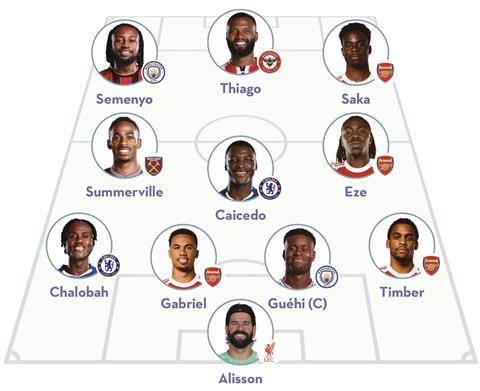
Subs: Doku (Man City), Estevao Willian (Chelsea), Yoro, (Man Utd), Lacroix (C. Palace), Gakpo (Liverpool), Awoniyi (N. Forest), Madueke (Arsenal), Hincapie (Arsenal), Sadiki (Sunderland), Bassey (Fulham)
OK, so it’s an extremely attacking side, but there’s no doubt that this line-up would strike fear into the hearts of most defences, as long as the only goalkeeper doesn’t get injured. I’ve only included players who have specifically spoken publicly about their Christian faith in some way (eg by posting on social media). We could create a whole second XI of players who are thought to privately hold Christian beliefs, but for me, even this side would be red-hot favourites for the Premier League.
Faith in the dressing room
This isn’t an entirely new phenomenon; in 2023, Leyton Orient were so impacted by their core of Christian players that they celebrated their promotion to League One by singing worship song ‘Old church basement’ in a widely shared social media video. Last season, Crystal Palace appeared to have amassed a Christian majority in their first team – and utilised their unity to win an unexpected and historic FA Cup title.
These were the early signs that something exciting was happening. Now, the 2025/26 season has seen an explosion of faith in football. Some of the biggest and most successful clubs in the land seem to have a nucleus of outspoken Christian players. At Liverpool, Brazilian goalkeeper Alisson Becker and forward Cody Gakpo are overt believers, the former having famously baptised former teammate (now pastor) Roberto Firmino. At Manchester City, recent recruits Marc Guéhi and Antoine Semenyo – both regular presences in Ballers in God content – have joined winger Jeremy Doku as first-team faithfuls.
Perhaps most notable of all is Arsenal, where the galaxy of believers includes Bukayo Saka, Jesus, Eberechi Eze, Noni Madueke and Gabriel Jesus, led by their verse-quoting full-back, nicknamed ‘Pastor Timber’. Manager Mikael Arteta has commented on the phenomenon, dubbed in the media as Arsenal’s ‘Bible brothers’. “I love it because I think it connects them more,” he told TNT Sports. “[Their belief] helps their wellbeing, the mental side, and what it brings to them as human beings. I think it’s phenomenal.”
There is, of course, a common thread among these players: many of the Premier League’s most openly devout players come from a global majority heritage; cultures where public expressions of faith are far more commonplace. Brazilian football, for instance, has long been intertwined with evangelical Christianity; it is not unusual to see players praying together on the pitch, wearing shirts bearing Bible verses, or speaking openly about their beliefs. Meanwhile, many young Black British footballers have been raised in faith-filled households, connected to one part of the UK Church that is certainly growing.
By comparison, it is probably fair to say that younger generations of white British people in particular have become used to being quieter about their beliefs. There are, of course, exceptions: Bournemouth’s Ben Gannon-Doak spoke about his Christian faith in a recent BBC Scotland documentary. There are also white players talking about Jesus in the lower leagues, including Southampton FC’s Leo Scienza and Wycombe Wanderers’ Jason McCarthy, who previously shared his testimony with this magazine, as well as Swansea City’s Josh Key and Joel Ward (previously part of Crystal Palace’s 2025 FA Cup winning side, which also included Eberechi Eze and Marc Guéhi).
As a footballer boldly talks about Jesus, we just have to like and share
That said, we appear to find ourselves in a moment where younger people are again becoming interested in faith, and where talking about Christianity no longer seems to carry the stigma that it once did. Where global-majority heritage Christian players may have blazed a trail, perhaps a gloriously multicultural ‘city on a hill’ might now shine.
Arsenal’s Michelle Agyemang is currently the most prominent women’s footballer to proudly talk about her faith, but as a Lionesses heroine and freshly minted BBC Young Sport’s Personality of the Year, she has enormous influence. Just as the current crop of men’s players have normalised faith in their game, we should pray there’s a mirrored effect in the Women’s Super League, led by vocal players like Agyemang.
An open goal
Eze’s cross celebration has become so prominent that children are replicating it on park pitches around the country. Post-match interviews are so littered with references to Jesus’ lordship that broadcasters have given up trying to edit them out. Fascinated journalists are writing profile pieces on how players’ relationships with God have inspired them through the adversities of their football journeys. Social media feeds are littered with references to all of these, as excited Christians share these expressions of faith with their friends. As a footballer boldly talks about Jesus, the perfect opportunity emerges for some low-intensity evangelism; we just have to like and share.
The missional potential of this is huge. From slipping references to Semenyo’s integrity into our sermons, to asking our friends at the pub what they make of Timber’s pre-match Bible references, this is a cultural conversation that is already happening. Of course, it’s a little more complicated than simply demonstrating that faith in God improves your team’s performance (we’ll get on to that in a moment) but it’s also a phenomenon which is fascinating to the average person. Why, as if from nowhere, are some Premier League football teams experiencing a kind of Christian revival? You don’t need to be interested in Jesus to be interested in that conversation. It’s an open goal.
Joining the conversation
Any good pre-match chat involves an analysis of the pressing talking points. Here are just a few examples of everyday discussions that are naturally focusing on faith and football.
Is God on Arsenal’s side? At time of writing, a few teams with a core of Christian players are enjoying a very good season. As the Arsenal manager pointed out, that’s probably more about shared focus and an increased sense of unity than God literally helping out His chosen ones. When interviewed recently for this magazine, John Bostock talked about how his perspective on this has shifted. “I [once] felt like: If I honour God, He’s going to bless me,” he explained. “And God does bless you, but the blessing might look like defeat. The most blessed moment in history was a cross. It didn’t look like victory, but it was.”
Should Christian players wear the rainbow armband? Marc Guéhi, then captain of Crystal Palace, attracted controversy last season when he wrote ‘I love Jesus’ and then ‘Jesus loves you’ on his rainbow captain’s armbands, produced to promote the Premier League’s LGBTQ+ inclusion campaign. Guéhi told the BBC that the messages were about “truth and love and inclusivity,” adding: “I hope people can understand that my faith is my faith, and I’ll stand by it for the rest of my life.” The moment created debate about the intersection of religious freedoms, discrimination and league-mandated campaigning.
What about other faiths? Liverpool’s Mo Salah and Ibrahima Konate are just two of well-known Muslim players in English football, while the prayer room, which has become an important part of the pre-match routine at Arsenal, was opened by former player Mohammed Elneny, also a Muslim. In a recent article for this magazine’s website, Tim Dieppe wrote that pausing matches during Ramadan so that players can break their fast was a sign of the “Islamisation of Britain”, and that “only a confident, bold, assertive Christianity can withstand this trend”. Conversely, one might argue that the bold, assertive band of Christian players are doing a fine job of coexisting with their Muslim teammates while showing little sign of being Islamised.
The key point: the high profile of Christian faith in football creates a natural starting point for God conversations. They may not always be neat – theological discussions rarely are – but this is a remarkable opportunity for connection and evangelism.
Football Focus
There are some fantastic Christian organisations combining faith and football – from elite to grass roots level.
Ambassadors Football
A global mission organisation working in 35 countries, using football as an evangelistic tool ambassadorsfootball.org
Ballers in God
Connecting pros at every level with each other, providing discipleship input, and sharing testimonies and inspiration online @BallersinGod
Bridge the Gap
Innovative young organisation initiating volunteer-led, faith-linked footballing communities in locations around the UK bridgethegapfootball.org
Christians in Sport
Aiming to reach the world of sport for Christ, this long-running charity supports football pros, students, parents and more christiansinsport.org.uk
Kick
Now multi-sport but with origins firmly planted in football, this children’s and youth ministry provides coaching and support for schools and church-connected academies kick.org.uk
Rising to the challenge
It doesn’t quite follow, of course, that your average non-Christian will experience a Damascene conversion because their favourite player just put a 30-yard screamer in the top corner and pointed to the sky. The faith and football intersection creates its own apologetics questions, and not just about whether God favours a particular team.
On one recent post from Ballers in God, an Instagram user made a rather cutting observation. “If I was paid millions of pounds a year to play a game I loved, I can see how the Christian God would work quite well for me.” Though it might feel like a ‘gotcha’, this should provide a serious challenge both to those who profess Christ in the Premier League, and to those who seek to support them.
If footballers really are our modern Billy Grahams, they can’t simply espouse a hollow faith in a God who prospers those who namecheck Him. There are plenty of signs among the players discussed here that this is a challenge they readily accept, intentionally playing different roles in the Church of the Premier League. Eze is the evangelist, Timber the Bible-quoting pastor; Semenyo the role model of Christ-like character. For football fans everywhere, their words and examples could be persuasive. That really would be something to cheer about.

























No comments yet