












Bible Society’s groundbreaking Quiet Revival report has been withdrawn after YouGov admitted data collection errors. Emma Fowle explores what happened and the implications for those who were encouraged by its findings
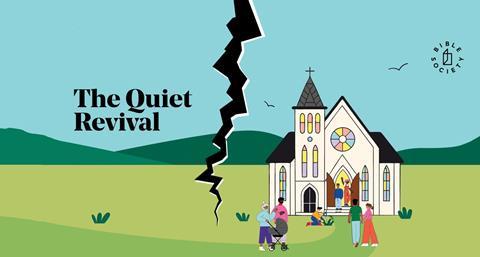
In April 2025, Bible Society released research that suggested the number of people attending church in the UK had increased dramatically. The Quiet Revival report said attendance was up by 56% between 2018 and 2024. There were particularly large spikes among Gen Z, with the number of 18-to-24s in church apparently quadrupling from 4% to 16%.
Bible Society declared the data was evidence the Church was in a “period of rapid growth, driven by young adults and in particular young men”.
But almost a year later, following sustained scrutiny from statisticians and sceptics, the polling company that supplied Bible Society with the data admitted it was unreliable. In a statement, YouGov confirmed that having “re-analysed the data using new tools and techniques”, they’d found “a number of respondents who we can now identify as fraudulent”.
YouGov said they took “full responsibility” for the error, stressing that “Bible Society have at all times accurately and responsibly reported the data we supplied to them”. Bible Society confirmed they had requested numerous checks from YouGov over the past twelve months, but the polling company “repeatedly assured us…that the results were reliable”.
Criticisms
Following decades of negative headlines announcing the continuing decline of churchgoing in the UK, Bible Society’s report had been praised by thousands of Christians who were overjoyed to discover the tide of belief in Britain was finally turning. This magazine ran a regular column entitled ‘Quiet Revival Analysis’, with most contributors welcoming the news. But not everyone was convinced.
Writing for premierchristianity.com in November 2025, Christian journalist Tim Wyatt described himself as a “quiet sceptic”, arguing that the findings contradicted the most statistically robust church attendance data available – namely the annual attendance reports from the Church of England and Catholic Church. Given the latest CofE data had suggested only a modest increase of 1.6%, Wyatt argued that Bible Society’s claims required believing either that a single YouGov poll outweighed decades of professional statistical reporting from the Anglican and Catholic churches, or that millions of new worshippers had joined smaller churches that produce no comparable statistics.
“Neither claim is remotely credible, unfortunately,” he wrote. “I wish it were not the case, but Britain is not in the grips of a quiet revival.”
Conrad Hackett, a demographer of religion at the Pew Research Center, raised similar concerns. Pew’s own research into religion in Britain showed that the Christian population in the UK fell from 62% in 2010 to 49% a decade later. Hackett warned against the accuracy of opt-in polls such as those used by YouGov. Writing for premierchristianity.com in February, Hackett was clear: “Christian identity and practice are not increasing among young adults in Britain.”
Reasons to be hopeful
While voicing disappointment, many Christian leaders have expressed support for Bible Society. Krish Kandiah praised the organisation’s “openness and transparency” in acknowledging the data problems, saying that it “doesn’t cancel what many of us are seeing – more openness, more curiosity, more conversation about faith”.
Gavin Calver, CEO of Evangelical Alliance added that the “plethora of incredible salvation stories” pointed to a “new season of openness to the gospel”.
Revival isn’t the word we should have ever been using… ‘rebirth’ still feels appropriate
However, Wyatt was less impressed. In his Substack newsletter, he called Bible Society’s reversal a “humiliating climbdown”, accusing the charity of having “aggressively attacked” critics of the report before “shamelessly pivot[ing] away” from its central hypothesis. “We need some accountability here, and more than a little humility”, he wrote. “Maybe we could begin with an apology.”
The stirrings of something
When Bible Society withdrew their report in March 2026, they issued a new document, The Quiet Revival One Year On: What’s the story? This emphasised that the faulty survey sample “does not undermine the reality of a significant trend in which many people – especially young people – are finding renewed relevance in the Bible and Christianity in Britain today”.
The Quiet Revival One Year On claims “there is in fact a very positive story to tell”. In the foreword, the organisation points to an “unprecedented public conversation about Christianity”, alongside increased Bible sales, growing numbers of baptisms and confirmations, and rising attendance at evangelistic courses.
There is plenty of anecdotal and statistical evidence from across the UK Church to support these ideas. Bible sales rose by 134% between 2019 and 2025 according to Christian publisher SPCK. The Evangelical Alliance’s Changing Church report, published in May 2025, suggests average attendance at evangelical churches increased by 13% over the same period. A survey of 1,000 teens by British Youth for Christ in July 2025 revealed weekly church attendance among eleven to 18-year-olds has doubled from 4% to 8% in the last five years. At the same time, Easter baptisms in the Catholic Church reached record levels, alongside a record high in participation in Alpha courses globally.
Reflecting on these developments, author and former Premier Christianity editor Justin Brierley conceded that “revival isn’t the word we should have ever been using”, before adding his belief that “‘rebirth’ still feels appropriate”. Referring to many of the aforementioned statistics, alongside similar patterns of renewed interest in Christianity across parts of Europe, he is careful to qualify the moment. “None of these figures or trends amount to a revival,” Brierley says, “but they are reliable data points, and they indicate that something is happening.”
For some Christian leaders, the controversy has prompted a refocus away from numbers and percentages. Evangelist and speaker Glen Scrivener drew on the story of Jesus walking on the water to reframe priorities entirely: “Is it high tide? Is it low tide? Is the tide returning – or not? You could take lots of different views on what’s happening culturally, and there will be lots of different experiences in your local church expression. But high tide or low tide – Jesus comes walking on the water.”
























No comments yet