











The former Archbishop of Canterbury is no fan of managerialism, but it can be necessary and effective to help church leaders focus on evangelism and growth, says Rev Dr Ian Paul. When it doesn’t, it must be ruthlessly cut out - starting right at the top
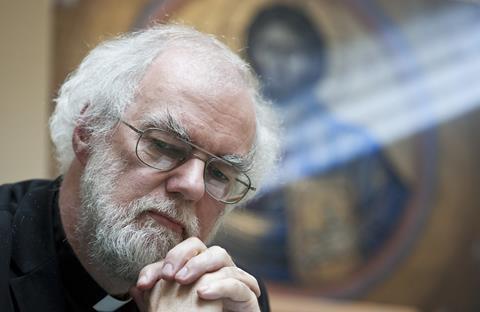
In a recent interview, Lord Rowan Williams, the former Archbishop of Canterbury, made a rather startling remark about Church bureaucracy. He was in a conversation with UnHerd about evil and the demonic in culture - particularly “the erosion of standards of truthfulness in public life and the normalisation of violence in word and deed”. And he was also worried about a Church “too preoccupied with strategy — with schemes for solving problems — and not preoccupied enough with its own integrity as a community of witness and prayer.”
The interviewer, Freddie Sayers, asked whether Williams considered this, too, to be demonic. “In a word, yes”, he replied, explaining that the diabolical is a “pull to the destructive and towards a kind of idolatry of the self and the corporate self and its wellbeing and security and control.”
I know very well that Williams intensely dislikes bureaucracy and ‘managerialism’; I learned it from him in personal conversation, but also from observation when I joined the Archbishops’ Council just over ten years ago. The Council then appeared to have inherited a fairly chaotic set-up, and despite significant improvements, I still have major questions about its effectiveness.
A quartet of bureaucracy
To properly make sense of Williams’ comment however, we first need to recognise that there are four kinds of bureaucracy: the necessary, the effective, the needless and the damaging.
Some bureaucracy is necessary. The Church of England is not a gathered community of the committed; it is the steward of 16,000 parishes, thousands of listed buildings, hundreds of schools, and a legal and financial architecture of extraordinary complexity. Someone has to manage the pension fund. Someone has to sign off on the faculty application for the leaking roof. That is not to say this is all done well at the moment; those administering the bureaucracy often need to be better connected with those affected by it. And there is real scope for simplifying it.
A recent survey found that clergy spend more time on admin than preparing their sermons
Much of this is bureaucracy is also driven by where we are as a culture. Safeguarding failures - catastrophic, real and genuinely evil - demanded new systems and oversight. Employment law changed. Charity law changed. The expectations of insurers, auditors and regulators changed. Much of what looks like bureaucratic sprawl from the outside is, on examination, the Church trying to behave responsibly in a world that holds institutions to account in ways it simply did not 50 years ago.
I think it might be possible to say that there is something evil in this cultural change - in that it is driven by a lack of trust and openness that was taken for granted a generation ago. But that cannot be said of our response to this culture.
The goals of the gospel
So what of effective bureaucracy? Williams’s critique appears to assume that the structural and the spiritual are necessarily in tension. This is a very Anglican sort of anxiety, but it is not obviously true.
The early Methodists were extraordinarily organised. The Catholic religious orders that evangelised medieval Europe ran on rules, rotas and hierarchy. The Jesuits, arguably the most effective missionary movement in Christian history, were essentially a spiritual army with a chain of command.
Structure does not preclude evangelism. What precludes evangelism is a failure of nerve, a loss of confidence in the gospel, and a reluctance to speak plainly about what the Church actually believes. Those pathologies are not caused by having too many diocesan committees (though these might be a symptom). They run much deeper.
The key question is whether the bureaucracy is serving the goals of the gospel or hindering them. A common complaint is that the application process for funding mission initiatives (from the ‘Strategic Mission and Ministry Investment Board’) is too demanding - too bureaucratic. But the aim of the process is to ensure that those applying have really thought through what they are trying to do, and that this is based on evidence - as all charitable expenditure needs to be.
This is not merely a guard against lack of trust, but against our tendency to kid ourselves that we are doing the right thing before we have asked serious questions of ourselves. It is intended to be bureaucracy that serves the mission goal, even if it sometimes fails to do that.
Going against growth
Paul tells his readers in Corinth that “I planted, Apollos watered, but God gave the growth” (1 Corinthians 3:6). Can we think strategically about our planting and our watering, and still believe that God alone gives the growth? This is where we encounter the possibility of needless bureaucracy, which is closely related to the damaging.
Williams is right that organisations can develop interests of their own; that process can become an end rather than a means, and that caution can calcify into timidity. These are real dangers that we need to be alert to.
Structure does not preclude evangelism
A recent survey found that clergy spend more time on admin than preparing their sermons. Is that because of an evil culture of bureaucracy, or because we are easily drawn from the important to the merely urgent? Or is it a collusion of the two? As I travel around different churches, my impression is that some denominations engage in mission with much less bureaucracy than the Church of England. What can we learn from them?
The remedy is not to abandon structure or attack it as demonic; it is to keep structure in its proper place - accountable to mission, transparent in its costs, ruthlessly pruned when it genuinely fails to serve.
And if we are going to prune, perhaps we should begin at the top. Why do we have as many bishops, archdeacons and duplicate diocesan structures as we had when the CofE was twice the size it is now?
Williams is certainly right on one point: we need to be preoccupied with our “own integrity as a community of witness and prayer.” Would appointing bishops who actually believe the doctrine of their own Church be a good place to start?

























2 Readers' comments