












The latest Diary of a CEO episode sees Steven Bartlett pressing Christian apologist Wesley Huff on hell, scripture and the meaning crisis of our age. Their long, searching conversation is compelling and Huff performs brilliantly, says Andy Kind
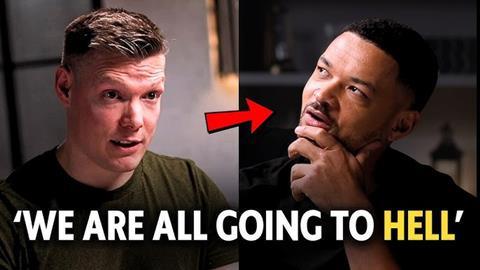
“Am I going to hell?” Steven Bartlett asks Wes Huff during the teaser trailer.
“Yes”, comes the flat reply.
As is often the case, that cutely edited clickbait is there to lure the viewer into what is, beneath the surface, a hugely gracious, always fascinating and usually effective dialogue between the wunderkind and the golden boy.
At two and a half hours long, you may not have enough remaining free time in your mortal life to watch it, so I have watched it all for you.
The first thing to say is that the very existence of this interview is astonishing. It was posted three days ago, and on YouTube alone it has already amassed 1.9 million views. For context, the Eastenders Christmas episode on BBC One had 2.85 million viewers. Christian apologetics is now primetime material, reader. Now hear ye?
The fact that one of the biggest podcasts in the world is giving all this time to a Bible scholar - and a fair hearing at that - would have seemed unthinkable even five years ago. God is in the dock, but not on trial. Wes Huff is treated with reverence by Steven Bartlett, as he pilots their long haul flight over the major continents of Christian apologetics - the reliability of scripture, science, morality, meaning.
Steven Bartlett is an exceptionally successful young man with a midas touch. A judge on Dragon’s Den, he seems at times to be everywhere, doing everything, and doing it with reward. He is, in so many ways, the Millennial encapsulation of success. And yet even he is not immune from the meaning endemic sweeping the Western world. A close friend of his recently became a Christian, and it has got him thinking deeply and seriously. He claims to be open-minded in the pursuit of truth. Isn’t that what everyone says, but I believe that it’s true for him.
There is no bluster, no posturing, no cynicism
Here, the whole sheen of wealth, success and celebrity is sandpapered away, and you see a young, slightly vulnerable, intermittently hopeful 33-year old. It’s fascinating to watch, and something for which the host deserves immense kudos. There is no bluster, no posturing, neither a display of nor an encouragement for the viewer towards cynicism. The questions he asks are genuine and completely reasonable. But how about this: then he listens to the answers and absorbs them. Everything Wes Huff says is given time to breathe.
At times, Bartlett reminds me of an impatient walking tour guide, keen to press onto the next viewpoint when I would have liked to stop for a picnic on the current promontory. We get breadth rather than depth for most of the second half of the show. But here is where Wes Huff flexes his academic muscles. He is always calm and never fazed, always being ready to “give a reason for his hope” (1 Peter 3:15), but with gentleness and respect. Like most apologists, he is a jack of all trades, master of one. And it’s the opening section of the interview, in which Huff’s specialism of biblical scholarship is the focus, which is by far the most persuasive and compelling. To have an evangelical scholar lay out so robustly why Christians can feel confident about the reliability of scripture and how it all hangs together will surely achieve a great deal. And again, there is no trap set. Bartlett clearly wants to know and understand and, by extension, to have his 15 million subscribers understand.
At other points, it seems we are getting the potted answers that you might expect at a UCCF mission’s week - which carries a curious uncanniness for those of us who frequent them - but even over two hours there’s only so much you can say. There are certainly Christian philosophers better equipped to tackle some of the questions on morality or science, but not many who could perform at this level for so long. Huff is a big-game player. He has form - having already tackled the biggest podcast in the world last year. He is never caught out, never loses his shape. Evolution? Reincarnation? Huff has heard all these questions before. He knows the field, and can walk it from memory.
There are times where, to my ear, Huff is as much an apologist for the American Reformed school of theology as he is for the Gospel as a whole. He’s like Mikel Arteta’s current Arsenal side - functional, grinding out victories and scoring from set pieces, when perhaps I would have liked a tad more flair and creativity. But let me be clear: almost nobody in the world could have been as cogent and as winsome over that length of time in that environment.
Huff’s message at the end is that Christianity not only provides an antidote to the meaning crisis of our age, but the antidote. The episode ends with Bartlett reading aloud from Romans 12 in the Bible that Huff has gifted him. It is a beautiful and fitting end to an extraordinary show.
We so often expect our public representatives to be ‘a man for all seasons’. Wesley Huff is certainly a man for such a time as this. I commend him, and I commend just as highly Steven Bartlett. Yesterday, this sort of thing seemed unfeasible. Who knows what will happen tomorrow?

























2 Readers' comments