









When a family crisis left Hazel Southam with no choice but to find a care home for her father, she was troubled by the poor standards. Here, she explores a Christian alternative and notes the difference faith can make in caring for society’s most vulnerable
What do you do when your parents need more care than you can provide? It’s a choice facing many of us, and probably not one that we want to think about.
Dementia is one of the leading causes of the need for professional care. According to the Alzheimer’s Society, around 982,000 people in the UK live with dementia, a number that is set to rise to 1.4 million by 2040. That’s a lot of families worrying about how to best look after their loved ones.
The need for residential care is often precipitated by a crisis. My father, who had dementia, lived at home for six years before my mother had a stroke and could no longer look after herself or my dad. Stark choices had to be made – and quickly.
I visited local care homes and, ultimately, settled on the only one that didn’t smell of urine, and where residents weren’t sitting silently in the lounge with the television on. He lived there for four years before his death, and although it was far better than the other options, it wasn’t what any of us wanted.
The quality of care is about serving God, not just the person
In particular, there was little to meet his spiritual needs. For some, there are other options – mainly in the form of Christian-based care homes. The latest to be built by the Pilgrims’ Friend Society is Middlefields House in Chippenham, Wiltshire. Constructed during the pandemic, it is new and gleaming, and an integrated part of the local community. I set off to find out how different it could be from the experiences offered at other care homes, such as the one my dad was in, and how the Christian ethos permeates life there.
When compassion shapes care
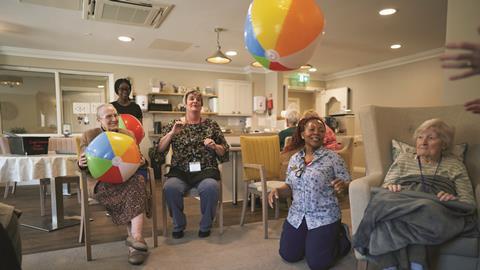
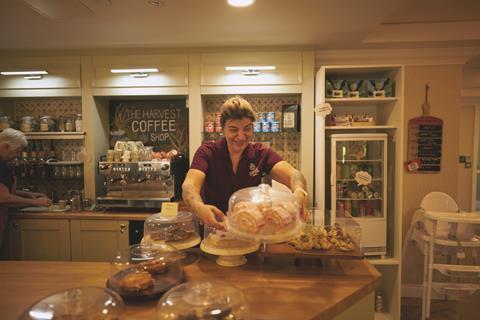
The first thing that you notice about Middlefields House is that it doesn’t feel like a care home at all. Step inside and you enter a community café, frequented by locals, with a distinct buzz in the air. Tea comes in pretty cups, and generous slices of cake are available.
Once through the doors to the four ‘households’ where the residents live, the rooms are decorated in soft colours with elegant curtains. Each household has multiple lounges that host activities and family visits.
Every en suite bedroom is personalised but can also be augmented with practical support such as fall mats and hoists as residents’ needs change.
Gordon: ‘It feels like family’
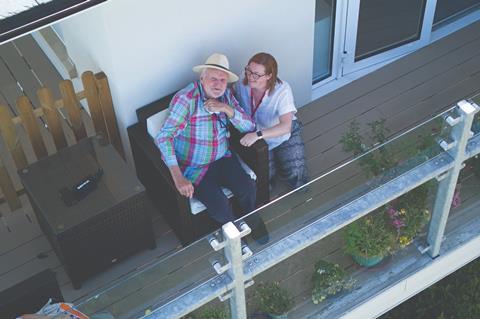
Gordon, 93, was born in Yorkshire and became a chef, working at the Dorchester Hotel. He went on to work for an air chief marshall and even served Charlton Heston on board the HMS Queen Mary. Much of his life was spent in Weymouth and Torquay training future chefs. He married and had three children and, later in life, was ordained, helping to run a small local church.
According to his son, Roger, it was members of his local congregation who first noticed signs of dementia. Over time, different provisions were made to ensure that he was safe and receiving the best care. But by the time of the Covid-19 pandemic “it was clear that he wasn’t able to look after himself,” says Roger. Slowly, respite care was introduced, including three stays at Middlefields House.
“He had visited so many homes when he was working in the local church – and some can be horrendous,” says Roger. “He repeatedly said he never wanted to go into such a place. But Middlefields House is different. So many of the staff are Christian. The whole culture is different, in terms of saying grace at meals, having Bible studies and praying about things. That’s all normal.”
After his third visit, Gordon decided to stay. He has now lived at Middlefields for two and a half years. “It feels like family,” says Gordon. “Family that looks out for each other.”
Instead of urine, Middlefields House smells of cake, home-cooked meals and clean carpets. No resident looks like they’ve been dressed in clothes that suited the carer’s convenience rather than their own individuality.
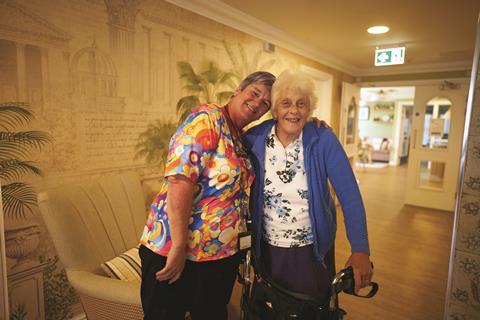
The sound of distressed crying is also, thankfully, absent. “People say to us that there is a different atmosphere here,” says Rali Ivanova, care manager at Middlefields. “There’s a sense of peace. We believe that God is present with us.
“We want to support people in their faith,” she continues, outlining who drives their standard of care. “The quality of care is about serving God, not just the person. It’s not about the CQC [Care Quality Commission]. We are helping people who have served God all their lives. It’s a privilege.”
This then, is the fundamental difference. Faith permeates not just what is done, but how and why it is done, too.
Life inside the home
Each week, there is a church service. And each household also has a weekly ‘family time’, which looks a lot like a house group. Grace is said before meals, and there are times of prayer. Christian staff come alongside residents to pray and worship with them as part of the everyday rhythm.
“It’s spontaneous,” says Ivanova. “In mainstream homes, as staff you aren’t allowed to witness. Spiritual support isn’t available [to residents]. But here it is a vital part of our provision.”
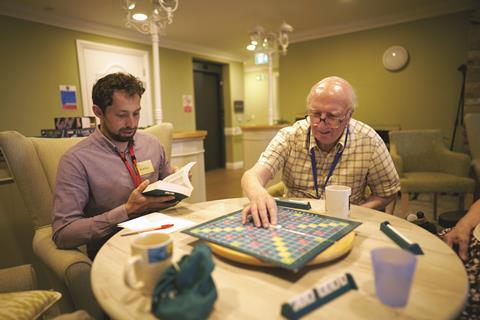
Matthew Stevens, the activities and community engagement facilitator, organises everything from film nights to classical music sessions, visits to the local Men’s Shed, puzzle groups, Scrabble groups, gardening and craft groups.
I find him leading a family time for nine residents. They are enjoying fellowship, singing hymns such as ‘How great thou art’ and ‘Amazing grace’, and reflecting on the subject of compassion through the lens of scripture.
Cherry: ‘You’re not cut off from faith’
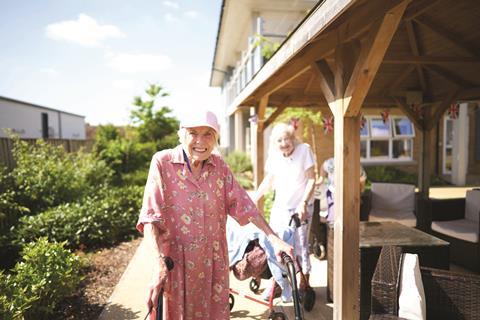
Former librarian, Cherry, 88, was involved in the production of Collins English Dictionary, a copy of which is ever-present on her bookcase. She married a widower, a father of three children, and together they built a family of six. Today, she has many grandchildren and great-grandchildren.
Cherry moved to Middlefields House in 2025. “I came here because I was falling,” she says. “I needed a certain amount of care. The people here are so lovely and kind.
“I have always been CofE and now I can go to a communion service on a Wednesday morning and that’s lovely. It’s lovely because you are not cut off from religion.
“My daughter and son are very relieved to know I’m here.”
“I’ve worked in this sector for nine years,” says Stevens. “I saw people’s fear in other homes. They think that this is the end. Here, we approach death with families around and know[ing] that you are going to heaven. It’s much more positive. It doesn’t feel like the waiting room for death. People still have a purpose.”
On the mantlepiece in the lounge is a wooden sign that reads: “God is love”, alongside a Paddington Bear. On the walls, you’ll find helpful reminders of what day it is and what the weather is like.
While the last hymns are being sung, carers start preparing lunch, laying the tables with knives and forks while joining in the worship. It is about as far from my father’s experience as you can get.
Of course, nowhere is perfect. Ivanova says that finances and helping staff members of other faiths feel at ease are issues at Middlefields House.
“Our family members want to connect with God,” she says. “We have staff who aren’t Christian and that can be a dilemma, and can be uncomfortable for some.”
But, as we live longer, and the number of people living with dementia rises, places like this are going to be increasingly in demand. Pilgrims’ Friend Society currently operates twelve care homes, with more in the pipeline, alongside nine sheltered housing schemes.
Do I wish my father could have lived in a care home like this? Absolutely. He would have valued the fellowship, church services, Bible reading and prayers. But more than that, he’d have benefited from the peaceful atmosphere, from a sense that, although this isn’t the home you’ve known, there is community you can belong to.
When your loved one lacks peace, so do you. I spent four years feeling stressed, dreading visits and comforting myself by buying a bunch of flowers on the way home. I had no idea that Christian care homes existed. Truthfully, before the moment of crisis came upon us, I hadn’t done any research because I couldn’t bear to think about it. For those who can take up the option, they look like a great one to me.
Pilgrims’ Friend
The Pilgrims’ Friend Society was founded in 1807 to help older Christians who were living in difficult situations. As care needs changed, it built its first home in Camberwell in 1834. Its first modern-day care home was built in Leicestershire in 1954.
Middlefields House was opened in 2021 and can house up to 48 people. It is part of a wider housing development that includes a doctor’s surgery and a shop. The café serves the whole community.
The 110 staff need to be in sympathy with the Christian faith, but not necessarily Christian. Costs range from £1,300 to £1,922 per week according to a person’s needs. According to Age UK, the average cost of weekly care is £949 to £1,267.
Fred: ‘It’s a community that understands’
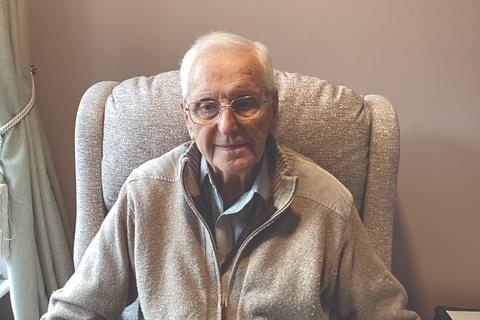
Fred, 94, knew he’d be a missionary from the moment he came to faith, aged 16. He became an evangelist and worked for a church in Nigeria with his wife, Pat, for 30 years. “It was a calling from the beginning,” he says.
Fred and Pat were married for 45 years, and photographs of the pair adorn his room. After her death, Fred was diagnosed with Parkinson’s disease. He moved to Middlefields House in 2025.
For a man of faith, the Christian ethos of the home is vital. “There are prayer times and I go to the church service and any other interesting thing,” says Fred. “But the really useful thing is a community which has similar problems to yourself.”





















No comments yet