








Anger is seeping into everyday life, observes Jeff Lucas. As tempers shorten and tensions rise, even in the most ordinary moments, how do we recognise what’s happening within us – and learn to respond differently?

His face was warm, smiley even, as he asked: “Can I help you, sir?” But my eye was immediately drawn to the black box mounted squarely on his chest. Clipped to his uniform, bold words announced its purpose: “VIDEO AND AUDIO RECORDING!”
I was taken aback, aware that my words, expressions and movements were being captured; evidence that could be used to convict me if I became a threat. I weighed my words carefully and, at last, said: “I’d like the baked potato with tuna, please.”
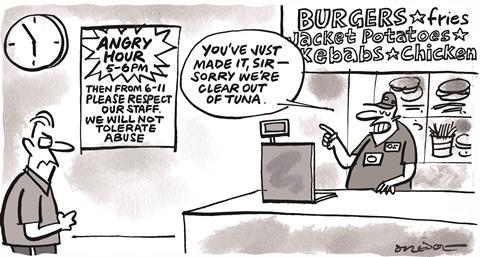
My conversation was obviously not with a member of the constabulary, but rather with a server in a restaurant. We’d popped into an eatery in a quiet market town, nowhere near an urban sprawl where antisocial behaviour might be more anticipated. And yet, for their own safety, staff were wearing body cameras.
When I asked about his tech, the friendly server sighed. “People kick off so quickly these days, and not just on Friday and Saturday nights when the booze is flowing. If there’s a problem with an order, if we run out of a discounted item, they get enraged – and that’s dangerous for us.”
I was stunned. But I shouldn’t be surprised: Britain is getting angrier. A recent survey reports that 80% of us believe that anger has significantly increased, spilling over into our commuting, families and workplaces. The UK now boasts the highest incidents of road rage in Europe. Half of us admit to having stormed out of a shop because we were unhappy with a lack of service. And there are countless keyboard warriors who delight in bruising others with their words.
The Church is far from immune from this contagion. Posting a comment supporting women in church leadership recently, I was stunned by the level of vitriol from some. I anticipated robust, healthy disagreement, but was shocked by the verbal thuggery from a few. Bullying is always horrible – but literal Bible bashers intimidate without shame, seemingly proud that they are supposedly ‘guarding’ the truth as they wound.
Here’s another horrifying discovery, one that I’d rather not admit: I am angrier than I used to be. A recent trip to a supermarket saw me irritated with the speedy driver, frustrated with the slow driver, exasperated with the chap who bumped his shopping trolley into mine, and quietly furious that they’d run out of mint sauce.
I own a book entitled Don’t Sweat the Small Stuff (Hodder), but reflection shows me that I’m increasingly likely to perspire over incidentals.
Not all anger is wrong, which is why we’re told: “When you are angry, do not sin” (Ephesians 4:26, NCV). Frustration and irritation are a normal part of life. But anger can lead to red-hot reactions and white-hot words – and that is where sin makes an ugly entrance.
We are right to feel outraged at racism, injustice and exploitation, lest we slide into benign indifference. But I want to heed writer and theologian Frederick Buechner’s warning: “Of the seven deadly sins, anger is possibly the most fun. To lick your wounds, to smack your lips over grievances long past, to roll over your tongue the prospect of bitter confrontation still to come, to savour to the last toothsome morsel both the pain you are given and the pain you are giving back; in many ways it is a feast fit for a king. The chief drawback is that what you are wolfing down is yourself. The skeleton at the feast is you” (Wishful Thinking, Bravo Ltd).
So, with God’s help, I want to walk in greater peace, and tame the anger that can eat away at me. The taste of a baked potato with tuna is so much nicer.























No comments yet