












A recent survey from the Lausanne Movement found that 95% of Christian leaders agreed that digital technology will have a huge impact on fulfilling The Great Commission. But far fewer said the Church currently represents Jesus online in a way that feels “real and relevant”. Glen Scrivener explains how you can share the gospel in a way that really connects
My neighbour is a smoker in rental accommodation. This means he’s out on his front porch 25 times a day – terrible for his health, but good for his soul because my wife and I can speak to him daily. And that’s how our witness began. Funnily enough, the first spiritual exchange happened after he watched a viral video on his phone, and it sparked a conversation. Within ten days, he came to church for the first time. Over the coming months we continued to speak about the gospel, sometimes face-to-face, but even more on WhatsApp. I sent him podcasts, videos, songs, articles, memes, a link to our digital evangelistic course, 321 – and he responded with dozens of links of his own. I’d say that the majority of my gospel-sharing was via digital platforms – and this is my neighbour, with whom I share a bedroom wall.
Digital evangelism is not divorced from face-to-face evangelism. It often initiates face-to-face evangelism, and it almost always accompanies it as the relationship continues. It is simply a feature of modern life.
Two Easters ago, we were on the porch talking about a song we were writing together (coming to Christ has unlocked incredible creativity in him – he’s since written over 100 songs to Jesus!). His wife heard us talking about our idea for a song about Mary Magdalene’s fear that grave-robbers had stolen Jesus’ body. She said: “What are you lot talking about grave-robbers for? I thought you were Christians.” So, we told her the story. After a beat she said: “Man! I’m gonna have to read this thing, ain’t I?” We had to agree.
I showed her the YouVersion Bible app and she downloaded it in front of us. I took her to the ‘321 Bible reading plan’ which walks you through John’s Gospel with brief commentary. She began reading there and then. Once she’d finished her cigarette, she went inside, still glued to her screen. Ten minutes later she banged on my door, thrusting her phone in my direction with John 2 on the screen. “Why,” she demanded, “is Jesus calling his mother: ‘Woman’?”
It was an unexpected apologetics session, but I gave it my best shot. After another ten minutes of conversation, she seemed sort of satisfied – enough to go back next door and read some more. And that’s the way it is with evangelism. It’s in-person and it’s digital. Then it’s back to in-person and then back to digital.
Similarly, Tom recently got in touch with us at Speak Life. A lifelong agnostic, he binge-watched our YouTube videos, was directed to our 321 course, and then messaged us to ask for a church recommendation in east London. A few months later, he was baptised.
Digital and physical are not alternatives. We all live at the intersection. And so does our mission.
So let me offer up five lessons we’ve been learning as we try to resource the Church for its mission in a digital age. I trust these will help you whether you’re a content-creator, a scroller/sharer or just a Christian trying to navigate this digital revolution.
1. We’re all digital evangelists
There are 3 billion monthly users on YouTube. Three billion on Meta too (the parent company that owns Facebook, Instagram and WhatsApp). If these were countries, they’d be the biggest on earth, and we need missionaries in these places. But we shouldn’t think of the online space as a foreign land. We all live here. And if you’ve ever recommended a Christian podcast or sent someone an article or video – on social media or via text or WhatsApp – you are a digital evangelist.
If you’ve ever recommended a Christian podcast or sent someone an article or video on social media or via text, you are a digital evangelist
In all these examples, your audience was a flesh-and-blood human. You probably didn’t think about the digital means of delivery. Nevertheless, knowingly or not, you were a digital evangelist. But the same obliviousness often happens the other way too. You can think of online media (like a Christian testimony going viral) and never really consider that every view represents a real person, really engaging with the gospel.
The ‘digital’ in digital evangelism can be misleading. It can make us think that we’re reaching digital beings in digital land. We’re not. We’re reaching people – very often our nearest and dearest. All evangelism, no matter what the medium, is person-to-person. And nowadays the direction of travel will almost certainly run in the other direction too – in-person evangelism will then involve online engagement. Think of meeting anyone new. In no time, you’re exchanging numbers. Next comes a text, and all of a sudden, we’re off to the digital races. Digital does not mean unnatural or inhuman – at least it doesn’t have to. Which leads to point two.
2. It’s a ‘like and share’ world
Social media works the same way that the human heart works. This is for better and for worse. On the worse side of things: our fallen hearts are naturally selfish, proud, angry, lustful, jealous, callous, distracted, petty, fearful, slanderous and 1,000 other vices. Online, these forces are amplified by the most powerful computing technologies ever devised – technologies that don’t care about virtue.
But the algorithms can – and do! – boost positive dynamics, too. The two most prominent buttons on a Facebook post sit next to each other for a reason. They are a match made in heaven: Like and Share. Here’s the principle undergirding all things – social media, human hearts and the growth of the kingdom – what you love, you share. Jesus says: “Out of the abundance of the heart, the mouth speaks” (see Matthew 12:34). If something grips your heart, it wags your tongue. And the kind of gospel sharing which Jesus commands is not pushed out of us via willpower, nor is it pulled out of us by the needs of the world. First and foremost, Christian witness flows from hearts filled by Christ. At Speak Life our strapline is: “Love Jesus, Share Jesus” – and the order is important.
What does this mean for our witness online? Remember that Jesus does not say: “Try to burn brightly for me.” He says: “You are the light of the world” (Matthew 5:14, my emphasis). It’s not about adding something to our witness (cranking up the intensity of our faith). It’s about removing something (our embarrassment at Jesus and our Christian identity).
Our approach to social media is: Be yourself, be distinctively Christian, express your love for life – and Jesus! – and don’t be a jerk
If we mute our distinctive faith, we’re like people who “light a lamp and put it under a bowl” (Matthew 5:15), or like those who post online about everything except Jesus. Instead, our approach to social media boils down to: “Be yourself, be distinctively Christian (naming this in the bio is an easy win), express your love for life – and Jesus! – and don’t be a jerk.” If you manage this, you’ll shine like a star against the black backdrop of social media’s “grumbling and arguing” (see Philippians 2:14-15).
It’s this black backdrop we address next.
3. Ride the waves, avoid the riptide
When surfing, you need to be aware of competing flows of water. You want to ride the waves towards the beach without the riptide pulling you straight out to sea. In the online space, the riptide is real. Porn, gambling, brain-rot and simulated ‘community’ that only isolates you further are real dangers. But riptides don’t invalidate surfing. There are still ways of riding the waves towards shore. And there are many ways that online life leads towards real connection.
Think of online dating. In 2024,
61% of couples in the US met online. The next most popular route to romance was “meeting through friends” at only 13%. This tells us at least two things. When it comes to relationships, online connection is the most common way in, but it’s also the number one way on – leading to face-to-face contact. In the same way, a ‘like’ on social media might lead to subscribing, which might lead to thicker online communities (like access to members groups), which might lead to chat communities, which might lead to in person meet-ups.
At Speak Life, we try to be intentional about this. We reach millions via platforms like YouTube and Instagram, but the next thing someone watches after one of our videos could be any old slop. We try to draw people from the “fast and wide” to the “slow and deep” – still an online space but somewhere people can consider the gospel at a more appropriate pace and with help around them. Podcasts are slower and deeper; our 321 course is slower and deeper still. And they can go slower and deeper still in our chat community. All the while, we’re encouraging them to use our church finder and, in this way, many are winding up in local church communities. Our best estimate is that, since 321 launched two years ago, 1,000 people have started going to church regularly.
The dangers of online life are undeniable – the riptide is real. But if we’re intentional, we can help people ride the waves the other way. This, of course, will involve a real wrestle.
4. Learn the local languages, resist the local gods
There’s an old saying in missions that gets to the heart of the problem we all face, whether we’re reaching a new country or a new platform: “Learn the local languages, do not worship the local gods.” We must contextualise the message (because it’s meant to be understood). We must never compromise the message (because it’s meant to be unchanged). We all get this wrong and we all have a temperamental ‘lean’, either to the gospel being understandable or unchanged.
Mine probably favours an unchanged gospel, so I’ve certainly been guilty of treating platforms such as YouTube as a mere ‘shelf’ on which to store videos, rather than a social media platform to engage viewers meaningfully. There’s been a reluctance to speak “the local language”, even as I’ve sought to proclaim Christ. If that’s your temperament, you might neglect the importance of things like video titles and thumbnails (the image representing the video) and many other tricks of the YouTube trade. But if you do learn the local language there’ll also be the minefields of clickbait, rage-bait, audience capture, algorithm capture and a dozen other dangers to navigate.
And that’s just YouTube.
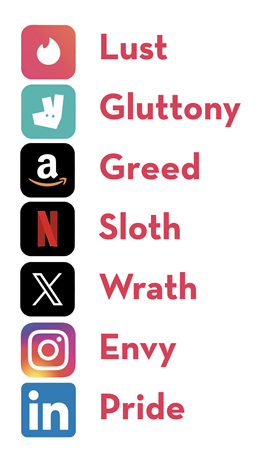
The other day I found an amusing post linking the seven deadly sins to seven online platforms: Sloth is Netflix; Greed is Amazon and so on. I was interested in the last three because Christians have a significant presence on them: Wrath is X (formerly Twitter); Envy is Instagram; Pride is LinkedIn. If you’re on these platforms, you need to constantly resist these tendencies, even as you work hard at speaking their language.
But the point is this: your struggle to contextualise without compromise is not a sign you shouldn’t be engaged on these platforms. (It’s always possible of course that God is calling you to bin your smartphone, or fast from social media indefinitely, never rule that out!) But wrestling doesn’t mean it’s wrong. It might well be a sign that you’re exactly where you need to be: heeding the call of a missionary.
5. Digital resources are like Google maps
When I first learned to drive, some time back in the 1990s, we had a dog-eared A to Z road atlas in the glove compartment. Before setting off to a new destination, we’d memorise the names of the roads and if we started getting lost, we’d pick up the map from the passenger seat and read it, somehow managing not to crash into oncoming traffic. Crazy times. Now, of course, I can’t remember the last time I even thought to plan my route. Google Maps figures it out. It doesn’t physically drive me to my destination, but when I use Google Maps in conjunction with driving, it’s liberating.
It’s the same with digital evangelistic resources. They won’t evangelise for me but the fact that I have a supercomputer in my pocket frees me to simply get into a gospel chat. If the conversation goes well, I can say: “There’s plenty more on this app / channel / podcast which I love, I’ll send you a link.” On the other hand, if it goes badly, I can say: “I didn’t really put things how I wish I had, but there’s this app / channel / podcast which I love, I’ll send you a link.” Either way there’s gospel content to follow up with.
Today, there’s no need to embark on an evangelistic encounter like it’s a 1990s car journey across north Wales. There’s no need to navigate tricky apologetics questions like you have to memorise 15 different B-roads. Nowadays we just jump in and off we go. The digital aspect of our lives could isolate us, that’s true. But it doesn’t have to. It could be like Google Maps. Not freeing you from gospel conversations, but for gospel conversations.
So, what are you waiting for? Load up your phone with an evangelistic Google Maps (If you don’t know what to use, 321course.com is free!). And let it liberate you to engage in real conversation. Jump in and off you go!























No comments yet