







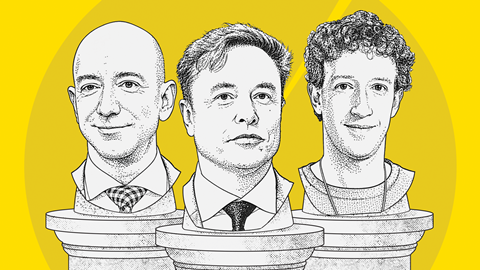

They’ve given us connection, convenience and endless information – but at a cost. Bezos, Musk and Zuckerberg are more powerful than most world leaders, says Martin Saunders, and Christians are wrong to view them as neutral figures. These tech titans have a special plan for your life…and it isn’t good
There‘s a scene in controversial cult film Monty Python’s Life of Brian that suddenly feels very pertinent. At a secret meeting of a Jewish revolutionary group, plotting to kidnap Pilate’s wife in an attempt to rid Judea of their Roman occupiers, a famous question is discussed: “What have the Romans ever done for us?” It’s meant as a throwaway dismissal of their invaders, but as members of the group list the technological leaps that Rome has brought them – the aqueduct, sanitation, roads, medicine – the penny begins to drop: the terror of occupation has also brought quite a few benefits.
John Cleese and the leadership of the People’s Front of Judea are unimpressed. Yet the scene stands as an illustration of how occupation subdues resistance: not just with force, but with gifts of innovation. It might be Monty Python, but it also has a ring of historical accuracy. From the time of Genghis Khan through to Vladimir Putin, invaded nations are often offered a choice: to submit and join, rather than be eliminated. If they choose the former, access to the invader’s superior technologies are offered as a reward.
Silicon Valley’s special plan for your life isn’t just different to God’s, it’s the exact opposite
We live in an age of invasions; tragically they’re a staple of our nightly news programmes. Yet perhaps the greatest invasion of all has happened by stealth, over the course of the last three decades, and at a scale that even Alexander the Great never dreamt of. What has been captured is more significant and valuable than physical territory. Instead, the invaders have taken our time, our attention and our money. The benefits we’ve received in return are – just like those Jewish peasants realised – multitudinous. But at what cost? Perhaps it’s time to ask the question: What have the tech billionaires ever done for us?
Revolution or invasion
Let’s take a trip back to the early 1990s. Back then your circle of relationships was relatively small and usually dictated by geography; it was mostly maintained by face-to-face conversation, phone calls and the occasional letter. You got your information about world events from a few half-hour TV bulletins and a daily newspaper, and your political opinions formed slowly, often influenced by family and your community. You did your shopping on the local high street, got your facts from the library, printed your photographs from negatives and kept the only copies in an album. That’s what life was like before something we often call the ‘digital revolution’. Perhaps, though, we’ve been using the wrong word.
In 2026, we’re firmly standing on the other side of something. Thanks to social media, our networks of relationships are larger and more thinly spread, maintained through platforms such as WhatsApp, Facebook and Instagram. The same services are often our gateway to news and political opinion, while more extreme options are available through less-policed platforms like X (formerly Twitter). We still do some shopping in person, but a huge amount takes place online, and that market is dominated by the brown cardboard packages of the megalithic Amazon. Our knowledge is drawn from – and filtered through – Google and other increasingly AI-powered sources. Our lives are catalogued in vast, virtual photo and video libraries 100 times bigger than our physical albums could ever hold.
What have the tech companies, and the billionaires who own and run them, ever done for us? They have facilitated technological innovation on an unimaginable scale. But the more important question – the one that all this entertainment, ease and synthetic connection distracts us from – is: What have they also conquered and taken?
Who wants to be a billionaire?
In a planet of 8bn people – or as they might also be termed, users – a small handful of names exert an extraordinary level of influence. It’s no exaggeration to say that few individuals in history have held so much power outside of political leadership. Mark Zuckerberg, CEO of Meta (which owns Facebook, WhatsApp, Instagram and more) has an estimated net worth of almost $250bn, as does Amazon founder Jeff Bezos. They both look on with envy at the ever-expanding wallet of Tesla and SpaceX pioneer Elon Musk, who is very close to becoming the world‘s first trillionaire.
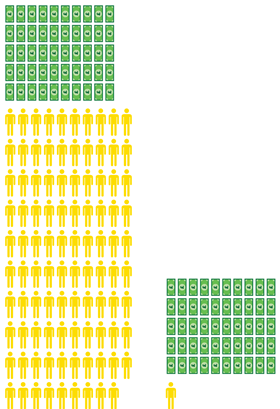
It’s important to stop at this point and reflect on these numbers. They represent greater wealth than that possessed by most nations. The idea that individuals can hoard so much in a world of such great need is deeply troubling, and conjures images of JRR Tolkien’s famous dragon, Smaug, sitting on untold piles of treasure while people outside his cave starve.
While their record-breaking earnings might enable their influence, the money itself is not the greatest source of their power. Their unassailable, often unaccountable positions as leaders and main shareholders of Meta, Amazon and X respectively enable them to drive their own agendas at an untold scale.
So, what are those agendas? What do the tech billionaires want? Aside from their own immortality – which we’ll get to – each seems to desire control over their slice of the future. In a sense Bezos’ interest here is easiest to understand: he simply wants to continue to create the largest and most profitable shop of all time, in other words, he desires our spending.
Through his hard-to-understand purchase of once-balanced discussion platform X, Musk has revealed his hope to own public discourse, and perhaps even political direction. It’s Zuckerberg’s aim that should perhaps give us most pause, however, because through his various platforms, it seems as if he wishes to own – and monetise – our relationships.
Why do they want these things? Partly because the potential of owning and directing the world’s future is so compelling to their very particular personalities. Yet the root of it all, just like the “root of all kinds of evil” described in 1 Timothy 6:10, is the incessant, unquenchable desire to make even more money. Amazon, Facebook, X – and all the rest – are just trying to get bigger and bigger. A trillion dollars just isn’t enough.
Church dotcom
The Church – and individual Christians – have of course benefited from the digital revolution that these men have driven. The Covid-19 pandemic might have presented far greater challenges to our ability to worship together had livestreamed services not been possible via YouTube. Modern discipleship has benefited from online Bibles, prayer apps and WhatsApp accountability groups. The gospel can be taken to the furthest corners of the (internet-connected) planet, even in places where the faith is explicitly outlawed.
At the same time, we face a raft of new challenges on account of the internet. Aside from the vices which it enables (pornography use and addiction being just one), it also has a terrible habit of keeping us distracted and busy. The author and productivity expert Cal Newport writes in Digital Minimalism (Penguin) about the phenomenon of “solitude deprivation”. He suggests that moments of silence and idea-birthing ‘boredom’ have been almost entirely eradicated from our lives. If we are constantly distracted, with no natural moments of quiet in our lives, it becomes far more difficult to connect with God.
The tension here is that there is now an elite group of people who are very rich, and have a plan for getting even richer, whose aims and philosophy are in direct conflict with the agenda of God’s kingdom. To caricature, it’s a battle between a vision of accumulation, individualism, polarisation, distraction and relentless technological progress and one of service, community, love and worship. Quite a bit of Silicon Valley’s special plan for your life isn’t just different to God’s, it’s the exact opposite. And yet, like the Romans and their aqueducts, they offer much that is not only broadly compelling and helpful to us as humans but actively enables the mission of the Church. Like that famous old Facebook relationship status, it’s complicated.
Gates and hell
At this point, it’s worth asking a different but related question: Should we really have billionaires at all? Oxfam estimates that the world’s wealthiest 1% own up to 50% of total household wealth, while the top 0.001% – the kinds of people we’re discussing here – share three times as much total wealth as the poorest 50% of the global population. The simple answer of course is that it’s immoral for finance to be so disproportionately distributed, especially when hundreds of millions are living in life-threatening poverty. Yet perhaps it’s not quite as simple as that. After all, plenty of people throughout history have been in control of unimaginable resources; it’s what you do with them that counts.
Bill Gates is often – and rightly – named as the outlier among the mega-rich techbro community. The Gates Foundation, set up with ex-wife Melinda in 2000, is now the third wealthiest charitable organisation in the world, and has been directly funded by the couple to the tune of an estimated $60bn. Extreme global poverty, which is targeted by the foundation, has been significantly reduced over the period of its operation. He’s not the only one either. Now-disgraced cryptocurrency tycoon Sam Bankman-Fried (a subject of this column last year) was at the forefront of a movement of so-called ‘effective altruists’ who calculate ways to put vast wealth to the best possible use.
In a planet of 8bn people, a small handful of names exert an extraordinary level of influence
In the Gospel of Luke, Jesus tells his most extreme story, about a person who misused this kind of disproportionate share of the pie. The parable begins on earth, where a rich man openly displays his opulent wealth while ignoring any social responsibility to Lazarus, the beggar at his gate. Then there’s a twist, and this is where the story gets really interesting. Both men die, but the rich man ends up in a worryingly literal-sounding hell. Abraham appears with Lazarus, and the tortured soul shows a remarkable lack of acceptance of their reversed roles, asking Abraham to “send Lazarus to dip the tip of his finger in water and cool my tongue, because I am in agony in this fire” (Luke 16:24).
Abraham refuses, explaining that by not offering comfort in life, the man will now go without it in his unending death.
It’s a chilling warning. Financial might on the scale of the tech billionaires makes you more powerful than many nations. It effectively turns you into a world leader. But billionaires can choose. As Bill and Melinda Gates, Warren Buffett and others have done, they can comfort the beggars at their gates. Or they can continue to build their own kingdoms – and risk an afterlife of extreme thirst.
Who wants to live forever
Perhaps it’s this vague fear of eternal consequence, or the looming reality that earthly empires cannot last, that is driving one notable way in which Bezos and Zuckerberg are investing their fortunes. Both men have given millions of dollars to anti-ageing and cellular rejuvenation companies, in the hope that there might be significant breakthroughs in life extension. Lesser-known data storage tycoon Larry Ellison has reportedly donated $370m to anti-ageing research (stick that in your next sermon) and the co-founders of Google have even started a research biotech start-up, Calico, that focuses on ageing. It’s the obvious play for men who are beginning to come to terms with their own mortality.
Technology cannot defeat death as Jesus did, and these men are not gods. But neither are they simply businessmen, trying to earn an honest buck at an epic scale. The size of their ambition and the nature of their technologies make them much more like the invading kings and emperors that we find in history books, including the Bible. They are capable of both profound harm and immense good, and we are foolish if we see them as innocuous or neutral.
Empires shape the people who live under them. Since Google and the rest began to reshape modern life in the 1990s, we’ve all been changed and impacted. But to what degree have we quietly absorbed the values of the Digital Invasion: accumulation, influence, self-promotion and comfort?
The question, then, isn’t: What have the tech billionaires ever done for us? but: Who are we becoming? As we live within systems and structures designed by men who want to own every corner of our world, could our desire for innovation, novelty and ease be quietly drawing us away from the kingdom we’re called to live for?
The Quiet Revolution
There are two distinct readings among scholars about whether Jesus’ engagement with the Roman Empire was subversive or submissive. Walter Wink, in his 1992 book Engaging the Powers (Fortress Press), is perhaps the best known proponent of the idea that Jesus was presenting a non-violent ‘third way’ in the famous “turn the other cheek” passage (Matthew 5:39-42). Here are just a few ideas for how we might adopt a similar approach to the tech invasion.
Make digital privacy a spiritual discipline. Apps track our location and serve us customised ads, but these features can be turned off. Doing so reduces Silicon Valley’s ability to commodify us, and reminds us that our identity is defined by God, not Meta.
Engage with ‘Buy Nothing’ moments. Movements like Buy Nothing Day challenge the liturgy of consumption embodied in the tech industries very own religious festival: Black Friday. Choosing not to spend – even occasionally – can be a powerful way of living differently.
Embrace ageing and mortality. Life extension is the Holy Grail of the tech billionaires. Christians should be loudly promoting the virtues both of aging well (wisdom) and dying (eternal life). Why would you want to live forever in a broken world when paradise is available?
Practice intentional limits. The key is to control our tech, not be controlled by it. Consider setting boundaries on certain apps, or even your phone overall – as a way of retraining your brain for moderation and creating more time in your life for what matters.
Work on your ‘Solitude Deprivation’. Cal Newport’s phrase should serve as a wake-up call. It’s time to start building our boredom muscles, and stop listening to podcasts while walking the dog, or scrolling Instagram while we wait for a bus. In 2026, doing nothing is a holy act of resistance.





















No comments yet