









Alec Ryrie’s provocative new book argues that Western society has moved from the ‘Age of Jesus’ to the ‘Age of Hitler’. But does his diagnosis of our cultural crisis and his proposed solutions stand up to scrutiny? Dr Roland Clark gives his view

I have been teaching Modern History to university students for almost 20 years now, and one of the first things we drill into them is the lesson “never buy a used car from a historian”.
Not only are most historians I know remarkably ignorant about car maintenance, but they are very good at putting spin on an argument. Historians are also terrible at predicting the future. We’re very good on the past, but asking a historian to tell you how the story is going to end is like expecting a political scientist to know who is going to win the next election. We study things because they puzzle us, not because we understand them.
One thing every historian does love though, is a good pedantic argument. Especially when it comes to their colleagues’ books. It could even be said that we enjoy tearing a good book apart even more than we like shining light on the hopes and dreams of people long dead.
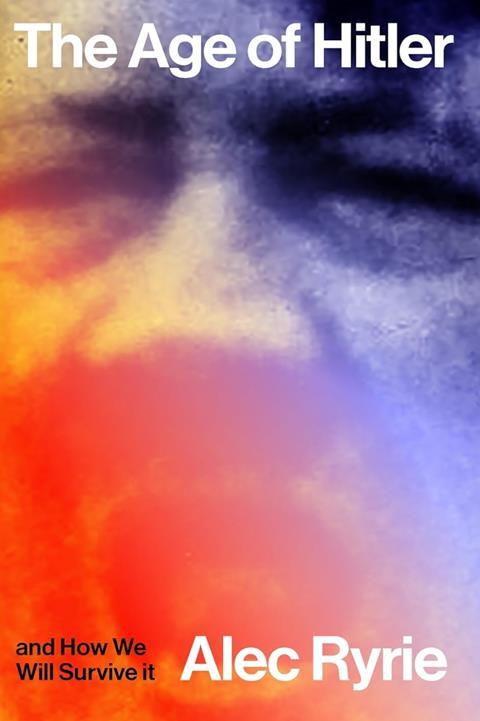
Alec Ryrie is an excellent historian. Educated at Cambridge, St Andrews, and Oxford, he is now Professor of the History of Christianity at Durham University and a Fellow of the British Academy. He has written some of the most widely respected histories of the Protestant Reformation, as well as books documenting the spread of Christianity around the globe. He might be on relatively unfamiliar territory when it comes to the 20th and 21st centuries, but he knows the nuts and bolts of how to write a good book. And as one might expect, The Age of Hitler (Reaktion Books) is a very good book.
Based on his Bampton Lectures at Oxford, it is erudite, beautifully written, with witty anecdotes and penetrating observations in all the right places. It tells us that we are moving from an age of moral certitudes into one where it is increasingly permissible for world leaders to commit acts of horrific barbarism and to behave like small children, and it gives practical suggestions for how best to survive this moment of historic change. The argument builds methodically, and it leaves one feeling both informed and edified.
Is he right though? Well, let’s look under the bonnet.
Historians might be dangerously good at pulling the wool over your eyes, but we’re also nothing if not honest. At the same time that we’re telling you that the thing purrs like a big cat, we’ll also disassemble the engine so that you can see for yourself. If you’re not a good enough mechanic to tell when we’re lying, that’s your problem. Ryrie lays his evidence out for us clearly and openly, but he also makes certain assumptions about things that are “common knowledge” and that is where the book stumbles from time to time.
Ryrie begins by telling us that up until the second world war we lived in “the Age of Jesus”, by which he means that for centuries Jesus was the touchstone of what it meant to be a good person for those of us in the West. However much some people might have objected to Christianity, everyone agreed that if you behaved like Jesus then you were on the right track. Citing Dietrich Bonhoeffer’s pronouncement about “a religionless Christianity”, Ryrie argues that Christianity ceased to be the touchstone of morality in the West starting with the second world war, with the cultural revolution of the 1960s putting the final nail in the coffin.
Ever since the 1970s sociologists of religion have been falling over themselves to tell us that Britain is far from being a secular society. People might not be coming to church as often or in the same numbers as they used to, but they engage with religion in different ways. Christianity in today’s Britain is what the anthropologist Matthew Engelke has called an “ambient” religion – it is taught in schools, Christmas is celebrated on television and radio, and most people know the stories of Moses, Jonah, and Jesus better than they remember which of Henry VIII’s wives lost their heads. The name of Jesus might not be evoked as often as it once was, but it has far from disappeared in British society.
Ryrie tells us that after 1945 the West moved away from The Age of Jesus and entered into “the Age of Hitler”. Instead of Jesus being the standard go-to example of goodness, for the past 80 years Adolf Hitler has been brought up in moral debates as the epitome of evil. Comparing someone to Hitler is to say that they are genuinely bad. I found myself nodding along in agreement as Ryrie unpacked this idea, up until he described the touchstone of the Age of Hitler, the idea of universal human rights, as “a castle in the air”. Human rights aren’t grounded on anything other than our stubborn insistence that they must be real, Ryrie says, taking issue with Thomas Jefferson’s claim in the American Declaration of Independence that it is: “self-evident, that all men are created equal, and are endowed by their Creator with certain unalienable rights.” In starting the story of human rights with Jefferson, Ryrie conveniently ignores the rich philosophical debates that animated Europe from the time of the Spanish friar Bartolomé de las Casas through to the English philosopher John Locke, in which the philosophical basis for the idea of human rights was established so thoroughly that Jefferson did not feel the need to go over it all again. What happened in 1948 in the Universal Declaration of Human Rights was that this idea, which had been a mainstay of political rhetoric in Europe and North America for centuries, was now applied wholesale to the non-White peoples of the earth. What had been used as a weapon against arbitrary abuses of power by European rulers or by campaigners hoping to limit colonial abuses in Africa or Australia, was now being used to hold governments around the world accountable to the newly created United Nations. Human rights did not appear out of nowhere in the late 1940s, it was just being used in a new way.
If there are problems with the details of Ryrie’s periodisation, they do not necessarily undermine his central argument, which is that the Age of Hitler is now coming to an end. Comparing someone to Hitler no longer has the moral force that it once had, Ryrie observes. When Donald Trump can organise political rallies that explicitly evoke the atmosphere of Hitler’s annual rallies at Nuremberg, or empower ICE agents to arbitrarily arrest or murder American citizens without due process, and when entire groups can be targeted based on ethnicity, religion, gender, or sexuality without overwhelming political consequences, any talk of human rights begins to feel increasingly hollow. These are indeed developments that should make us sit up and pay attention, but are they really epoch making? Do they genuinely deserve to be seen as the harbingers of a new Age? After the Holocaust the world was united in its cry of “Never again!”, but this did not stop the mass murder of Tamil people in Sri Lanka, Mayans in Guatemala, Bengalis in Bangladesh, ethnic minorities in Cambodia, Bosnians in Yugoslavia, Tutsis in Rwanda, and so on. The list of genocides that have occurred around the world during the Age of Hitler suggests that condemning people for behaving like Hitler was only ever a rhetorical flourish used in polite conversation – it was never the serious foundation of a political order that has suddenly begun to unravel over the past ten years.
Let’s assume for argument’s sake that Ryrie’s diagnosis is correct. How should we respond? Ryrie suggests that at the heart of this epoch-defining crisis lies a culture war between progressive secularists and conservative traditionalists. With half of society looking back at the Age of Jesus through rose-coloured glasses and the other half panicking that the doctrine of human rights is no longer doing its job of keeping unrestrained evil at bay, the only sensible way forward is for the two sides to reach some sort of compromise and to learn from the best of what the other has to offer. Once again, one wonders whether Ryrie is projecting the cultural struggles of white, middle-class Britain (or more specifically, of Church of England synods) onto the world writ large. Is the fact that Western leaders seem increasingly uninterested in distancing themselves from Hitler really the biggest problem occupying the minds of people living in Chengdu or Lagos? Ryrie thinks it is. Or at least, that it should be.
The solution, he says, is for progressive, secular-minded people who cherish “universal” anti-Nazi values to rediscover “tradition”. Ryrie is fairly ambivalent about which tradition needs to be rediscovered, but the idea is that it should be a deep historical tradition with profound, grounded values, not “self-evident” rights that were discovered all of a sudden in 1776 and again in 1948.
In the West, Ryrie suggests, this must obviously be the Judeo-Christian tradition, although he never says exactly which strand of that tradition would be most appropriate. Why this is so obvious is never clearly explained, and I suspect that Ryrie would be horrified if, in an increasingly multi-cultural Britain, someone proposed Buddhism or Islam instead.
Ryrie addresses himself to conservative traditionalists as well as progressive secularists, and his message to them is to learn to be tolerant and open minded when it comes to their progressive brethren. Even though it looks like conservatives are becoming increasingly powerful, he warns that their influence will be a chimera and will disappear into thin air if it is not united with real cultural change. “Dog-whistles, identity building” and tribalism are just the rallying cries of populist demagogues, he says. Only by forming genuine and lasting ties that transcend the two sides of the culture wars can conservative traditionalists hope to see their most cherished agendas taken seriously and put into practice.
All of this is great advice, and it would be wonderful if people genuinely made political decisions in this way. But Ryrie’s antidote to today’s culture wars fundamentally ignores the vast body of research on why people take political stances, how social disagreements form, and why people find it so difficult to understand someone who disagrees with them. Not to mention the practical challenges posed by our polarising social media, political parties that say one thing and do another, and churches that entrench the culture wars by making them into core religious doctrines.
Like so much of this book, I fear that although Ryrie’s solutions sound superb, they are in fact a new paint job and some polish that hides the much deeper mechanical problems hidden under the bonnet.
The Age of Hilter And How We Will Survive It (Reaktion Books) by Alec Ryrie is out now

























No comments yet