












As headlines often focus on the darker side of immigration, Helen Nathan of Pilgrims’ Friend Society points out how workers who have left their homes and families to care for older people in the UK are making a vital contribution. We should do all we can to make them welcome, she says

When Li, now 25, arrived at our care home Finborough Court in the Suffolk village of Great Finborough, it’s fair to say it was something of a shock to the system.
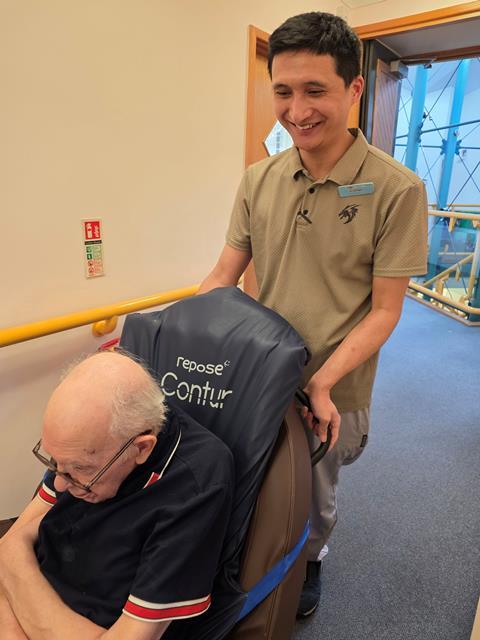
Li comes from a large town in Myanmar, and as well as being away from loved ones and adjusting to a cooler climate with a different pace of life, he also had to pick up the language. Before he came to the UK, he’d studied English, but he wasn’t confident speaking it day-to-day. At first, he was very shy because it was hard to communicate.
Thanks to a warm welcome from staff and residents at our home, Li quickly settled in and has now been with us for just over three years as a much-valued member of the care team.
The willingness of Li, and others like him, to leave behind their homes to care for older people in the UK has made an enormous difference to Pilgrims’ Friend Society and many other providers across the social care sector.
The value of overseas workers
In recent days, there have been attention-grabbing headlines about migrants seeking to stay in the UK by whatever means. A BBC investigation has revealed that legal advisers are exploiting migrants whose visas are running out, charging them thousands to help them pretend to be gay and gain asylum. Then there are the migrants making false domestic abuse claims to secure a fast-track residency.
Such exploitative and nefarious practices should of course be called out and stopped. But only focusing on the negative headlines risks overshadowing the enormous contributions of the many migrants who are here legitimately.
It was in early 2022, when staff vacancies in the social care sector stood at around 165,000, that the then government added ‘care worker’ to the list of shortage occupations with applicants eligible for a Health and Care Worker visa. Thousands responded to the call and the influx of overseas workers has helped to drive vacancies down.
Li is one of 82 staff members from overseas currently working at Pilgrims’ Friend Society on a sponsored visa. Across the organisation, we’ve welcomed staff from a host of countries, with the highest proportion coming from Nigeria, followed by India, then Zimbabwe, then Nepal.
Recruiting colleagues from overseas to our teams brings many benefits. Many come from cultures where older people are revered and they treat those in their care as they would their own family. Many are also Christian, keen to uphold the Christian ethos of our homes. Having full-time staff members (as opposed to relying on agency staff) also helps promote continuity of care, enabling the relationships that are at the heart of excellent care to blossom.
The future of care in question
Thanks to overseas workers, providers like us have also been able to make significant savings. Across our organisation, the fees paid to external agencies to cover care shifts have fallen by 90% since 2024. In a sector where government funding doesn’t match the cost of care, such savings enable us to steward our resources well, and invest in growth and development.
However, sadly some of those who have come to work in care under the overseas sponsorship scheme have faced abuse by employers. Some workers paid thousands in illegal recruitment fees. Others were housed in unsafe conditions and forced to work unreasonable hours. In response, between 2023–24 the Home Office revoked the sponsorship licences of 470 care agencies, leaving more than 39,000 migrant carers without a place to work.
Many overseas workers come from cultures where older people are revered and they treat those in their care as they would their own family
There have also been steps taken to curtail the numbers of those coming from overseas. In March 2024, the government prevented prospective overseas care workers from bringing dependants, leaving some with a painful choice.
Then, in July 2025, the government closed down sponsorship for carers from overseas altogether. Providers like us are allowed to recruit workers who are already in the country. However, these visas can only be renewed or switched to another sponsoring employer until July 2028. What will happen after that is unclear.
Living with uncertainty is difficult for everyone – both for individual care workers in need of a job, and for organisations like us who need to fill our staff teams. The reality is, we need these hard-working people to serve our precious elder members of society.
We invited them here and so it is only right that those like Li, who have answered the call, are treated well and their contributions acknowledged in wider conversations around immigration and the planning of policy.
























1 Reader's comment