









Just because it’s quiet, doesn’t mean it’s not revival. Now is the time for churches to disciple well, pray harder and believe God for more. Because he’s only just getting started, says Luke Hancorn
This year at Freedom Church, we are celebrating 903 salvations. That sentence still takes my breath away. For us as a church, it is unprecedented.
These truly are the days that we have prayed for. Days that we believed for during quieter seasons. Days we held onto when fruit felt slow and faith required perseverance.
During 2025, we saw a growing narrative of church attendance beginning to rise again. Not hype driven. Not trend led. But something steadier and deeper.
In our own church, we have witnessed this firsthand. Over the past 12 months, our church attendance has grown by more than 40 per cent. People are coming. Hearts are opening. Lives are being changed. We are profoundly grateful, both for God’s goodness and his sustaining grace. For the way that he carries his Church and provides. For the incredible yet undeniable way he is drawing people to himself.
And as a church leader, it leaves me with a holy question stirring in my spirit: What next? Lord, what do you desire to do in 2026? If you are in ministry, I suspect you have felt this too. The sense that gratitude and expectation must walk hand in hand. That celebration should never cancel out hunger.
The best way to position ourselves now is not to assume we have arrived, but that God has more. He is “able to do immeasurably more than all we ask or imagine” (Ephesians 3:20).
If we ever lower our expectation, it is rarely because God has less to give. It is usually because we have quietly stopped believing he will.
So perhaps the posture of “immeasurably more” is not optional, but the only one that says we trust in the God we confess to believe in.
Only God brings revival. Only God brings the glory. Our role has never changed. We simply put out the vessels for him to pour into. So, as leaders, I want to urge us to put the vessels out like never before.
An unexpected lens
In the world of technology and innovation, there is something known as the adoption curve. It describes how new ideas move through society. Not all at once, not evenly, but gradually. A few respond first, momentum builds and, eventually, what once felt new becomes normal.
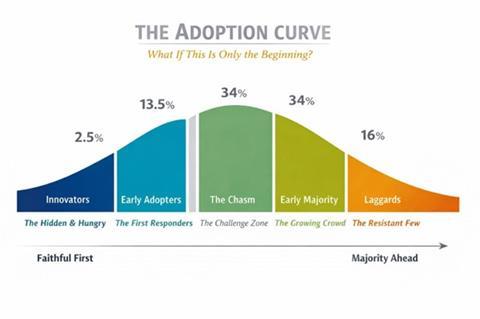
What if the ‘quiet revival*’ that many are talking about is not the culmination, but the early stages of something still unfolding?
Revival has always begun with a particular kind of person. Early adopters are rarely the loudest in the room. They are often the most attentive. They are searching, but not cynical. Curious, but not closed. They tend to live with deeper questions than most, and they are quick to respond when something rings true.
These are people who sense when something is authentic. They are drawn to presence more than performance, substance more than style. They may not have everything figured out, but they recognise life when they encounter it. When God begins to move, they feel it before they can explain it.
They are often the first to step back into church after a long absence. The first to respond to an altar call. The first to say: “Something is happening here”. They do not need certainty before obedience. They move when conviction stirs.
This is why early revival often looks quiet. Prayer rooms fill before auditoriums do. Repentance increases before platforms expand. Faith deepens in individuals before it spreads through communities.
And yet, this is never where revival is meant to stop.
Waiting and watching
If this is an early adoption moment, there are far greater numbers still to come. The majority are not uninterested, they are watching. They are waiting for safety, stability and credibility. They are asking questions: Will this last? Is this healthy? Can I trust this with my family, my doubts, my story?
Then, when trust is built, something shifts. Faith begins to feel accessible. Church no longer feels like a fringe pursuit but a meaningful one. Testimonies multiply. Lives change visibly. Growth comes not through transfer, but transformation.
Over time, what once felt like a quiet return becomes a cultural reawakening. The gospel is no longer treated as outdated but essential. Church attendance feels normal rather than niche. Even those who resisted longest - often because of pain or disappointment - begin to find their way home.
If we are early in this story, then our response matters deeply.
This is not the moment to rush. It is the moment to deepen. Not to chase scale, but to steward what God is already doing. To disciple well. To pray with greater faith. To put out bigger vessels.
Revival rarely starts with crowds, but with conviction. It spreads through credibility. And it lasts when it becomes culture.
If what we are seeing right now feels quiet, tender, and even fragile, that may not be a sign of weakness. It may be the clearest sign yet that God is just getting started.
*Editor’s note 27/03/26: In April 2025 Bible Society published their ‘Quiet Revival’ report, based on polling by YouGov which claimed to show a significant increase in the number of people attending church in the UK. Following widespread debate and questioning of the data in the press, YouGov, admitted “human error” in the way data had been collected and apologised unreservedly to Bible Society, who withdrew their report in March 2026. See Premier’s news story and Premier Christianity’s editorial for more information.




















No comments yet