









The combination of a claimed ‘quiet revival’ and the emergence of Christian nationalism has created a challenging new climate for many church leaders, suggests Andy Hickford
I recently received a phone call from a vicar in a north-east town, he had a question for me.
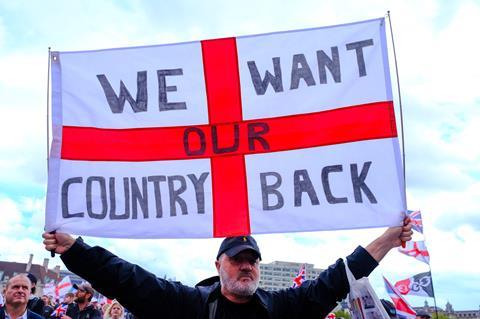
“I’ve woken up this morning and our church and graveyard is completely surrounded by St George’s flags. Half of my congregation is made up of people who I suspect will vote Reform and the other half are immigrants and asylum seekers. What do I do?”
Every Christian leader out there should be aware that the climate has changed radically. We’re not in the same country or world we were in even five years ago. The church is currently on the back foot and we need to get onto the front foot quickly.
A quiet revival and a new nationalism
Two shifts define the current landscape we find ourselves in that are radically different to the world in which I have been pastoring for 37 years.
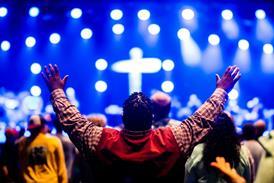
The first is what the Bible Society has called a “quiet revival”*. I was recently working with a church leader who baptised nine people on Sunday. He estimated that church is growing by 10% every 6 months, which is just wonderful.
And at the same time, we are seeing the rise of Christian nationalism. This is a very broad title encompassing a lot of different people. As the Evangelical Alliance ’Cross-Section’ podcast helpfully highlights, some Christian nationalists have a “big C and a little n” — devoted followers of Jesus who broadly sympathetic to the idea that the nation’s pretty broken and in need of radical fixing. Then you’ve got the “small c and the big N” — who are nominally Christian but carry a strong sense of nationalism.
You can mix and match the c’s and n’s into various combinations. The point is that Christian nationalism is a very broad grouping.
The second shift is an even bigger movement across the world. The old political identity, whether we were essentially socialist or capitalist, is gone. Two broader groups have emerged in their place. David Goodhart called them the ‘Anywhere’s’ and the ‘Somewhere’s’.
The Anywheres tend to be university educated, mobile, building identity around their own achievement. They value individual choice, feel at ease in a globalised world, and are a socially liberal people more comfortable with at ease with what some call “woke” ideas.
The Somewheres or ‘community nationalists’ are more strongly linked to the grassroot sense of identity tied to where they belong. They are less likely to have gone to university and have found themselves excluded from economic progress and the cultural diversity of the nation. Their core values are group loyalty, security, and they tend to be more socially conservative and anti-woke.
The Referendum on the UK’s membership of the EU saw these two worldviews collide. But the divide has continued and deepened. Now, Christianity is appealing to some community nationalists as a way of resisting what they perceive to be a failing multiculturalism and a slide into woke culture. They want us to return to our historical identity as a Christian nation with laws and values derived from the Bible.
There’ll be different opinions, but it should be understood Jesus always trumps those opinions. The way to common ground is higher ground. Let’s go to him.
That is essentially why Christianity is suddenly becoming politicised. At this summer’s ‘Unite the Kingdom’ march, clergy led the crowd in the Lord’s Prayer and then marched off to the chant that “Christ is King”. A Sky News reporter present said, “I’ve seen this in the States, but I’ve never seen in in the UK.” There’s something new happening here.
What worries myself, and many others, is that just as the quiet revival is gaining momentum, it could be hijacked and derailed by a political agenda.
The real crisis
So what do we do? We must avoid lazy, ill-informed, knee-jerk reactions. Powerful state actors are manipulating social-media algorithms to keep us divided. And a divided nation, as Jesus said, will fall.
A pastor I spoke to on the south coast said that each weekend two groups gather on the seafront — one protesting about the presence of asylum seekers in a hotel, the other standing in solidarity with them. His words to me were “It is a vicious atmosphere.” With feelings running so high we have to be really wise.
Religious nationalism might be new to us, but it’s not to Jesus. Jesus was always coming up against the nationalistic agenda, even among his own disciples. It was so deeply embedded in the way they thought about Jesus it made it almost impossible for them to comprehend his death on the cross.
They couldn’t reconcile their idea of a political Messiah who was going to overthrow the Romans with Jesus’ model of messiahship.
Even after the resurrection, as Jesus prepared to ascend into heaven, they asked, “Is it now that you’re going to restore the Kingdom to Israel?” (Acts 1:6)
I think that speaks very powerfully into our cultural moment right now. For some of the disciples a mixture of true faith and nationalistic hope is what drew them to Jesus in the first place. Only by following him in practice did they unlearn the misconceptions that had conflated the real Jesus with the one they imagined.
If we can model how to disagree without being disagreeable, how to love one another — we will be the healing oil that comes over this deeply divided country.
The Church today needs to proclaim the message that Jesus is the way, the truth and the life, but that he transcends all of us. His ways are not our ways – and that is true whether we are on the right or left of the political divide.
The Church as healing oil
The local church is probably the only place in the country right now where asylum seekers and Reform voters will be on first name terms. It’s probably the only place where people who put up flags and people who are here as a result of immigration will belong together.
If we can begin to model how to disagree without being disagreeable, how to love one another, how to talk deeply and how to listen to one another — we will be the healing oil, a balm that comes over this deeply divided, angry country.
There’s so much fear, anger, and bitterness on both sides. We need the presence of a fully functioning church, not one that sweeps this issue under the carpet, but one where there’s honesty and love.
There’ll be different opinions in our congregations, but it should be understood Jesus always trumps those opinions. The way to common ground is higher ground. Let’s go to him.
How can church leaders facilitate the kinds of conversations which aren’t taking place because of our social media burrows? If we can do that, we will be in a profoundly prophetic place as we respond to Christian nationalism.
Andy Hickford was speaking to Andy Peck on a Leadership Special episode of The Profile podcast
*Editor’s note 27/03/26: In April 2025 Bible Society published their ‘Quiet Revival’ report, based on polling by YouGov which claimed to show a significant increase in the number of people attending church in the UK. Following widespread debate and questioning of the data in the press, YouGov, admitted “human error” in the way data had been collected and apologised unreservedly to Bible Society, who withdrew their report in March 2026. See Premier’s news story and Premier Christianity’s editorial for more information.






















1 Reader's comment