









As evangelicals in the Church of England push for new churches to be planted while traditionalists rally to “save the parish”, the incoming Archbishop of Canterbury will need to grapple with questions of place, power and what it really means to be a local church in 21st-century England. Tim Wyatt reports
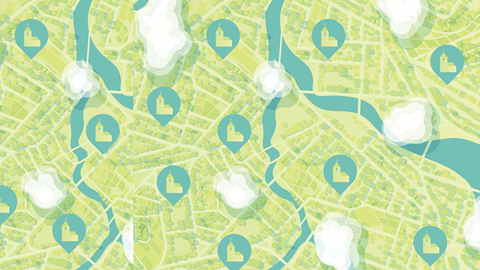
The Church of England takes its mandate as England’s national church very seriously. Every square inch of England sits within one of its 12,500 parishes. And each parish has its own church and – in theory at least – a parish priest to care for every soul within their patch. There is no one in England who cannot point to a church, just a short walk away at most, and say: “That’s mine.”
But twice in the past 100 years, sharp-elbowed evangelicals in Oxford have ripped up this ecclesiastical map. At the turn of the 20th century, those dissatisfied with the ‘popish’ high church persuaded the Bishop of Oxford to make them a new parish. They raised funds and built their own church to be a flagbearer for Bible-believing Protestantism – St Andrew’s.
A century later, they did it again. This time St Andrew’s planted a new church on a deprived housing estate called Cutteslowe, which was being largely ignored by the affluent village church to whose parish it technically belonged. The new church initially met in a community centre and was led by a lay pastor. It grew through intensive outreach and, eventually, the bishop gave Cutteslowe Connected its own vicar, despite it flagrantly trespassing parish boundaries.
This is both the story of my church, and also of the modern – and ancient – Church of England.
For some, Cutteslowe Connected is an example of how creative church planting can break out of the ossified straitjacket of CofE rules and breathe new life into a dying denomination. But for others, it is a calamity; an example of reckless, power-hungry evangelicals riding roughshod over cherished church institutions.
Boiling over
In recent years, this simmering tension has burst out into open conflict. Rows over blessing same-sex couples and recovering from a litany of abuse scandals will no doubt dominate Most Rev Sarah Mullally’s in-tray in the coming months. But lurking beneath these concerns is another rumbling argument that the new Archbishop of Canterbury will have to defuse.
Does the inherited Anglican patrimony remain the best and only way to faithfully build God’s kingdom in England? Or should we move beyond legalistic concerns about boundaries, sacraments and rules to imagine a new way to do church? This fissure divides bishops, clergy and lay people.Yet out of the crucible of this disagreement, some see signs of hope for mission and ministry.
As Anglicans in the 1980s faced up to decades of decline in church attendance, some began to experiment beyond the traditional parish system. New churches were planted – sometimes taking over dying parish churches but, at other times, establishing brand-new congregations outside of the old parish network. Informal renewal movements such as Messy Church and Fresh Expressions sidestepped traditional Sunday services to gather around a toddler playgroup or in a pub on a weekday.
Around ten years ago, this nascent church planting movement was turbocharged. Hundreds of millions of pounds were released from church coffers to plant “city centre resource churches”. Much of this funding went into a network run by Holy Trinity Brompton (HTB), the CofE’s only megachurch and pioneers of the Alpha Course. HTB began sending teams of clergy and volunteers to plant new churches in almost every region of England.
In the face of Anglican outrage that the vicar was ministering beyond his own parish, Wesley famously declared: ‘The world is my parish’
For the evangelicals at HTB, it was all a tremendous success. Derelict buildings and despondent congregations in England’s largest cities were turned into buzzy, thriving hubs of mission and ministry. Some of the only churches bucking the national decline were these new church plants.
But some clergy saw HTB as interlopers bulldozing through historic worshipping communities. No longer rooted in their own places and people, the new plants implemented a cookie-cutter formula of electric guitars, TED talk sermons and smoothie bars, irrespective of whether they were in Newcastle or Newquay, a gritty post-industrial town or sleepy seaside suburb.
In 2021, with pandemic-era tensions over church closures still bubbling under the surface, a remark at a church planting conference galvanised this opposition. Announcing a CofE-approved project to plant 10,000 new churches by 2030, a leading church planter said most would be led by lay people, not ordained clergy. “Lay-led churches release the Church from key limiting factors,” he enthused. “When you don’t need a building and a stipend and long, costly college-based training for every leader…then we can release new people to lead and new churches to form.”
The backlash was swift and severe. Many vicars were furious that years of theological study had been glibly dismissed as a “limiting factor” on church growth. Efforts by bishops to soothe concerns fell on deaf ears. Save the Parish was formed by traditionalists who began to organise to elect their candidates to General Synod. Save the Parish’s leaders cast their battle in almost apocalyptic terms: either the pernicious church-planting monster that had infiltrated the Church would be defeated, or true Anglicanism would be strangled by it.
The parish must not become an “inherited, embarrassing knick-knack”, warned Rev Alison Milbank, a prominent figure in the movement. “We are at crunch time: are we the CofE, with its reformed Catholic character, its sacraments, orders, and liturgies and its parish witness, or are we a nonconformist sect?”
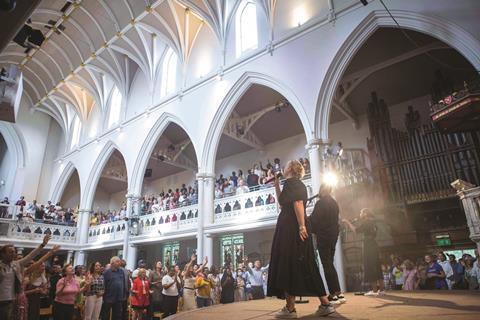
People and place
At the root of the debate is the theology of place. The traditionalists of Save the Parish see the CofE as fundamentally grounded in geography. A church must be the collective expression of a neighbourhood or village’s spiritual life, not a collection of believers sucked in by car from miles afield.
Rev Frog Orr-Ewing, a church planter, vicar and theologian, says this idea was “deeply engrained” in English culture; that a local church was not a private club for the Christians who attended, but belonged to everyone in a specific place. “We all have a church, even if we choose not to go to it.”
Rt Rev Andrew Rumsey, Bishop of Ramsbury, has authored several books about this subject. He loves the parish system because human societies were all inextricably geographical, he argues. “Land is the context for our encounter with God”, going back all the way to the Old Testament. Remaining faithful to one place for the long-term, resisting the pressures of transiency or internet-enabled dislocation, was essential to mission, he adds.
Linda Woodhead, a leading sociologist of religion from King’s College London, says her research underlines a growing disparity between the English people and the Church on this question. Most people still value the heritage and culture of the parish, but church leaders are increasingly drifting away from this intense localism. Recent archbishops have failed to understand the parish because they unconsciously worked out of a more evangelical or congregational “gathered church” mentality, she says. “None of them understood it’s about being part of this neighbourhood and being English and not necessarily being religious. It’s about the fete and the Women’s Institute and the Mother’s Union and belonging.”
This bucolic vision has been fraying at the edges for a long time. The growth of the welfare state in post-war Britain saw the government gradually encroach on the communal activity of the parish church, in everything from education to healthcare. A growth in secularism meant genuinely committed believers began to predominate within congregations, subtly shifting emphasis. What Woodhead called the “filling station” model, where people only come to church when they feel they need something (to confess a sin, baptise a child, bury a parent or light a candle), was gradually overtaken by a “lighthouse” approach, where the church acts as beacon to draw people into a transforming faith in Jesus.
Rumsey, Orr-Ewing and Woodhead all expressed sympathy with Save the Parish’s crusade against church plants that either stretched the inherited parish to breaking point or, in some cases, simply ignored it. But all also believed the traditionalists had missed the point.
Secularisation and church decline have gutted the financial model of the parish, making it impossible for today’s CofE to deploy a vicar in every neighbourhood in England as it ostensibly aims to do. “I have less time for a defence which doesn’t acknowledge that,” Rumsey says.
Rather than stifling the traditional parish, fresh ways of being church could revitalise it
Rt Rev Pete Wilcox, Bishop of Sheffield – a bullish evangelical – has come under criticism for his radical plans to reshape his diocese’s local ministry. But he accuses parish defenders of living in a dream world. The model of one paid full-time priest serving in every single parish has actually never existed, he says. Even at its peak, Sheffield diocese could only deploy 155 clerics across its 175 parishes. Today, they’re down to just 109.
In much of the CofE, the dwindling ranks of ministers have been stretched thinner and thinner, effectively being asked to do two, three or four jobs at once. For Wilcox, this is a recipe for the eventual disintegration of the system. His alternative is to raise up lay leaders in every parish and use his few ordained priests as overseers.
A senior figure from the HTB network, who did not want to be named, says lumping more and more parishes onto beleaguered clergy could not continue. While some HTB plants had bypassed the parish network, he says – citing one controversial scheme where a diocese had converted a former Chinese takeaway into a new non-parochial church – many had revived dying parish churches, he insists. “It’s a little bit of a surprise when the movement that calls itself Save the Parish takes on HTB because we’re trying to save the parish as well!”
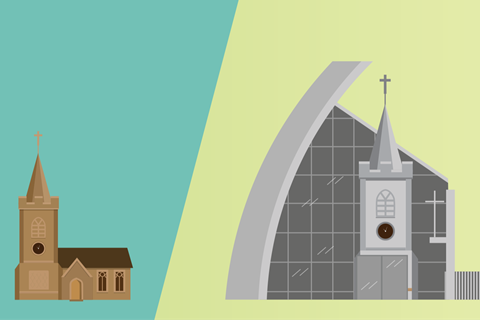
Changing church
Contrary to some of the wilder tales from the traditionalist wing, the parish system was not handed down on stone tablets. Church historians describe a gradual evolution over many centuries. The word itself derives from the Greek paroikia, meaning ‘those who live beyond the city walls’. It first described Christians whose citizenship was in heaven, later the sphere of influence around a missionary and, finally, the churches founded by these wandering ministers. By the eleventh century, each settlement was expected to have its own church, yet this nascent network remained a mess of overlapping districts and local eccentricities. “It’s still an enormously varied patchwork quilt,” Orr-Ewing says. “The idea of one-size-fits-all didn’t exist.”
Guild churches serving one industry or craft were widespread before the Reformation, as were a plethora of abbeys and monasteries. Later, the 18th-century evangelical revival saw an explosion of private chapels and preaching houses, where wealthy patrons could promote Reformed Bible teaching regardless of the disapproval of the local parish cleric. John Wesley and George Whitefield pioneered outdoor preaching. In the face of Anglican outrage that the vicar was ministering beyond the boundaries of his own parish, Wesley famously declared: “The world is my parish.”
In the Victorian era, the experimentation continued. Explosive population growth in industrial cities led to aggressive CofE church planting. Rules were liberalised to allow new churches to be built quickly on land carved out from existing parishes. “The new parochialism blended this regularisation – the institutional love of the Victorians – with the missionary mindset,” Orr-Ewing says – and enabled the frustrated evangelicals of north Oxford to start St Andrew’s 120 years ago. Ironically, it is this radically flexible and endlessly redrawn parish map which the High Church opponents of today’s evangelicals are seeking to defend.
Like many others, Orr-Ewing argues that the bitter culture war currently dividing the CofE is founded on a false premise. At heart, both sides are seeking the same thing. “The parish has always been an ideal,” he says. Not a boundary on a map or a legal definition, but a dream of how a local church could be. Just as the idea of the parish has evolved and flexed over the centuries, so it must be reimagined again for our time.
But while the parish may need to change, the institution remained “more relevant than ever”, Rumsey says. Save the Parish sees church plants and oversight ministers as threats to the parish but, in many ways, they aim to safeguard the idea of local church ministry.
At their best, HTB church plants are outward-facing missional communities grounded in a neighbourhood. So is my own church, Cutteslowe Connected. It is not a parish church in the legal sense, but it is more incarnational in its neighbourhood than any congregation I’ve ever been part of. It is not a private club of believers gathering on a Sunday, but an expression of the spiritual life of everyone who calls Cutteslowe home. It serves the whole needs of its community, feeding their stomachs as well as their souls.
The model of one paid, full-time priest serving in every single parish has never existed
And those 10,000 new churches the CofE aims to plant? They will mostly be built by and supplement the existing 12,500 parishes, not supplant them, Wilcox argues, because “people have quite a strong need to belong locally”. Rather than stifling the traditional parish, fresh ways of being church could revitalise it instead.
The CofE hierarchy have tried to make this case themselves. At the height of the anger over ‘limiting-factors’ in 2021 Most Rev Stephen Cottrell, Archbishop of York – the church’s second most senior cleric and architect of its new strategy – spoke directly to Save the Parish in a high-profile speech. “The heart cry of your movement echoes in all our hearts and reminds us of the centrality of place, the importance of the local, and why our resources must be focused on the local church of missionary disciples.”
A parish, at its best, is a seven-day-a-week, outward-facing spiritual community that places itself at the service of those who live nearby, believers and non-believers alike. No church planter would resist the exact same definition for their own community. But persuading the two sides to put down their weapons and embrace each other as brothers-in-arms may be one of Mullally’s toughest challenges. After years in the ascendancy under her predecessor, Justin Welby, the HTB movement is on the back foot. A number of high-profile bishops are openly backing Save the Parish and demanding the Church’s billions be put into struggling parish churches, not converting Chinese takeaways.
Rev Marcus Walker, who co-founded Save the Parish, says ordinary churchgoers are increasingly agreeing with his argument: that the decline of traditional parish ministry, the lack of clergy, and “eye-watering” diocese financial deficits are not a “natural disaster” impossible to stop, but the result of choices made by the hierarchy. People no longer accept that church plants are the only way to reverse decline, he says. “There’s a very serious question as to whether the new stuff does work. The conversation is shifting, and that’s good.”
Mullally has not yet staked out a clear position on either side. She is, by her own admission, a consensual figure who may try to find a compromise. Can she persuade Save the Parish to expand their understanding of what counts as a parish church? Will she throw her weight behind diverting more cash back to traditional clergy? Or will this civil war dog the CofE for years to come, hampering its efforts to receive the fruit of the much-discussed quiet revival*?
*Editor’s note 27/03/26: In April 2025 Bible Society published their ‘Quiet Revival’ report, based on polling by YouGov which claimed to show a significant increase in the number of people attending church in the UK. Following widespread debate and questioning of the data in the press, YouGov, admitted “human error” in the way data had been collected and apologised unreservedly to Bible Society, who withdrew their report in March 2026. See Premier’s news story and Premier Christianity’s editorial for more information.























2 Readers' comments