











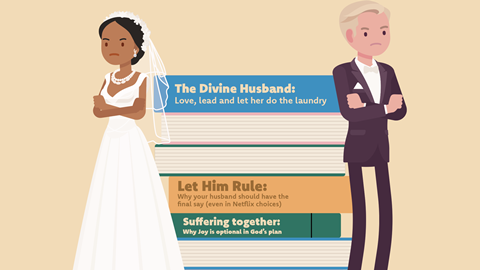

A lot of popular evangelical teaching actually leads to worse sex and less happy marriages, argues Sheila Wray Gregoire. Here’s the Christian marriage advice you really need
I’m constantly surprised at the many and varied ways the sentiment that ‘marriage is hard’ is expressed in the evangelical Church: Marriage takes work. You can’t expect your spouse to make you happy; only God can do that. Marriage is meant to make you holy, not happy. God wants to refine you through your marriage difficulties.
How depressing! No wonder Hallmark doesn’t have a line of ‘evangelical marriage’ cards.
Personally, I’d phrase it a little differently: “Life is hard. But marriage should make it easier.” Life can bring job losses and financial insecurities, illnesses, interpersonal conflicts and more. Marriage often brings children, who can add huge layers of additional responsibilities and complexities. And, of course, infertility or baby loss can also bring great stress and heartache. While being married can add complications, marriage should nonetheless be a source of strength to face what life brings. Marriage should be your safe place in the storm, not the cause of it.
My team at Bare Marriage has been trying to parse out the good and the bad in evangelical marriage and sex advice for the last five years, conducting four different surveys in which we have spoken to more than 40,000 people – most recently for our new book The Marriage You Want (Baker Publishing Group), that my husband, Keith, and I wrote together. We take Jesus at his word when he said that we can judge things by the fruit (Matthew 7:16), so that’s what we’ve done. We’ve researched how different teachings predominant in evangelicalism – and especially in the bestselling marriage and sex books coming from American evangelical publishers – actually affect marital and sexual satisfaction.
Let’s look at why we encounter this “marriage is hard” teaching so often, and then explore what actually helps couples feel close, loved and cherished.
Does male headship ‘work’?
One reason that marriage may seem hard is the widespread teaching in evangelical circles that it is a hierarchy rather than a team. Sally Gallagher, a sociologist, reported that the hallmark of evangelical marriage advice was adherence to the idea of male headship. Now, Gallagher’s work (and ours) showed that while many evangelicals pay lip service to the idea that men are in authority over their wives, most husbands don’t actually exercise this authority, and instead function as pragmatic egalitarians. But when a couple do truly practise putting one gender in authority over the other, divorce rates skyrocket (7.4 times higher in our study, and John Gottman found an 81 per cent chance of divorce when men don’t share power with their wives). Signs of emotional immaturity increase, sexual desire diminishes and marital satisfaction falls. This all makes sense. After all, how can you have true intimacy if one person believes they have the right to override the other’s opinion?
Marriage should be your safe place in the storm, not the cause of it
This doctrine may also help to explain why men tend to be happier in marriage than women. While men’s marital satisfaction tends to stay stable over time, women’s satisfaction drops precipitously after the first few years, accelerating around the ten-year mark, cratering at the 20-year mark and staying there for the rest of marriage. Why are women not enjoying marriage as much as their husbands are? Let’s look at the data.
Housework matters way more than you think
When asked what the two biggest areas of conflicts in marriage are, most people assume it’s sex and money. That means most people are wrong!
Our most recent study used standardised, previously validated scales to measure marital satisfaction from one to 100, with most people falling in the 60 to 90 range, meaning the majority are pretty happy, and small changes are actually quite significant. If a couple has money problems, their marital satisfaction drops an average of five points. Likewise, going from having sex multiple times a week to having sex just once a month is associated with a ten-point drop. But going from splitting the housework evenly to one person doing more than 90 per cent? That decreases marital satisfaction by 30 points. Bearing the burden for the housework and mental load of a household tanks your marital satisfaction (and kills your libido) far more than sex or money problems. This was true even when one spouse stayed at home or only worked part-time. It’s just too much to carry. Five out of six times, if someone is doing almost all of the housework, that someone is a woman. And she’s slowly getting fed up.
With time, small stuff often becomes big stuff
It’s not just the extra work; it’s the fact that she’s always ‘on’, that she’s the one who has to remember that Johnny has to practise piano every day for his performance next week; that Megan needs to be picked up late from school tomorrow because there are auditions for the school play, and if she makes it, she’s going to need someone to drive her to rehearsal every Tuesday night. That the chicken needs to come out of the freezer tonight so it defrosts for dinner tomorrow. That someone needs to be home for the repairman who is coming on Friday and you have a meeting scheduled in the middle of the afternoon. It’s everything.
It’s also not just housework that’s usually skewed unfairly in one direction; many other responsibilities are too. When we asked couples: “Who cares for your side of the extended family” (eg buying birthday cards for their mum) about half said they each managed their own family, and half said that the woman did it for both. What about making medical and dental appointments? Again, we found that couples either each manage their own or she does it for both of them. Very, very rarely does the husband do it for both of them. And when things are unfair, resentment grows.
Remember the unfairness threshold
We called this resentment that we saw in the data the “unfairness threshold”. It applies mostly to women (we didn’t see the same trend for men), and it tends to look like this: In the first few years of marriage, a wife can put up with a lot of unfairness in an area, and it doesn’t really affect her. But by year ten, her marital satisfaction is dropping; by year 15, it’s fallen a lot, and by year 20, she’s had it. We saw this same phenomenon in several areas. When she does more than 75 per cent of the housework; when she’s the one who overwhelmingly takes the initiative to repair after conflict, when she’s the one who handles kinkeeping for both sides of the family. And this is even reflected in when she doesn’t reach orgasm during intercourse. It doesn’t bother her at first but, by year 20, divorce ensues or the marriage becomes sexless, while her puzzled husband wonders what suddenly changed.
The moral of the story? Bring up things early; don’t wait it out. The answer isn’t “don’t sweat the small stuff” because, with time, small stuff often becomes big stuff; instead, fight for partnership and teamwork early in the marriage, before inequity gets entrenched and it’s harder to fix.
Don’t prioritise sex
Enough of the doomsaying! How do we make a marriage that endures and actually thrives? How can we keep (and stoke) that passion we had for each other when we said our vows? Well, here’s something surprising that we found. If you want a great sex life, don’t prioritise sex in your marriage. Prioritise the ingredients that make great sex instead.
It’s so much better to help people create a marriage they love than convince them to stay in a marriage they hate
In the Church, we typically talk about problems with sex in marriages solely as an issue of frequency – that is, somebody doesn’t want it enough. Predictably, the solution is for that person to understand how important sex is to their spouse and do it anyway (with the occasional tone deaf and extremely unsexy: “Don’t you realise it’s a gift from God?” thrown in for good measure).
But we found that frequency simply isn’t a problem when:
- Both people frequently reach orgasm
- There’s high marital satisfaction
- They feel emotionally close during sex
- There’s no porn use in the marriage
- There’s no sexual dysfunction
In other words, frequency and libido are not the problem, they are symptoms of something else. Sadly, these five real problems get little press in the evangelical world, despite the fact that we struggle with all of them. For example, we found that within evangelical couples, 95 per cent of men report always or almost always reaching orgasm in a sexual encounter, compared to just 48 per cent of their wives. We also found that evangelical women suffer from sexual pain disorders at 2.5 times the rate of the general population, and that more than half of married evangelical men currently use porn at least intermittently. Maybe there are reasons, then, that women don’t want sex. The good news? If we stop pressuring people to increase the frequency of sex they don’t want to have and instead focus on the core things that actually make sex great, then couples thrive.
Faith matters
It turns out “the couple that prays together, stays together” is true. We found praying together increased marital flourishing scores. And the effect was larger when emotional intimacy was lower. Among couples who found sharing what was on their hearts difficult, when they were able to pray together, their marriages did better. When couples have difficulty sharing because of childhood wounds, or anything that makes vulnerability difficult, prayer seems to serve like training wheels. Praying together creates a space where we can acknowledge what’s important to us and talk honestly about our fears, feelings or deep longings. When we open up emotionally to God with our spouse, it causes us to feel more emotionally connected, which in turn builds a marriage that flourishes.
While prayer builds connection, there’s something that builds it even more: frequently talking about spiritual things. Having those conversations about things that really matter, and bringing Jesus in front and centre, builds your marriage.
Quality time isn’t one-size-fits-all
Ever heard the advice that every marriage needs a weekly date night? Well, it turns out that spending time together is far less about the activity that you do and far more about the meaning that you both attach to it. When we asked couples: “What does quality time look like for you?” we received answers that were as different as the couples we talked to. Some were adamant that it had to be getting a babysitter and having weekly date nights outside the home, while others were quite content to stay in and do puzzles together. One couple told us: “Marriage is the art of being allowed to be boring together.” The activity wasn’t important; feeling connected and having low-stress time to talk naturally was what mattered.
Bearing the mental load of a household tanks your marital satisfaction and kills your libido
Sarah, one of our long-time Bare Marriage blog readers, lost her husband to cancer three years ago, leaving her a widow when she was only 40. Every Thursday, they would have date night together. She told us: “He was sick with cancer for five years, and we would still have date nights in hospital beds and infusion chairs. It was something we prioritised. Three years later and Thursday nights still bring all the feels. In itself, that time together was rarely profound. Often it was spent in our own kitchen while we had the kids in their rooms. The key was we loved being together.”
Sarah’s husband died on a Thursday night while she was holding his hand. In her grief, she can hold on to the memories of all those Thursdays, including the last one, where he made it clear to her, week after week: “I want to be with you because I love you.”
Intimacy is the key
If you’re married, or dream of being married one day, it’s likely because you want to experience the real intimacy that Sarah had – the feeling that you’re totally known, totally loved and totally accepted. You’re free to be who you are, and you have someone you can love who will be with you through all life’s ups and downs. God said that it wasn’t good for us to be alone, and when two people are able to truly open up, share and grow together, acting as partners, practising mutual respect, we see intimacy thrive.
I’m saddened that so much of evangelical marriage advice seems to revolve around convincing people to stay in a marriage they hate. It’s so much better to help people create a marriage they love! Marriage doesn’t have to be a hard slog. It doesn’t have to be unfair, sexless or sad. It can be exhilarating, rejuvenating and fun. And guess what? Among Christian couples, it usually is. That’s good news. We hope that our findings help you create the marriage you want, too.























1 Reader's comment