




Chris Goswami looks back at the biggest news stories from 2025, explores how they have impacted the Church and takes a look at the year ahead
What memories will stay with you from this past year? From the Catholic Church electing an American Pope and the CofE appointing a female Archbishop of Canterbury, it’s been 12 months of historic firsts inside the Church. Elsewhere, news headlines have been dominated by ongoing conflict in Ukraine and the Middle East, Trump’s contentious immigration polices, wildfires and floods.
Here are three defining news stories I’ve chosen from 2025 that deserve a second look.
The quiet revival – hope or hype?
“Go back to your churches and prepare for revival!” Perhaps you remember this (mis-quoted) line from David Steel MP, leader of the Liberal Party, in 1980s.
Addressing the 1981 party conference on its final day he declared: “Go back to your constituencies and prepare for government!” The party faithful roared with delight. But the 1983 election delivered a landslide victory for Margaret Thatcher’s Conservatives.
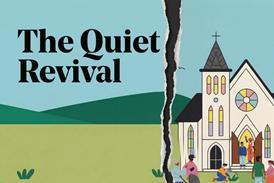
To be fair, “prepare for revival!” is not what the Bible Society said when they released a report called The Quiet Revival* in April, but it’s what many people seemed to hear.
The YouGov Survey commissioned by Bible Society indicated a substantial and unexpected growth in Christian faith since 2018. It indicated that, across all ages, church attendance was up by 50 per cent. And among 18–24-year-olds, church attendance had quadrupled, alongside a soaring interest in the Bible.
The publication of the report led to a flurry of press interest. There were moving stories of conversions, baptisms and local growth. Many were asking: Could it be that the long-established trend of declining church attendance in the UK was reversing?
Then came the push-back. Other surveys – such as the long-running British Social Attitudes study – still pointed to decline. And the annual ‘bums on seats’ attendance counts taken regularly by the Church of England and the Catholic Church continued to show a downward curve.
Some suggested that these millions of new church attenders were tucked away in small denominations that don’t do counts. But as Christian journalist Tim Wyatt argued, it would be extraordinary for attendance to rocket without anyone noticing.
What we do know, however, is that the Church is changing, and with online services now common, ‘attendance’ might mean something different than it did a decade ago.
At the same time, society is also changing. Immigration has brought new Christians from Eastern Europe and the Global South. And it now seems more socially acceptable to identify with Christianity. Even the infamous atheist Richard Dawkins says he’s a “cultural Christian”. Younger people especially seem less embarrassed to admit an interest in church and less likely to identify with atheism. These are all encouraging signs.
On the less encouraging side, we also see far right groups adopting Christianity and Christian symbolism as a response to what they see as a threat from Islam and the liberal left agenda.
What’s the takeaway?
Amid the confusing shifts in society, there are encouraging green shoots. But we are in a changing Church landscape with new forms of attending and belonging that may require a shift in our theology and discipleship if we are to see sustained growth.
The word ‘revival’ (whether quiet or loud) is emotive and highly charged. It simultaneously seems to make us feel excited and afraid of being disappointed. So perhaps we should use it sparingly.
Small boats and the need to belong
2025 was thick with stories on small boats, immigration and Islamophobia.
Outside hotels housing asylum seekers, there were protests and counter-protests. “Operation Raise the Colours” covered our streets in Union Flags; for some, a reflection of national pride, for others a warning that only certain people belong.
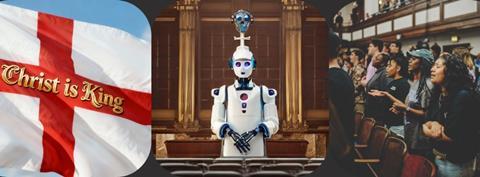
Tommy Robinson marches drew thousands carrying flags, crosses and “Christ is King” banners. Some Christians were horrified. Others were delighted. Let’s look at the tensions on both sides.
The Right
I grew up in Blackburn, in an area that was almost entirely white in the 1970s (apart from my family and a few others). Now, it’s about one third Muslim. Some people feel that the town has changed in ways they don’t like. For instance, the pub on our road is now a non-alcoholic café and my old comprehensive school is now an Islamic Academy. Some of my white friends have moved out to nearby villages. I don’t share their opinion, but their sense of loss is real.
This frustration exists in many other UK towns. Some are afraid of all asylum seekers because crimes involving them make national news. But this is hype; there’s no evidence that asylum seekers commit more crimes than anyone else. And only about five per cent of those who settle here arrive on small boats anyway – politically huge, but numerically tiny.
So, while there are legitimate concerns, some are simply wrong, and they can spill over into racism. For Christians, scripture speaks clearly: welcome the stranger, the refugee, the outcast. Hatred of any people group is sin.
The Left
Many on the left genuinely want a more equitable, fair society. But sometimes the way this is pursued undermines their aim. I recently attended a discussion on Islamophobia in Bradford. The panel included two Muslim MPs and a barrister. We heard shocking accounts of discrimination and violence against Muslims that were simply unacceptable. However, the panel singularly failed to acknowledge the stories of white British residents who felt excluded; who were frustrated that their pub has become a café. Those stories were simply not present.
In my work as a chaplain at Manchester Airport, we are in a lengthy dialogue about calling Christmas, “Christmas”; the signs in the airport shops state: “Happy Holidays”. But we try to mark other religious festivals authentically. When it’s Eid or Diwali, we don’t say: “Happy Holidays”. This seems to be driven by the retail department’s intention to not offend, rather than any deliberate attempt to sideline Christianity, but the outcome is poor.
Ironically, these kinds of gestures generate the very sense of inequality they seek to prevent. And worse – they unintentionally feed the far-right narrative that their culture is under threat.
Most of us inhabit the middle ground. Our task is to listen widely, hold tensions honestly, and resist the extremes.
Can AI make us “more human”?
Finally, the topic that never left the news - Artificial Intelligence. I’ve written a lot on AI in 2025, so this focuses on just one question: What is the distinctively Christian response to AI?
Christian theology insists that humans are set apart from anything artificially made. Even if AI were to become sentient and was granted legal rights, as some propose, it would still lack subjective experience – like feeling the warmth of the sun on your face or the smell of fresh bread. Also, it has no values or ethics of its own; it simply absorbs what it finds online. And importantly, it does not share our fragility - our fallenness and redemption are essential to being human. Since AI is not made in the image of God, it cannot be in relationship with God.
Christianity has the language to answer the question increasingly being asked: “What makes us different to AI?” and people are surprisingly keen to hear it.
Paradoxically, this means that AI can help us to be more human. We need to lean into what it means to be authentic and embodied. For example, a recent meeting on conversational AI bots in care homes ended with renewed awareness of what makes human pastoral care distinct. And one Christian organisation now states clearly on its homepage: “Every interaction you have with us is human”.
This is not about retreating into the past. Christians should use AI for what it is good for. But we must move forward with wisdom, all the while re-valuing human relationships and the incarnational nature of Christian ministry.
How do we move forwards?
The 2025 Vatican Report on AI, Antiqua et Nova, puts it beautifully: “With wisdom both ancient and new (cf. Matthew 13:52), we are called to reflect on the current challenges and opportunities posed by scientific and technological advancements, particularly by the recent development of Artificial Intelligence.”
2025 was the year AI stopped being the domain of the tech geeks and became part of everyday life - including church life. It’s no longer novel to say: “I used AI”, it’s normal. We will use AI, but we must do so with ancient and new wisdom.
AI Christian Partnership is publishing guidelines for using AI in Christian ministry.
*Editor’s note 27/03/26: In April 2025 Bible Society published their ‘Quiet Revival’ report, based on polling by YouGov which claimed to show a significant increase in the number of people attending church in the UK. Following widespread debate and questioning of the data in the press, YouGov, admitted “human error” in the way data had been collected and apologised unreservedly to Bible Society, who withdrew their report in March 2026. See Premier’s news story and Premier Christianity’s editorial for more information.



















No comments yet