









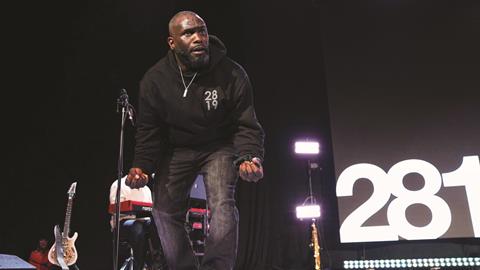

The leader of one of the fastest-growing churches in the USA wears all black as a representation of his daily death to self. On a recent visit to London he opened up about his calling to confront lukewarm Christianity, which he warns is keeping people comfortable in sin
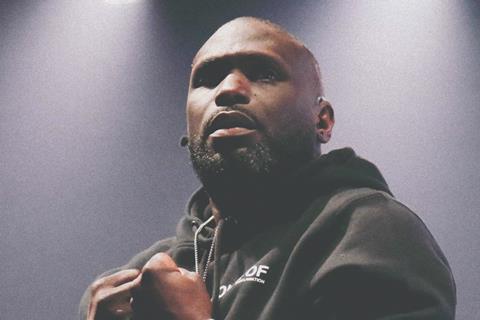
There is both an air and reputation that precedes Pastor Philip Mitchell. Watching his sermons online, you’re likely to encounter a manner of ministering that is blunt-edged and unsoftened, and when I sat down with the American-born minister, that rugged seriousness was unmistakably present in the room. Our interaction lasted around 50 minutes, from my greeting him at the lift to the conclusion of our interview, and I do not recall seeing a single smile cross his face.
But this no-nonsense posture begins to make sense when Mitchell articulates his context. He’s pastoring in an American Christian culture that has become, in his words, “dishonourable to the Lord”. A reverence and fear of God have been lost, he says, and he feels it’s part of his calling to restore it.
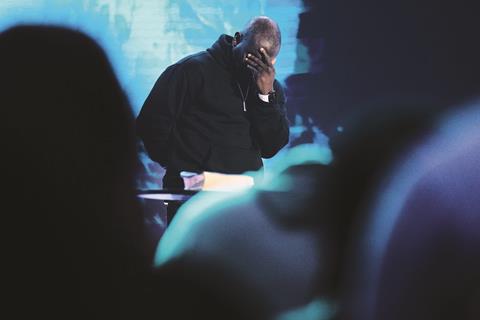
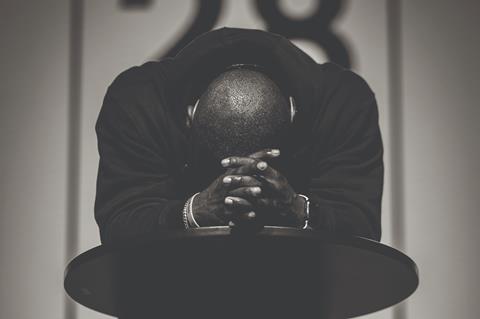
Online, clips of Pastor Philip literally crying for revival attest to both the divine responsibility he feels he’s been assigned and the weight he bears in carrying it.
Love and grace aren’t absent from his messages, but they are often accompanied – and occasionally eclipsed – by warnings of wrath, judgement and hellfire, offered as a remedy to what he believes is an American Church saturated with proclamations that keep people “comfortable in sin and compromise and lukewarmness” rather than challenging them into holiness.
“I’m a very fiery person by nature,” he tells me. Perhaps that’s a product of a life formed in a difficult urban environment – a first-generation American born to parents from Trinidad, Mitchell was raised in Queens, New York. His adolescence arrived in the early 1990s when hip-hop was becoming a global cultural force. Captivated by worldly allures – wealth, weed, women – he was selling drugs by the age of twelve. It was a path that would quickly escalate into larger-scale trafficking and shootouts.
By his early 20s, he had acquired everything he thought he desired: “a dope apartment, a beautiful girlfriend, a luxury car”. But in November 2003, Mitchell found himself overwhelmed by an emptiness that culminated in an attempt to take his own life. It was during that season, he says, that “the grace of God” intervened. He had previously known God only as a name “on a page of a book that my parents read”. After that night, Mitchell became convinced that he was real.
Fast-forward 23 years and the Atlanta-based pastor has exploded into prominence. Within the last three years, he has amassed millions of followers on social media, and his church is growing fast. Next weekend 2819 church will fill London’s Excel arena for their first crusade of 2026.
What this visibility conceals, however, is more than a decade spent “being forged in the fire” of hardship and obscurity. It was a necessary refinement, says the pastor. God was developing the character required to steward what would follow – one of the fastest-growing, most widely watched ministries in the world.
Pastor Philip is a man as sincere as he is austere. The austerity is present in statements such as: “for me, preaching is a matter of life and death”, and his commitment to only wearing black, as a representation of his daily death to self. The sincerity is present in the private wrestle he describes, questioning whether he is stewarding his ministry in line with God’s will, and the unprompted moment at the end of our interview when he prays for all who will read this conversation.
You’ve been open about your upbringing in New York – being raised in a Christian home but selling drugs as a teenager and leaving the city because of legal trouble. What did you carry from that stage of your life into the next?
I had all the trappings of worldly success but, on the inside, I felt empty, and that journey led me to a point of extremity where I was searching.
I remember being suicidal, sitting on my apartment floor with a shotgun on my lap and a bottle of alcohol. That night, a young lady I knew, who was a follower of Jesus, came to visit my apartment, and my door was unlocked by God’s grace. She sat down next to me on the floor and held my hand, but she did not say anything. Her presence talked me off the ledge.
I look back on that and realise that God, in his sovereignty, saved me from blowing my brains out.
A few months after that, my [now] wife got into a car accident. She came back to her apartment thankful that she survived. She put on gospel music. It was the first time in my life I had heard gospel music, and she was walking back and forth with her hand raised, worshipping God and thanking him.
I thought to myself: Whatever that is I need that. I crawled into the bathroom on my hands and knees and I started yelling at God.
I knew God was a name on the pages of a book that my parents read, but I did not know he actually existed. God revealed himself to me in that bathroom, November 2003.
Although I did not have the framework for it, I knew something had happened to me because that night I attempted to lay down with my girlfriend and, for the first time, I felt conviction for sin.
What happened between then and you stepping into ministry?
Six months after I got saved, I sensed God speaking to my heart for the very first time about pastoral ministry, preaching and proclamation. But I ran from it. After four years of running, I finally surrendered to that call.
For years, I served other men in other ministries. I did everything from cleaning toilets with joy to being involved in youth ministry. I don’t believe there is any such thing as an overnight success in the kingdom of God. I think what some people see as an overnight success is often a person who was forged in the fire and obscurity that God eventually brings to the light. I spent over a decade in that obscurity.
The secret sauce is God’s word and obedience
I know the deep pain of ruining relationships I wish I still had. I know the deep pain of wanting to quit 1,000 times – preaching and driving home with deep insecurities and tears in my eyes. I know the pain of struggle and lack.
I think God used those years to purge things out of my heart that were very vain and to transform me into the person I needed to be – to steward what he’s trusted to me now. So those years were not wasted, but nobody saw them.
How did you see God work through your vanity, and what changed as a result?
In December 2018, my wife and I went to Israel to spend ten days fasting, praying, seeking God there, because I knew I needed a transformation in my heart.
On the final day, my wife and I were at the Garden Tomb, and when I came out, I heard singing in a language I didn’t understand, but I could feel the presence of God.
I’m a bold dude, so I slipped into that gathering with a friend. It was a group of believers from Brazil.
I was sitting in the back, worshipping God, and the brother who was leading the gathering motioned for me to come to the front. He began to speak to me in a language I did not understand – but, by God’s providence, the gentleman who was with me spoke the same language.
He translated into English, and this is what he said to me: “I’ve been to your nation, America, and I see how the Church is dying. God is saying to you: ‘Young man, do you want to go back to your nation and do something about it? To go back and set the Church on fire?’”
I’m always asking: God, are you pleased with the way that I’m leading?
It was almost like God was charging me in that moment. I could hear God speaking to my heart to go back to America and cry aloud and spare not, to set his bride on fire. I fell down on my hands and knees, and that company of believers from Brazil laid their hands on me and prayed for me.
I feel that, in that moment, the pastor I had been died. The vanity I had in my heart died. It was almost as if I had an encounter with God like Isaiah did. I saw God for the holiness of who he was. I heard the counsel of heaven saying: “Who will go for me?”
I returned to the United States a man on a mission. I had no desire for anything that was materialistic. I had no desire for a large church, or a certain socio-economic status. Those things were gone. The only desire I had was to be faithful to what God said to me in Israel.
That was probably the defining moment in my ministry.
You only started 2819 Church in 2023, but you already have 1.48 million YouTube subscribers and are running events internationally, including in London. Give us the backstory.
Covid hit, and I lost my first ministry, Victory Church. I lost the facility we were in; I lost all of our membership; I lost the staff that we had.
Coming out of Covid, I had spent two years preaching to a camera in an empty room. I felt God telling me that we had to change the name of our ministry – and my wife felt the same thing, although we had not talked about it. Once we had this clarity in our heart, we prayed for two years about what that new name would be.
In January 2023, my wife and I buried the old ministry and founded 2819 with 183 believers. The name comes from Matthew 28:19 – to go and spread the gospel of Jesus Christ to the whole world. The culture of the Church was founded on Acts 2:42-47. It was going to be serious about the proclamation of God’s word, prayer, discipleship, community, generosity and outreach.
We never imagined two and a half years later that it would become global in its impact. Right now, my staff and I are doing our best to steward what we believe is a revival that God gave birth to in the south-eastern part of the United States that now has spread to the entire world. We take no credit for it. It is not man’s ingenuity. The secret sauce is God’s word and obedience.
You’ve said that the brokenness in America is part of your portion. What do you see in the US Church that stirs that emotion in you?
In America, I see a generation that has bought into a Western version of Christianity, disconnected from orthodox Christianity. I see the rise of false prophets leading a generation astray. I see a pursuit of spirituality through New Age and through the occult. I see a version of Christianity that is more about money and titles and prestige and position. I see a Christianity that is lukewarm and dying. I see a Christianity that is dishonourable to the Lord, and one that has lost reverence and fear of God.
I see a saturation, a preaching of love and grace, and not enough preaching about wrath and judgement and hellfire. And so, I see a faith that is keeping people comfortable in sin, compromise and lukewarmness – and not challenging them to come out of that life to what God has called us to be: a people that are holy and set apart.
What are the challenges and blessings of having such a massive outreach?
Oftentimes, we hold joy in our right hand and sorrow in our left hand. It is difficult right now because I have five teenage children. They see testimonies of lives changed on social media, and they see people who hate their father on social media.
There’s also the weight in my soul, if I could be honest, lying in bed at night thinking about the gravity of what God has entrusted to us and knowing that one day I’m going to have to give an account for that.
I don’t believe there is any such thing as an overnight success in the kingdom of God
I’m always asking: God, am I stewarding this right? Are you pleased with the way that I’m leading? Am I honouring you in my preaching and making sure that I’m not doing this for man’s glory?
Having a platform this large comes with warfare, attacks and the responsibility to keep wringing out from my heart things that that aren’t right. All of that is very, very difficult.

A woman once interrupted a service at your church and accused your congregation of idolising you. How do you navigate the risk of being idolised with your level of notoriety?
I don’t want to be so naive to say that there’s not some validity in what she said. Maybe there are people who idolise me as a spiritual leader.
But I’m doing everything possible to not allow people to exalt me as an idol, because I struggle with sin just like the next man.
That’s why I don’t preach every Sunday. I take time to step away so they can hear other voices. I never try to come off with this veneer of perfection. I try to always be honest about my humanity, so that people see that I’m a sheep, journeying with you just like anybody else.
You’re known as a very no-nonsense guy but there must be a lighter side to Philip Mitchell. How do you unwind and relax?
One of the things I admire about Jesus is that he is a lion and a lamb. We see him confronting Pharisees but also taking children to his arms, turning over tables in the temple but also having fun at a wedding.

When it comes to proclamation, I’m going to do that with my whole heart because I know souls are hanging in the balance.
But when I come down from that platform, I’m a regular guy. I enjoy spending time with my wife and my kids. I enjoy watching Netflix. I laugh. I go to restaurants because I’m a foodie. When I’m off that pulpit, I am a lamb. When I get up on that platform, I’m gonna be a lion, because it demands that.
To hear the full interview listen to Premier Christian Radio at 8pm on Saturday 7 February or download ‘The Profile’ podcast premierchristianity.com/theprofile
























No comments yet