











With family breakdown at a record high, marriage researcher Harry Benson argues that the real crisis isn’t divorce, but the quiet erosion of commitment before it begins

When he was just 21 years old, Harry Benson was one of the youngest helicopter pilots ever to serve in the Falklands war. He still has vivid memories of flying his seven-tonne machine at 100mph just 15 feet above the ground…and coming under heavy artillery fire in the process.
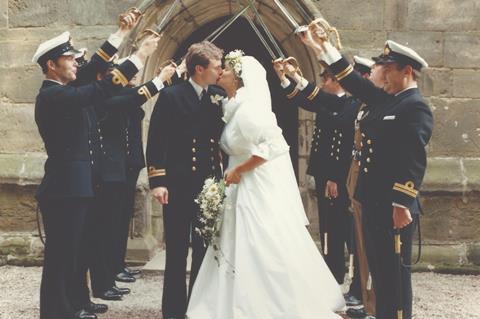
If that sounds scary, it was nothing compared to his wedding day, says Benson, who remembers shaking like a leaf. What got him through his nerves? The sight of his closest friends and family cheering him on, patting him on the back and saying: “Well done, good choice.”
That’s more than just a nice thought. It reveals the hidden psychology of weddings and marriage – the subject Benson has just completed a PhD on. Christians have long argued that marriage matters. It’s the gold standard of commitment and the foundation upon which long-lasting families are built, we like to say. Well, Benson has the research to evidence these claims.
Nearly half of kids are not living with both parents. I think that’s horrendous
He’s concerned at the sky-high rate of family breakdown that our country has seemingly become accustomed to. Half of teenagers are not living with both natural parents, he tells me, frustration and almost anger apparent in his voice. He’s at pains to point out that he has nothing but respect for single parents (including his own daughter), who do “an amazing job”, he says, “but it’s not the dream”.
During our conversation, I make the common mistake of implying divorce rates are rising. Benson quickly corrects me. Divorce isn’t rising. But family breakdown is. Why? The answer is that many couples have children but never marry. These relationships, statistically speaking, are less likely to last. That’s why the Marriage Foundation, where Benson serves as research director, was set up – to “wave the flag for marriage”.
Why are you so passionate about the topic of marriage?
Family breakdown is the highest it’s ever been in recorded history. If you go into a GCSE classroom today, nearly half of kids will not be living with both parents. I think that’s horrendous. I think that’s appalling. It’s way higher than it should be.
You can accept that there should be some level of family breakdown, because human beings can be horrid to one another; there can be abuse, addiction, abandonment or adultery. I don’t know whether we should expect five or 15 per cent of relationships to break down. But 45 to 50 per cent is really, really high.
A lot of people assume divorce rates are driving family breakdown. Why isn’t divorce the problem?
Divorce rates are the lowest they’ve been since 1970, because the people who are getting married today are doing so very intentionally. The driver is people not committing [to getting married] in the first place.
The Church has ridiculous rules about marriage
In my PhD thesis, I looked at 3,500 couples whose kids were born in 2000. I followed them over 14 years to see what happened. Marriage had by far the biggest effect on whether those couples stayed together, compared to never marrying.

Why is that?
Getting married cements your existing level of commitment. When you make a decision about something and then act upon it – which is what you’re doing when you get married – your subsequent behaviour is going to be consistent with the choice that you’ve made. Otherwise, you think: Why did I bother? And so, psychologically, we behave better in order to justify the choice that we’ve made.
Expressing that promise publicly in front of friends and family is what’s important – that’s the psychology that stacks the odds in your favour and makes it more likely that you’re going to succeed.
What are the common reasons why marriages or relationships don’t work out?
Drifting apart is by far the biggest cause of relationship break-up. Divorces are not acrimonious, by and large. Most of them are just: you’ve stopped talking to each other, you’ve fallen out of love – that sort of thing.
For most people, the solution is usually the man making a mental shift to prioritise his wife and effectively do what it says in Ephesians 5: “Husbands, love your wife as Jesus loved us.” How does Jesus love us? He doesn’t take control over us. He doesn’t dominate us. He waits for us, he’s patient with us, he sacrifices for us, he loves us. He’s very unconditional. And I think that’s a fantastic model for family life.
Husbands, love your wife, and then she will love you back. It seems so terribly unfair in our age of equality – we think everything has to be 50-50 – no, no, no. You’ve just got to step up and do it. And when you do, you get it back in spades.
You’re saying that from personal experience. Tell me more about what happened to you and your wife, Kate.
I had a pretty privileged upbringing. We were very comfortable. But my father left home when I was three, and I hardly saw him until he died in the early 2000s. I was brought up by my mother, and most of that was, frankly, being sent away to boarding school. My mother and I never really had a terribly intimate relationship, and she would have been the first to admit that.
When I met Kate, I was emotionally closed. We were quite functional as a couple, but we didn’t operate well in terms of intimacy. I think having children brings this to a head, because it’s very easy for mums to naturally take over the running of the show when children are born, and for dads to get pushed into the background. Very gradually and very surreptitiously almost, we drifted apart. We stopped talking to each other.
Eventually Kate confronted me. I was called into a meeting with the church leader and his wife. It was like a bolt from the blue when Kate said: “If you don’t get your marriage sorted out within the next year, it’s going to be over.”
I ended up getting counselling – against my better judgement. I did it because friends said I should. We had smart friends. Wise friends are key to getting any marriage back on track. They said: “Harry, you’re so closed, you’re borderline psychotic.” I wore that as a badge of honour! I had the most fabulous therapist who got me to open up and start being angry and upset about my childhood experience of abandonment at boarding school, which is what it felt like to me. I started to gain a vocabulary of emotions, and that was absolutely wonderful, but it didn’t really help our marriage.
I became a Christian around the same time – a wonderful Damascus Road experience at Jackie Pullinger’s church in Hong Kong. But that didn’t help our marriage, either, because I don’t think Jesus does particularly help you [in that way]. What he does is switches the lights on so that you can see what’s going on in the world, and that’s what he did for me.
Husbands, love your wife, and then she will love you back
We confronted the problem. We had a dual counselling session, and Kate burst into tears. I didn’t know what to do. I was like a rabbit in the headlights, and my counsellor said to me: “Come on, Harry, do something.” I had no idea what to do. Not a clue. That meeting was awful. I had to go back to work, and by the time I got home in the evening, there was a letter from Kate waiting for me. It was a sort of job spec of what it was to be Harry’s wife. Terms and conditions, hours, pay. But at the end of it, she said: “What I really need is a friend. And will I ever get that? Who knows? And WHO CARES?”
Those two words shocked me to the core. “WHO CARES?” really turned our marriage around. I literally got down on my knees and said to Kate: “You’ve got no reason to believe that I will change, but I will.” And I did. Somehow a switch clicked in my head. I realised: I need to do this for Kate’s sake, not just for the kids or mine. We had a lot of bad habits, and it’s taken a long time, but we’ve now got to a stage where marriage is almost automatic. It’s amazing, because we’ve built so much good stuff into our marriage. Years and years of training has got us out of that rut.
You’ve written previously: “Most couples who end up divorcing do so because they’ve grown apart. That’s a pretty pathetic excuse.” Why do you put this so strongly?
If you don’t have children, fill your boots and do what you like. But if you’ve got children, the game changes and you’ve got a wider responsibility. You’ve got to try and make it work, for the sake of the children. Ultimately, it is the right thing to do.
When a couple separates, what is the effect on children?
The biggest effect is that your resources become very heavily stretched. You can get into poverty. Look at the welfare statistics: the proportion of couples who split up and are on welfare is vastly higher than those who are still in couples.
You may think you’re getting divorced, but you’re not really, because you’ve still got to look after your kids.
I’m not condemning anyone. Most people who end up as lone parents don’t end up in that position by choice. You were looking for reliable love, and it wasn’t reliable, and you’re now on your own. Most lone parents do an amazing job. One of my daughters is an absolutely brilliant lone parent. But it’s not the dream.
Children tend to do better, counterintuitively, if their parents were fighting before they split up. It’s the ones where it wasn’t obvious – these drifting apart relationships (which is most of them) – where kids just don’t get it. The classic way that children internalise this is to believe the nature of relationships is [that] they just go pop for no apparent reason. That trashes your future. Or they believe: It was my fault. And that also sabotages their future relationships.
I’ve looked at the effect of family breakdown on teenager’s GCSE results. Family breakdown is the number one factor [that impacts results].
Most Christians would agree on the importance of getting married and not cohabitating, because of what scripture teaches. But how do we answer our non-Christian friends who might say: “I live with my girlfriend. We’re raising kids. What’s the point in getting married?”
The single biggest reason for getting married is that it brings clarity to your relationship.
In the current zeitgeist, if you’re living with somebody, or if you have a child, or you buy a place, we’re told these are really good signs of commitment. But they aren’t.
If you don’t marry, you live in a state of ambiguity. Marriage removes any possibility of asymmetry, where one person is more committed than the other.
The only way you really commit to each other is by standing in front of each other and saying: “Darling, do you want to spend the rest of your life with me? Because I would really like to spend the rest of my life with you.” And then you go and embarrass yourself in front of your friends by saying: “We’ve agreed. That’s what we’re going to do. That’s our plan.” We know the world says it doesn’t always work – sure, but you’re stacking the odds in your favour.
Isn’t marriage increasingly unaffordable for people?
I acknowledge there’s cultural pressure to spend a fortune on a wedding, but you don’t have to.
When you get married, it’s the best and cheapest legal document there is that protects both parties and also cements your plan for the future together. It’s a brilliant system, and it costs you £100 and a couple of visits to the local registrar, then you can go off and celebrate it in any way you want to.
It certainly doesn’t help that the media, wedding magazines and the wedding industry bump up people’s expectations. If you search Google, they say the average cost of a wedding is £20,000-30,000. It isn’t! I did an actual survey of a representative sample of married people in the in the UK. The median point is somewhere between £5,000-£10,000.
Are churches a help or a hindrance in this area?
The Church has ridiculous rules about marriage that are outdated. In the Church of England, you have to live within some area of the parish. The Church as an institution makes it hard for you to get married, not to mention the ludicrous thing during lockdown when we closed the doors of churches and made marriage incredibly difficult. We had a 61 per cent fall in weddings in 2020. It was the worst fall of any country in Europe because of our draconian, stupid policies. We lost 130,000 weddings that year.
I think the Church needs to get its act together and start saying: “We have a massive problem with family breakdown. And other problems like child poverty and teenage mental health are all linked very strongly to family breakdown.”
The Church needs to be unequivocally pro-marriage.
What does family breakdown cost in monetary terms?
Well over £60bn. It’s more than we spend on defence. It’s £3,000 worth of tax every single year for the average taxpayer, which is pretty shocking, really.
And it needn’t be as high as it is. I think lone parents should be supported. They do an amazing job. But how do we reduce the level of family breakdown from this outrageous level that we’ve become accustomed to? No one talks about it.

To hear the full interview listen to Premier Christian Radio at 8pm on Saturday 14 February or download ‘The Profile’ podcast premierchristianity.com/theprofile
For more information see marriagefoundation.org.uk

























No comments yet