





The prominent American evangelist Todd White has falsely claimed modern medicine is a form of witchcraft. Dr Kalpana Dein says White’s view isn’t just anti-biblical and misleading, but potentially deadly
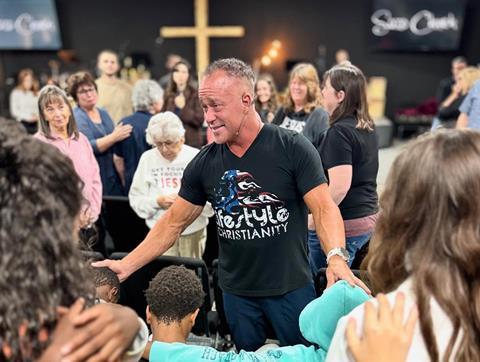
Following his recent expose of Shawn Bolz, podcaster Mike Winger has turned his attention to US evangelist Todd White. In a five-hour YouTube video that accused White of financial mismanagement and exaggerating healing stories (among other things), Winger shared an old clip of White suggesting that medicine was a form of witchcraft. It quickly went viral.
Citing the Greek word pharmakeia, found in the New Testament and often translated as ‘sorcery’, White denounces pharmaceuticals saying that he is “100% against the whole medicine factor”. Adding that “logic and reason are enemies of faith”, he went on to tell congregants to “throw your medicine in the toilet”…and then apologise to the toilet.
But is this what the Bible teaches?
I am a psychiatrist based in England. Several years ago, I went out for dinner with my husband, a secular Jew and fellow psychiatrist, and his acquaintance, a past president of the Royal College of Psychiatrists. When the ex-president realised that I was a Christian, he asked me: “Do you read the Bible?” I replied: “Every day”. He responded: “Good. So do I.” I would encourage everybody who listens to Mr White to show the same commitment to “examin[ing] the Scriptures every day” (Acts 17:11).
There is nothing in the Bible that prohibits the use of medicine
I became a Christian after an epiphany as a teenager. It was reason – something that White refers to as an enemy of faith - that first directed me to Jesus. Reading books by CS Lewis and Josh McDowell, I was reassured that Christianity offered the most rational explanation for my existence.
Subsequently, I felt the Holy Spirit’s leading to study medicine. My medical school had a vibrant Christian fellowship. We studied the Bible diligently, prayed and worshipped wholeheartedly. We also offered to pray for our patients.
When my mother, a doctor and a Christian, found out, she asked: “What will you do once you graduate from medical school? Pray for your patients or prescribe medication?” The question confounded me, as she had highlighted a key theological question.
Miracles and medicine
Christians have made major contributions to modern medicine, including the development of hospitals, hospices and specialised care for mothers and children. Christian ideas have helped shape medical schools. Christians including Pasteur, Lister, Laennec, Simpson and Keen have pioneered key medical discoveries in the fields of physiology, anaesthesia, germ theory and modern surgical practices. Florence Nightingale, the founder of modern nursing, exemplified this legacy, viewing her work as a calling from God.
One of the four Gospels was written by Luke, whom the Apostle Paul refers to as “the beloved physician” (Colossians 4:14) - not an ‘ex-physician’. Luke records many miracles of healing in his Gospel, yet he remained a doctor. Why? Jesus stated that the sick need a doctor (Luke 5:31).
In Luke 5:14, after healing the leper, Jesus tells him to show himself to a priest. This was not only fulfilling Jewish law, but also ensuring robust medical practice, as Jewish priests were the guardians of the community’s health.
Leviticus 13 and 14 include instructions regarding the examination of sores that read like a chapter in a dermatology textbook. The advice on quarantining people with infectious skin diseases is not dissimilar to the public health advice given during the recent Covid-19 pandemic. The cleansing rituals advocated for in the Old Testament were public health measures to reduce the spread of disease.
Far from the Bible prohibiting the use of medicine, both the Old and New Testaments contain examples of medicinal use, such as using oil and wine to treat wounds (Luke 10:34). In Isaiah 38:21, the prophet instructs that a poultice of figs be used to treat King Hezekiah’s boils.
Some would interpret this to mean that Christians should confine themselves to herbal remedies and not take advantage of advances in modern medicine. In a similar vein, should we avoid travelling on buses because they are not mentioned in the Bible? God is not anti-modernity, and modernity is not inherently sinful - no more than everything ancient is pure and holy.
We are blessed to be living at a time when infections do not routinely kill their victims, thanks to the discovery of antibiotics. Where the life expectancy from cancer is increasing due to breakthroughs in science. Cataracts and cleft palates can be surgically repaired. I thank God for these medical advances that benefit so many who are suffering.
So how did I answer my late mother’s question? I said: “Amma (mother), I do both.” I try to stay abreast of the latest medical advances in psychiatry, because the Bible has much to say about the importance of knowledge. Like my mother before me, and my sister (a public health doctor), I also pray faithfully (Romans 12:12).
Do no harm
It is impossible to calculate the level of damage that half-truths, such as those uttered by Todd White, have wreaked on the body of Christ. What happens to those with diabetes who skip their insulin, or those with schizophrenia who stop their antipsychotics? Some will lose their lives.
How does such reckless teaching fulfil God’s law to love our neighbour as we love ourselves (Matthew 22:39)? The Bible warns us that people’s lives are destroyed by lack of knowledge (Hosea 4:6) - both of sound biblical teaching and the practice of modern medicine.
Whatever the root meaning of the word ‘pharmacy’, let us not throw the baby out with the bath water. That would be a grave mistake.





















5 Readers' comments