











Ryan Gosling’s latest film, Project Hail Mary is a poignant, funny movie that reminds Christians of the fragile nature of human life, the value of friendship and the courage of sacrificial love, says Faith Lowe
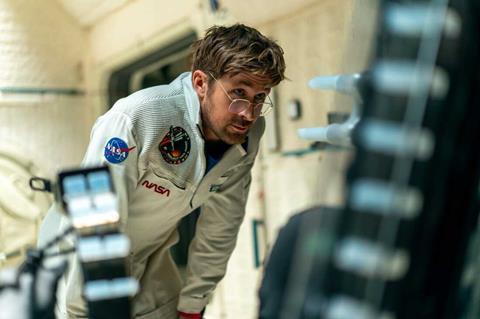
Phil Lord and Chris Miller’s new science fiction endeavour, Project Hail Mary, follows an unassuming primary school teacher whose life is upended when he is recruited to save the world from a dying-out sun. With Ryan Gosling at its helm, the film’s ability to hold the wonder of space and science alongside the frailty of the human psyche reminds us that there is no greater miracle than that of the soul.
Ryland Grace (Gosling) – a name that felt entirely purposeful – wakes aboard a spaceship (the Hail Mary) with little recollection of how and why he is there. As he comes to terms with his surroundings, we quickly learn that, although modest in character, Grace is an expert microbiologist who has been exiled from the science community due to his audacious belief that water is not essential to life. It is this belief that catches the eye of Eva Stratt (played by Sandra Hüller) who inevitably pushes him to greatness.
Grace is, against his will, the hero of the story. The film is unapologetically science obsessed, a world-saving thriller that moves effortlessly between humour and sincerity. It’s most essential messages to Christians though, must be the humanisation of the stranger and the courage of sacrificial love.
Grace for the stranger
It would not be spoiling the film to say that Grace encounters an alien species rather early on. After journeying the initial realities of loneliness and fear, he happens upon another ship inhabited by one other living creature. It is a moment of genuine connection and fascination in which this strange life form is given dignity. Grace patiently communicates with him, affectionately calling him Rocky, and begins to piece together a similar story to his own.
The pair become companions, and this enchanting friendship quickly becomes the centerpiece of this story. They both adapt to the other’s atmosphere, language, and even take watch over each other when they sleep for safety. The first time Grace agrees to this, Rocky declares in his broken speech: “Rocky happy not alone”.
Although it is an age-old story, it feels poignant in our current cultural moment. There is no villain in this film. In fact, the character who should evoke fear or hesitancy is the one who brings comfort, and who ultimately gives Grace the courage to fulfill his mission.
It is a reminder that there is an opportunity for connection everywhere. In unlikely, scary places - perhaps with those whose lives are wildly different from our own, should we only be so brave as to enter into it. Because, as this film depicts, our souls and our stories are often not so different after all.
This sweet bond makes space for the film’s even louder message: sacrifice. Stratt, the wonderfully German mission leader, explains that the only way to undertake something so terrifying is to find something worth dying for. We later see Grace aboard the Hail Mary writing out the words: “Who am I dying for?”. Is it a spouse? A child? All of humanity?
Fear and trembling
Rather refreshingly, Ryland Grace is an entirely unwilling hero. He is openly petrified and outright refuses to board the Hail Mary. The profoundness of this moment is only comprehended when, later in the story, he considers sacrificing his own journey home to save Rocky. He is sent unwillingly but, ultimately, chooses to sacrifice his life for the sake of a friend. Grace’s fear, cowardice and frailty disintegrate in the presence of love when, suddenly, he has something worth dying for.
It’s essential message to Christians must be the humanisation of the stranger and the courage of sacrificial love
It would be understandable, as Christians, that we would avoid secular stories focused on science and apocalyptic scenarios. They are often far from the biblical hope we believe in, or perhaps they feel too close to what we fear could unfold. But, more often than not, we find that stories like this leave more than enough space for the possibility of God, especially when love, sacrifice and courage reverberate through every moment.
“Greater love has no one that this: to lay down one’s life for one’s friend” (John 15:13).
























No comments yet