













If you want to be more like Jesus, you can’t do it alone, says Joe Warton. Discipleship happens when we help one another, and allow others to help us in return
If a friend described you as someone who doesn’t need anyone else, would you take that as a compliment, or an insult?
For many in our culture, independence is seen as a badge to wear with pride. It says: “I’m strong and capable; self-sufficient, self-defined, self-made.”
But if we lived in another time or place, we might view it differently. In many cultures, it would be seen as a huge insult. “People see me as arrogant and foolish. I’m not connected to other people. If I don’t sort this out, I’m in serious trouble.”
This was something American missionary E Randolph Richards, co-author of Misreading Scripture with Western Eyes (IVP), was confronted with when living and teaching in Indonesia. His students and colleagues were shocked by how much he tried to do things by himself. He was dubbed “the man who needs nobody”. It was not meant as a compliment.
Be known as the person who needs somebody. It’s not a weakness, it’s witness
I’m writing this article because I want to help you become more like Jesus, and to walk with Him in everything you do. Not just when you’re at church, or for a few minutes in the morning, but in all your working and cooking and studying and socialising – everywhere! And to do that, we need each other.
What scripture says
From beginning to end, the story of the Bible is one in which human relationships are front and centre. It starts off with God making a man and saying: “Hey, this isn’t good! He needs someone with him” (or words to that effect, see Genesis 2:18). It ends in Revelation, with an uncountable multitude living and worshipping God together.
Between these two relational bookends, we’ve got the laws and stories and poetry and proverbs of the Old Testament, which have much to say about the value of God’s people supporting one another. “As iron sharpens iron, so one person sharpens another” (Proverbs 27:17). “One who has unreliable friends soon comes to ruin, but there is a friend who sticks closer than a brother” (Proverbs 18:24).
We have beautiful pictures of deep friendships that radically shape the outcomes of people’s lives. Naomi and Ruth’s story of survival and blessing would look very different had they not committed to one another. And without Jonathan, what becomes of David?
As we roll into the New Testament, we have Paul – that guy we often think of as a bit of a lone-wolf, a Clubber Lang-style evangelist: “I travel alone, I write alone, and I’ll win souls alone” (if you have no idea what I’m talking about, stop what you’re doing immediately and watch Rocky III).
Going deeper
Often people tell me that they’d love to have more conversations with people at church about their journey with God, but they don’t know where to start without it being weird.
Here’s a few helpful pointers:
- Ask them what they have coming up this week
- Let them know you will pray for them
- Do actually pray for them (perhaps make a note in your diary or set an alarm on your phone to remind you)
- Next time you see them, ask: “How did that thing go?”
- And there you have it – you’ve had a couple of short conversations that bring God into the equation. This signals you’re someone who is open to talking about this stuff, and demonstrates that you care about other people’s lives and spiritual growth.
But that picture is not at all accurate. It’s clear from Paul’s letters that his preaching and teaching ministry was a team effort. He travelled with friends and even wrote with other people: Timothy, Silas, Sosthenes. And the letters he co-authored with them (as well as the letters by other New Testament writers) are peppered with “one another” exhortations: “be devoted to one another” (Romans 12:10); “be kind and compassionate to one another” (Ephesians 4:32); “encourage one another and build each other up” (1 Thessalonians 5:11); “spur one another on towards love and good deeds” (Hebrews 10:24).
And then we look at the example of Jesus. We know that He was there for others, but there were also so many times He asked others to help Him and be with Him: collecting donkeys, serving crowds, crossing lakes, sharing meals, praying before His trial and crucifixion.
If God is helping you grow in a specific way, tell someone about it
Research into how people grow as disciples demonstrates that this holds true today. Whether it’s exploring how people come to faith, how students and young adults follow Jesus and make Him known or how Christians at any stage of life live faithfully and effectively, the support of other believers is always key.
Helena, a teacher in her mid-20s, said this about the impact her small group has on her faith: “I really value my Christian friendships because they challenge me to rethink how I view situations at work and encourage me to respond in a godly way and to persevere with love through whatever I’m facing.”
4 ways we can help each other grow
1. Role modelling
It was a beautiful summer afternoon at our church away day, and a bunch of us were attempting to bend free kicks past the best goalkeeper in the congregation, Nathan. We were having a brilliant time, but play was slowed down by continually chasing after balls that went wide, over – or both. Suddenly, without prompting, Sunil placed himself behind the goal, retrieving the many shots that we ‘narrowly’ missed. With more balls in play, and less time spent chasing stray shots, the fun increased.
I thought to myself: Wow, Sunil has been so servant-hearted here. He has sacrificed his own fun to increase the fun of others. After a few more shots, I ran over to thank him and took over back-stop duties. A few minutes after that, 13-year-old Will jogged over. “Joe, I’ll do this, you go play,” he said.
Without speaking a word, Sunil had modelled Jesus to me and changed my actions which, in turn, influenced young Will. Role modelling is powerful.
Sometimes role modelling happens through direct observation, like that day on the football pitch. At other times, it might come through talking about how we’re trying to respond wisely to our difficult boss. Or through sharing something that’s helping us pray more consistently for our friends and colleagues. By talking about what God is doing in our lives, we can help each other see what following Jesus looks like in ordinary life.
2. Encouraging
I really do believe in the power of positive self-talk. But there’s something especially powerful about encouraging words from other people. Dietrich Bonhoeffer expressed this beautifully: “The Christ in his own heart is weaker than the Christ in the word of his brother; his own heart is uncertain, his brother’s is sure.”
We can encourage a fellow disciple by affirming the good we see in them – how they are already being like Jesus in some way. “I’ve noticed that you stay so calm with your kids, and I know you’ve not had much sleep lately; that’s really amazing.” Or: “I’ve noticed when you talk about your friends, you clearly care about them so much and serve them so well.” When someone points out something in us that we haven’t even noticed in ourselves, the encouragement goes deep. We feel like we’ve been truly seen.
There’s something especially powerful about encouraging words from other people
Another form that encouragement can take is in “[spurring] one another on towards love and good deeds” (Hebrews 10:24). Sometimes, a friend or someone at church can be on the verge of stepping from intention to action and our words can prompt them to take the plunge. “Hey, it’s so cool you were thinking of running Alpha for your colleagues; that’s such a brilliant idea, how’s it coming along?” Or: “You said you want to start reading the Bible regularly, what’s stopping you from starting tomorrow?”
3. A sense of togetherness
Living out the gospel every day is challenging. It’s hard to keep believing, valuing and doing certain things when the vast majority of people believe, value and do differently. Maybe you’re facing that very natural human tendency to doubt the reality and relevance of Jesus, and conform to the culture of your workplace, college or friendship group?
Knowing that you’re part of God’s wider family can help you live out your faith with confidence. A university student who wants to share his faith said: “I’m so blessed to have so many Christian friends who are in the same boat – it’s not like I’m the only Christian trying to share Jesus. I’m part of God’s wider Church at uni doing this mission together.”
Just being connected to other Christians who are being intentional about growing in their faith can make a tangible difference. And we can be part of that tangible difference for others.
4. Praying together
Masiko is a GP. She seeks to treat her patients with dignity by listening deeply to them and getting to know them as whole people. As well as honouring their humanity, this also helps her get to the bottom of what’s really going on with them, so she can offer the best course of treatment. This is not easy – especially in a pressurised, inner-city surgery.
Masiko loves being part of a small group where they talk about the
challenges and opportunities they have to make a difference in their work and wider lives. She loves having friends who know what’s going on for her, who pray for her and speak God’s word into her life. And she loves doing the same for them.
Callum has a multifaceted role in digital media: filming, photographing, designing, writing, social media-ing – and doing all of this with a boss who’s impossible to please. Callum wants to do great work that brings joy and encouragement to the world, not get sucked into bad-mouthing his boss along with his (understandably frustrated) colleagues.
Callum meets with a few Christian friends every Tuesday morning before work to read scripture, talk about how it connects to the day ahead and pray for each other. He says: “When I meet with the lads in the morning, it sets the tone for the day. And you pray for those lads because they have things they’re facing in their day-to-day life. But also knowing they’ve prayed for you is really, really encouraging.”
As Christians, we know that we have a God “who is able to do immeasurably more than all we ask or imagine” (Ephesians 3:20), and that through Jesus, we can approach God “with confidence, so that we may receive mercy and find grace to help us in our time of need” (Hebrews 4:16). Praying together makes a difference – and God’s word is powerful; especially when someone helps us see how it speaks into our particular situation.
Better out than in
So, here are some things that are true: God invites us to help one another grow, because we really can make a difference in each other’s lives – and there are easy, practical ways we can do this.
In light of this, how about we borrow the wisdom of the unapologetic public belcher: “Better out than in”? Perhaps we should commit to being more ‘better out than in’ when it comes to our relationships with one another.
The story of the Bible is one in which human relationships are front and centre
If God is helping you grow in a specific way, tell someone about it. If you see someone displaying the character of Christ, tell them what you see. If you’re praying for someone, message them to let them know. If a Bible verse comes to mind for someone, share it with them. And be open to them doing this for you, too. Be known as the person who needs somebody. It’s not a weakness, it’s witness.
Inside the matrix
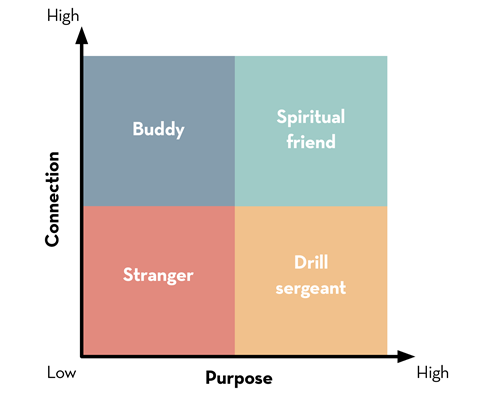
Relationships help us grow when they combine healthy connection with a clear purpose. Here’s a helpful model for understanding supportive, intentional relationships
1. Low connection, low purpose:
These are relationships that lack both closeness and intentionality. While we probably aren’t doing each other much harm in these kinds of relationships, we also can’t do each other much good. We are, essentially, just strangers to each other.
2. High connection, low purpose:
Lots of people say their relationships with people at church can be like this. There’s genuine warmth and friendship, but conversations are rarely about how we’re living out our faith. These relationships do us some good, but they don’t particularly help us become more like Jesus.
3. Low connection, high purpose:
These are relationships where people don’t feel particularly close to each other, and they might be lacking in psychological safety. Even though these relationships have a clear sense of purpose and might help us grow a bit, they are unlikely to be sustainable, and might even do us damage in the long-term.
4. High connection, high purpose:
These are the kinds of relationships Jesus and His apostles modelled and encouraged. In these relationships, we know and care about each other. We feel safe. But we also have a clear purpose: we are helping each other to live more faithfully as followers of Jesus. This is what we’re aiming for.

























No comments yet