










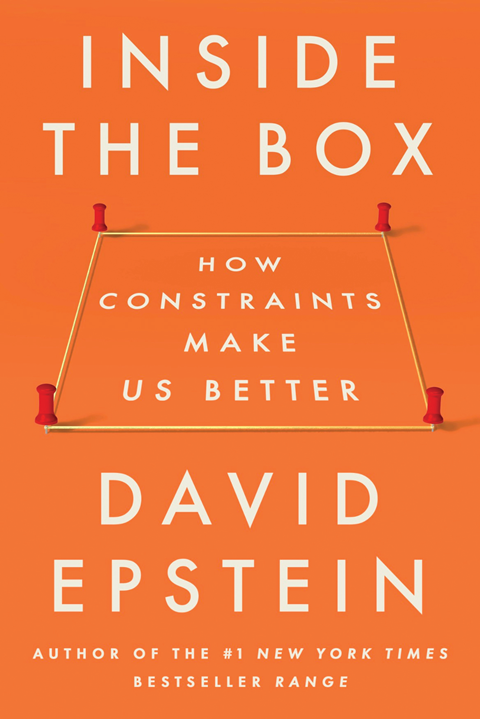
A leading social scientist is claiming that constraints make us better because they fuel greater creativity and innovation. Martin Saunders considers whether the logic could be applied to your church
What’s the biggest thing holding your church back in its mission? What’s the one factor which – if only it could change – would unleash your potential to share God’s love with the world? Perhaps the answer to that question comes easily to you; a Family Fortunes survey would surely put “more money” at the top of the list, closely followed by an increase in staff, volunteers and maybe a better building. In a world that prizes growth, we’re wired to always imagine that greater resources equal greater impact.
It makes sense that we want more. If we’re honest, what church leader wouldn’t wish for bigger budgets, larger and more modern facilities and, of course, more congregants? Yet while there’s no denying that these kinds of increases would yield some positive effects, a new book makes the case that if you really want to see breakthrough, more of everything is actually the last thing you need.
Total creative freedom
David Epstein is an increasingly well-respected voice in social science. His last book Range (Macmillan) explored why, in a world increasingly full of specialists, the jack-of-all-trades generalist can actually thrive. This kind of counterintuitive thinking seems to be Epstein’s speciality, and his new book Inside the Box (Macmillan) is another example. Employing the story-illustrated style that has become popular in big-idea non-fiction, Inside the Box makes the case that, while we might pine for infinite resources, what success really demands is constraints. That is to say: limitations, boundaries and budget cuts are often our friends, rather than the debilitating factors we assume them to be.
As a grand case in point, Epstein frequently returns to the cautionary tale of General Magic, the most significant technology company you’ve probably never heard of. Before Apple and Google took over the world, and long before the age of social media, the world’s biggest tech brains and investors joined forces to create a kind of electronics industry supergroup. Many of the big players of the time – Sony, Motorola, Philips and more – poured in money. These tech geniuses had access to almost infinite financial resources, and more ideas and creativity than a movie studio. Yet the reason you probably haven’t heard of General Magic is not because the company changed its name but because it failed completely.
Epstein’s argument is that this constitutes a perfect cautionary tale of too much creative freedom. Employees at General Magic could take as long as they wanted, spending as much as they needed, to develop whatever they thought was exciting. Some of the projects that entered development in the early 1990s included a touchscreen phone, streaming TV, networked games and an early version of USB, now the global industry standard for transmitting digital data and delivering power between devices. All of these things were way ahead of their time. But the trouble was, none were ever finished. Without hard deadlines, financial boundaries and management forcing tough decisions, the pioneers just kept on pioneering endlessly, like explorers who just kept sailing around the world, never choosing a place to settle. General Magic eventually folded in the early 2000s, its patents auctioned off and finally brought to their potential by cannier investors.
Inside the Box has a lot of stories like this, and they all underline the same key point: while we think we need freedom, we really thrive when we have boundaries in place. That, of course, is a familiar theological idea.
The first constraints
The Bible begins with two stories which beautifully illustrate the point. The Creation picture of six working days and one of rest is perhaps one of scripture’s most counterintuitive moments; why in the universe does God need a day off? In fact, God is introducing a desperately important concept to humanity – that we need rest if we’re going to function properly.
I grew up next door to a deeply religious family who didn’t watch television on a Sunday. The kids had to have all their homework finished by Saturday night. I thought they were a bit weird at the time, but they grew up to be some of the most well-rounded people I know. The constraint of rest meant that their brains got time off – and flourished as a result.
While we think we need freedom, we really thrive when we have boundaries in place
After the awe, wonder and Sabbath-boundary of the first seven days, the Bible gives us another story that might have fitted well in Epstein’s book. In Genesis 2:16-17, God tells Adam: “You are free to eat from any tree in the garden; but you must not eat from the tree of the knowledge of good and evil, for when you eat from it you will certainly die.” One boundary; one constraint. Aided by the serpent, Adam and Eve decided to exercise their free will, opting for ultimate freedom over any kind of restriction. The results were devastating.
Long before Epstein chose to illuminate them in his book, God has always pointed us to the value of constraints. He knew that human nature would always grasp for more; for the pushing and breaking of even a singular boundary. As with so much of the Bible, the point isn’t that this happened then, but that it happens now.
So, what can we learn (and rediscover) in a culture that – both inside and outside the Church – is always thirsty for bigger, better and more?
What’s in the box?
Inside the Box isn’t a single-idea book. Within his overall argument, Epstein makes a number of points that both break down the simple constraints theory and give us opportunities to apply the ideas to our context. For example, his counter example to General Magic is Pixar, the world-leading animation studio behind classic movies such as Toy Story. Although their past successes mean studio bosses can greenlight almost infinite budgets, they’ve learned to implement boundaries throughout their creative processes to prevent animators from getting bogged down in perfecting small details.
Pixar are one of several organisations that implement a theory called “Think Slow, Act Fast”, which means they spend an enormous amount of time working with a small team on pre-production. This means that when the full (and very expensive) team arrives to create the final product, it has been properly developed, with challenges anticipated and overcome in advance. This is how all movie production should work; with the final shoot representing only the tip of the iceberg.
For churches, the applications are myriad, from properly developing sermon series and festive schedules before rolling them out, to planning ahead for whole church meetings, or properly thinking through a new community project from every angle. Christian organisations could also take note; many initiatives, events and resources leap past most of the staging posts of innovation, with ideas whizzing into production before they’ve stopped in on proper development or piloting. There’s also the question of whether sufficient time has actually been spent praying before implementation. Sometimes when we’re caught up in the activity of ministry, prayer becomes an assumed background notion rather than a practice. Are we really praying about the New Exciting Thing, and listening to what God might be saying about it, or are we rushing ahead, inviting others to pray while we do the “important work” of ministry?
Another angle the book explores is the problem of ‘false positives’ in research. This feels particularly timely for British Christians right now, following the withdrawal of the Bible Society’s flawed Quiet Revival report. A false positive is a case where research technically doesn’t show what the researcher was hoping it would, but can be manipulated to demonstrate something else. In the book, Epstein uses the example of US drug trials, which during a certain time period saw a record-breaking number of apparently positive test results. However, when the practice of reporting ‘false positives’ was outlawed, the numbers of breakthrough studies fell through the floor. Researchers had been digging into disappointing survey results which didn’t say what they’d hoped, and found a way to make them say something else.
Good research clearly states what it’s trying to discover in advance and then refers back to that hypothesis. While that might not be a pressing issue in Christian ministry, it’s analogous to a related practice. It’s certainly not unusual for churches and Christian organisations to celebrate successes that were very different from the ones they’d originally aimed (or been funded) for. How many large scale events have been billed as evangelistic, but then attracted a vast majority of attendees who are already Christians? Research, funding bids and vision casting must all be constrained by their original promise; otherwise, we move the goalposts and deceive both our stakeholders and ourselves.
Our culture is always thirsty for bigger, better and more
Perhaps the most compelling idea in the whole book is what the author calls “Universal Design”; the principle that products and services should be developed with their most constrained user in mind. There’s a great story about how the US Army’s bulky, standard-issue body armour created problems for soldiers who weren’t an imagined ‘standard’ shape and size, but perhaps the most interesting direct applications come around accessibility and inclusion. In its simplest form, Universal Design means that if you can only have one point of access to a building, you’d create a ramp instead of steps so that wheelchair users weren’t excluded; or if you were designing a new kitchen utensil, it would work for left-handers even though they make up a much smaller segment of the population. This isn’t virtue-signalling – the basic premise is that if you make something work well for its most constrained user, it’ll probably work better for everyone. The access ramp is also safer for children and less punishing on the elderly; the well-designed utensil ends up also working well for right-handers with an unorthodox grip.
This could be a somewhat revolutionary principle for the Church to grasp. Doing so moves inclusion from being an expensive box to tick, or an act of love to those who might be excluded, to becoming a way to improve experiences for everyone. This is the power of constraint in vividly illustrated action: by taking time to think about the people who might find our product, initiative or church hard to access, we have to think a bit more rigorously, sometimes producing genius results.
A path of more resistance
Why do constraints help us to do better? Because total freedom can allow a “path of least resistance” in the brain, through which it conforms to the easiest pattern it can discern. Unless we force ourselves to think again, we naturally default to existing solutions and ways of doing things. A good example can be found in poetry: a writer given a completely open brief, without a prescribed format or rhyme scheme, is immediately up against the brain’s penchant for familiarity and cliche. Ask the same poet to write a haiku, however, and they’ll immediately be forced to change their normal form of expression. Favourite go-to words won’t fit; any form of rambling is impossible. Suddenly the poet’s brain is working in new ways and is likely to produce a far more creative outcome.
Unless we force ourselves to think again, we naturally default to existing ways of doing things
No church leader would ever wish for a smaller building, a lower budget, less time or fewer volunteers. These all feel like heavy losses; factors that would hold us back in reaching our communities. Of course, there’s some truth in that; I’m certainly not suggesting to a pastor on the edge of burnout that they should celebrate their enforced 80-hour week. Rather, Epstein’s excellent book offers hope – that having less than we want isn’t always bad news, and can create opportunities to do things differently.
A shrinking budget might cause us to have tough and long-overdue conversations about slaughtering a church’s sacred cows. A low number of youth ministry volunteers might necessitate partnership with another local church. Having to move out of a building could lead to a school move and a greater degree of community engagement. All that is required is to see a problem differently: as an opportunity.
We don’t tend to wish for constraints, but perhaps we should take them more seriously. Inside the Box makes a fine case that good boundaries, whether self-imposed or thrust upon us, can often enable breakthrough. What’s the biggest thing holding you back in your mission and ministry? The surprising answer might just be too much freedom.
























No comments yet