







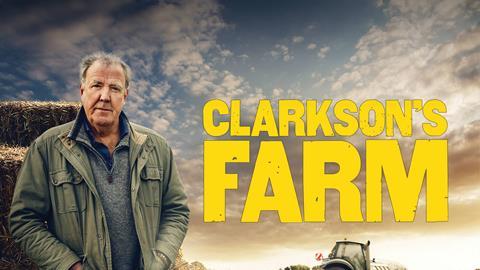

Beneath Jeremy Clarkson’s profanity and tractor mishaps lies a surprisingly moving story, says Martin Saunders. He explains why he’s among the millions who have fallen in love with life on Diddly Squat Farm
In Matthew 13, Jesus teaches: “The kingdom of heaven is like treasure hidden in a field. When a man found it, he hid it again, and then in his joy went and sold all he had and bought that field” (v44). This, in a nutshell, is the plot of Clarkson’s Farm.
In 2008, former Top Gear presenter Jeremy Clarkson bought around 1,000 acres of farmland in the Cotswolds. For the next decade, he employed a local farmer to work the land, which Clarkson renamed ‘Diddly Squat Farm’ on account of its lack of productivity. Then, when the farmer retired in 2019, Clarkson was presented with an opportunity: he could farm the land himself and turn the whole thing into a documentary TV series. Amazon Prime came on board, and Clarkson’s Farm was born. It has been so successful that a fifth series is being released this month.
Transporting his hard-headed buffoon persona from the world of high-end cars to the business of farming, Clarkson is the unapologetic star of the show. We watch him learn the processes, regulations and practicalities of farming from scratch, the name of his farm chiming with his own level of prior agricultural knowledge. It’s the classic fish-out-of-water tale, with Town Mouse Clarkson struggling to subdue the land and build an economically sustainable farming business. In general, he does so by trial and a lot of error, helped along the way by a colourful cast of countryside characters who actually do understand farming, while receiving regular doses of physical pain and on-screen humiliation in the process.
When it first appeared on our screens in 2021, having almost been derailed completely by the Covid-19 pandemic, it seemed like an oddity, a weird marriage of Countryfile and Top Gear. Would the nation (and those beyond it) really be interested in watching a notoriously Marmite broadcaster messing about in a tractor? The answer was an immediate and resounding yes. Clarkson’s Farm has become Amazon Prime’s most popular UK show, without deviating far from its simple and surprisingly heartwarming concept.
So why is it so popular, and does it have anything to teach us beyond the need for proper health and safety equipment?
A creation story
Back to that ridiculous-sounding opening claim. Granted, Clarkson’s Farm isn’t quite a verbatim retelling of Jesus’ blink-and-you’ll-miss-it parable about dropping everything to embrace the kingdom, but it certainly is a story about a man finding treasure in his fields. Whatever Clarkson expected to discover about agriculture, and himself, it seems clear that it has been far superseded by the reality.
Each series of the show has Clarkson (and his long-suffering partner, Lisa) attempting to conquer another element of farming life. To begin with, he’s trying to understand arable crops, then he moves on to lambing and pig-rearing. He’s also trying to create a sustainable, modern ‘farm-to-fork’ business by establishing a farm shop, an ill-fated restaurant and, most recently, a gastropub.
There is such beauty in a field ripe for harvest, or in observing the process of the ground producing new life
These are all interesting subplots, but what makes the show addictive is Clarkson’s continual insistence on undermining his good work through hilarious blunders. His penchant for fast cars and heavy machinery means he buys an enormous Lamborghini tractor that – while ludicrously powerful – is never really fit for purpose. He falls out with the local town council, who become his long-term nemeses; he regularly heads off on fools’ errands and repeatedly falls victim to supreme overconfidence.
Yet through all the facepalm I-can’t-believe-he-just-did-that moments, the real star of the show is the land itself. Watch Clarkson’s Farm for just a few episodes, and you suddenly start looking at the British countryside through different eyes. Those of us who drive on the UK’s highways and byways know just how easy it is to take the sweeping miles of fields that run alongside them for granted. The show reminds us that there is such beauty in a field ripe for harvest, or in observing the process of the ground producing new life; lambing – and even piglet-birthing – might be gross, but it still offers us insight into the mind-blowing miracle of creation. This is probably the best argument for watching a show which is, I have to warn you, jam-packed with profanity and blasphemy: it makes you appreciate God’s handiwork in a completely new way.
Clarkson is no Christian, but watching him continually caught up in awe and wonder at the natural world is infectious. Everything that grows and flourishes under the hapless farmer’s gaze points back to its ultimate creator.
A friendship story
While Clarkson is the unashamed centrepiece of the show, he’s surrounded by a compelling support cast, some of whom have become minor celebrities as a result. There’s ‘Cheerful’ Charlie Ireland, the land agent who advises Clarkson and frequently has to attempt to curb his bad ideas (one journalist, writing in the i Newspaper, described him as regularly delivering bad news “with the politely firm manners of a parish vicar”). Then there’s Gerald, responsible for maintaining the farm’s many miles of dry-stone walls, and who speaks with such a thick West Country accent that Clarkson’s total inability to understand him becomes one of the show’s running jokes. It’s thankfully a lot more affectionate than it sounds.
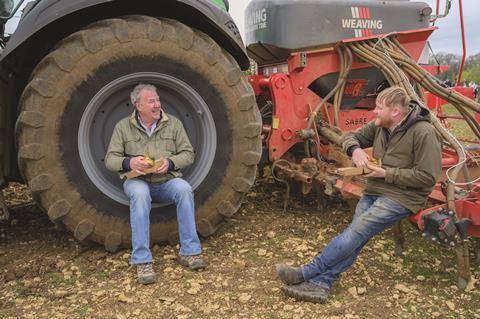
Most notable of all is Kaleb Cooper, a young farmer who Clarkson hires as his sidekick. Despite his youth, Cooper has forgotten more about farming than his employer will likely ever learn, and it’s through his tutelage that Clarkson grasps the basics and begins to work the land. Their relationship is the driving force of the show, partly because the younger man’s incredulity at Clarkson’s bumbling gives us constant permission to laugh, but mainly because it’s actually very sweet to watch their increasingly affectionate friendship grow.
Their relationship models what might be termed ‘reverse mentoring’. Clarkson is older, but his protege is an expert in the specific area that his employer desperately needs to understand. Alongside the usual bluster, Clarkson actually displays great humility as he listens to, empowers and eventually gives key leadership roles to Cooper. This is a great model for Christian leaders to follow. Before his resignation in 2024, Justin Welby, former Archbishop of Canterbury, invited Debra Nelson, a young Black woman, to reverse mentor him, recognising his own lack of experience and understanding of youth culture. Could other leaders follow this same model? Clarkson’s Farm certainly makes a compelling argument for it.
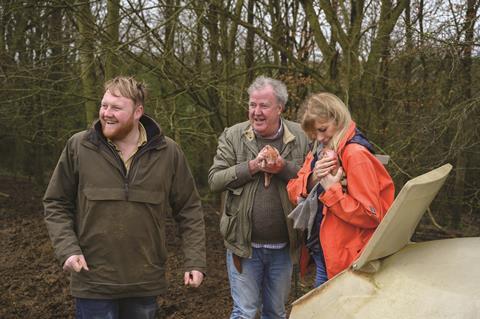
Each series of the show concludes with the same scene: Clarkson and Lisa, Kaleb, Charlie, Gerald and a couple of the other major players from recent episodes, sitting around a table together, reflecting on their shared endeavours. This is the second kind of treasure Clarkson has extracted from his field: community. Though curmudgeonly and often furious at the world, it’s clear that he has found a meaningful kind of purpose in this group of people, and that’s quite a theologically rich picture.
A redemption story
There are, of course, some elephants in the room. One is that although it presents as a documentary, the show is at least partly scripted. Not to the cringeworthy degree of, say, The Only Way is Essex or Made in Chelsea, but certainly in the way that certain characters appear at just the right moment to witness Clarkson’s latest agricultural howler. Then there’s the fact that Clarkson and his associates are making a fortune from the project, not only through Amazon pay cheques, but also the enormously successful online farm shop and the increasingly massive Hawkstone brewery.
Oh, and of course there’s the challenge of Clarkson himself, famously let go by the BBC after he assaulted a producer, and a man as widely disliked by sections of the population as he is beloved by others. If you’ve never seen an episode of the show, it can be hard to believe you could enjoy something so necessarily centred on the man.
Full disclosure: I was never a Top Gear or Grand Tour aficionado, but this show has somewhat won me over to the Clarkson phenomenon. The key reason for this is that, alongside his unsurprising attempts to increase his own fortune, Clarkson really is trying to be a force for good beyond the show. Through his farming journey, and particularly through his interactions with Charlie, he learns – and becomes increasingly indignant – about the challenges faced by British farmers. Not only that, but he becomes a lobbyist for their interests and concerns; in one slightly cringey moment, he and Cooper even get an audience with then Prime Minister Rishi Sunak. One recurring theme among online farming community groups is that Clarkson’s Farm did more for British farming in one year than Countryfile has in 30.
If the idea of Clarkson as a political lobbyist feels unsettling, there’s an even more notable transformation to report. Very early on in the show, when builder Alan scolds Clarkson for his love of gas-guzzling cars and their impact on the environment, the presenter is typically dismissive. A few years later, as he again counts the cost of weather-affected crop harvests, he’s unequivocal in his assessment that climate change is responsible. It’s an almost Pauline journey from denier to advocate, and the farm has been his Damascus Road.
This is the third and final unexpected treasure that Clarkson has unearthed: he’s found a way, and a reason, to make a difference; to make his life count for others. By drawing together a coalition of local farmers to supply his pub, he powerfully models interdependence as well as using his position and influence to help others. By stepping into an advocacy role, he has become a positive force for change among a community that has felt so forgotten that, for many, the mental health impact has become deadly. And by publicly changing his mind on the reality of climate change, he’s used his voice as a leader in a traditionally sceptical demographic to powerfully challenge others.
Everything that grows and flourishes under the hapless farmer’s gaze points back to its ultimate creator
Perhaps this is why Clarkson’s Farm resonates. Beneath the banter, the disasters and the celebrity spectacle, it is ultimately a story about repentance – not in an explicitly religious sense, but in the older sense of the word: a turning around. Clarkson begins the journey viewing farming as great content for a TV show, and the land as something to conquer. He ends up discovering that human beings are not owners of creation so much as participants within it. The weather, the animals and the economics humble him and, most unexpectedly of all, so do other people. Somewhere between the crop failures, council disputes and the heartbreaking animal tragedies, a man famous for cynicism finds himself speaking with genuine affection about stewardship, community and responsibility.
Which brings us back to the treasure in the field once again. Jesus’ parable is brief because its point is simple: when someone discovers something truly valuable, it reorders their priorities completely. Clarkson may not describe it in those terms, but Diddly Squat Farm has clearly become far more than a television project or business venture. In those fields he has uncovered wonder, friendship, purpose and a renewed sense of connection to the world around him. For all its profanity and chaos, Clarkson’s Farm asks profoundly spiritual questions about what makes a good life, the responsibility we owe to one another, and whether success is really measured by wealth at all. Strange as it sounds, that makes a deeply unlikely farming show one of the most unexpectedly hopeful programmes on television.
The fifth season of Clarkson’s Farm will be released to Amazon Prime on 3 June

























No comments yet