










There’s a rising tide of artists referencing Christian faith in their music, says Hope Bonarcher. Is the music industry undergoing some sort of revival, or are media-savvy musicians just jumping on the latest bandwagon?
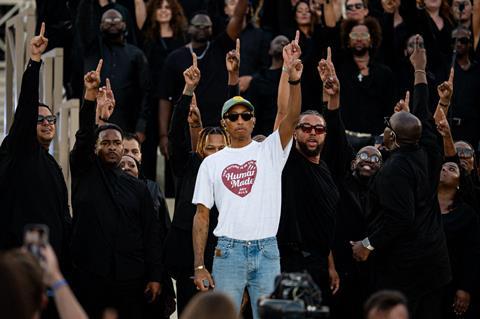
Is faith trending? Premiership footballers are praising Jesus on and off the pitch. Crossover Pop artist MIA recently dropped a Revelation-themed album and Raye is riding high, declaring and decreeing all over social media with her chart-topping track ‘Joy’. Even Pharrell Williams has released a gospel album with Voices of Fire, the choir he helped put together with his uncle, Bishop Ezekiel Williams.
For Christians, it’s always exciting to see an increasing God-tinged presence in popular culture. But what are the reasons behind it? And is it always a good thing?
A cultural shift
Some have cited the ‘Charlie Kirk effect’, a phenomena that began after the memorial of the slain evangelist was attended by more than 100,000 people and broadcast to a further 5 million. The service featured worship lead by Kari Jobe, Brandon Lake and Chris Tomlin and for many, it was the first time they had ever heard Christian worship music. The results have been steadily reverberating through culture ever since.
Christianity isn’t a soundtrack to life, quixotically mixed from one track to the next
But even before this, there has been a cultural shift. In 2019, Kanye West dropped his Jesus is King and Sunday Service albums to critical acclaim. Yet since his vocal Christian conversion, the artist now known as Ye has also courted controversy with public displays of debauchery and antisemitism (for which he later apologised). West has admitted to turning his back on God when he felt his prayers to save his marriage weren’t answered, and his story is an example of what can happen when the Christian experience runs only so deep.
Always there
When I came across a video of Williams’ new single, ‘The One’ on Instagram, I was quick to alert my friends: Did you see? Pharrell Williams made a Christian album! There’s a giddiness that can take over when believers see such a public display of God’s praise. We’re as happy for the artist as for the mass exposure to Christ’s worship; no matter the motive, we rejoice because He is being praised (Phillipians 1:18).
The album features a host of well known secular artists, including Tori Kelly and Teddy Swims. Some of its offerings, like the shoulder bouncing ‘Business’ with John Legend and ‘Miracle worker’ mix classical orchestration and trap beats to intriguing effect and warrant a closer listening.
Ophanim is said to symbolise the omnipresence of God. But the lofty reference seems plucked out of thin air
But, as I considered the 13 songs as a whole, I felt that something was missing. The album’s title, Ophanim, means ‘wheels’ in Hebrew and biblically, aside from the literal use, nods to the prophetic.
In the Book of Ezekiel, the prophet describes a divine chariot with four living creatures, each with a wheel beside them (Ezekiel 1:15), described as interlocking, full of eyes and moving in perfect synchronicity with the creatures.
Ophanim is said to symbolise the omnipresence of God. But the lofty reference seems plucked out of thin air, and since there is not much in the way of press explaining the project, the listener is left to guess at any deeper meaning.
An eternal truth
In his role as creative director for Louis Vuitton Menswear, Pharrell showcased some of Ophanim’s tracks in his 2026 runway shows. Yet, as trends change, using that platform to continue promoting the gospel has not happened, if it was ever intended.
The 2027 Spring-Summer show featured music produced by Pharrell for a Hip Hop artist I’ve never heard of and don’t care to promote here. The lyrics boasted of luxury goods, referred to women as female dogs, featured the ‘f’ bomb and encouraged the filming of derogatory sex acts for social media content, all set to a catchy beat. A gospel choir was stood to the side, enrobed in black, who knows for what purpose.
Perhaps for Pharrell, faith is trending, but biblical faith isn’t trendworthy. Christianity isn’t something to be outwardly worn while disguising one’s inner identity. True religion isn’t a £3,000 wool coat or an embellished sequin suit.
It’s not a soundtrack to life, quixotically mixed from one track to the next, changing tone as one changes their outerwear. When a believer puts on Christ, he must count the cost – the potential loss of friendships, family, mocking, persecution, even death - for the priceless sake of knowing Christ Jesus.
Our Christian faith shouldn’t change with the seasons. It should stand the test of time, anchored with deep roots that last through to eternity.





















1 Reader's comment