

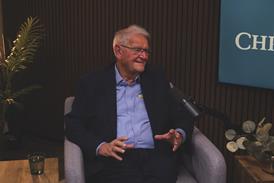








The shaking of secularism is driving young people towards Jesus, says KXC Church leader Pete Hughes. He explains why he’s convinced revival is already on the way 

When the property developer Argent erected a sign outside the wasteland behind King’s Cross station in London, the message on it was a strong rebuttal to their critics: “King’s Cross is being delivered”.

The year was 2009, and the UK was still in the grip of a global financial crisis. Argent’s £3bn project to transform this downtrodden part of London into a hub of creativity and culture was at serious risk. 

Budding church planter Pete Hughes was on a prayer walk when he saw the bullish sign. Yes! he thought: King’s Cross is being delivered, smiling at the double meaning. For him, it was a prophetic pronouncement of how Jesus wanted to transform lives, not just streets.   

When I meet Hughes, he’s full of positive stories of what God has done in the intervening years. Since planting KXC Church in 2010, it has grown from 50 to 1,000 people attending on any given Sunday. Among those are Gen Z-ers who are new to faith, many of whom have found Jesus through dramatic encounters, supernatural dreams or an unexpected desire to read the Bible. 

Hughes’ latest story of witnessing a spiritual awakening in the next generation took place just three weeks ago. A young man had been travelling the world, searching for meaning. One night he had a dream in which he shaved off all his hair. An angel appeared and uttered the word “Ezekiel”. Upon waking, he reached out to a friend, whose mother was a Christian. She recommended they read the book of Ezekiel together. He’s been visiting KXC every week since.  

If you’re wondering how your church can see similar growth, I need to give you fair warning: you might be disappointed by what follows. Far from offering strategic planning silver bullets, Hughes’ take is more grounded – and sobering.  

“I’ve been around long enough. I’m closing in on 50 and I’ve seen enough to know the best of our preaching, the best of our programmes, the best of our strategies aren’t going to bring about what we really long for,” says Hughes. I was keen to discover what he thinks will. 

How did you come to plant KXC Church? 

I remember when King’s Cross was like the armpit of London. I was watching a BBC documentary about the redevelopment programme. If you’re into architecture, I’m sure it was fascinating. I found it incredibly dull. At the end, the CEO of Argent was asked: “What will King’s Cross look like in 15 years’ time?” – ie around now – and his eyes widened. He talked about creativity and arts and a new university, theatres, bars, restaurants. He’s on a roll, and the interviewer says to him: “What about a church?” 

I’m watching, gripped, and I sensed God beginning to speak. They hadn’t planned for a church, but it was God saying: “I’m carving out space for you, to see this land not just regenerated but spiritually renewed and restored.” 

You were 30 years old at this point. What had you learned from other church leaders that enabled you to plant KXC?

I don’t think I was prepared, and that’s part of the joy of pioneering! You go in, hopefully with some faith and enough courage to take the step. But we didn’t know what we were doing. I didn’t have all the answers, and I lacked some wisdom. But I knew if we pursued the Spirit and did so wholeheartedly, God would honour that.

The story of KXC is God doing things that we weren’t planning for. We just kept saying yes and ended up on some really fun kingdom adventures.

Is there a tension between long-term, strategic planning and following the Holy Spirit’s leading?

I think there’s a place for strategy. But I have a conviction that what comes first is following the Spirit, which might not always fall in line with the best of our reasoning and logic. That’s why God sometimes uses “the foolish things…to shame the wise” and “the weak things…to shame the strong” (1 Corinthians 1:27).

The Church is more resourced than at any other point in human history, and yet, at least in the West, there’s been a dryness. And the answer isn’t just better strategy, better programmes. I think it’s quite humbling as a leader to recognise the best of what I can bring isn’t enough. We need the Spirit to move, and when the Spirit moves, we need to respond with a “Yes!” and boldly follow.

How has KXC grown over time?

Five years ago, a fairly common testimony before a baptism would be: “I went to uni, and I did things I regret, and now I’m coming back [to my childhood faith].” But now the testimonies [are from people with no church background]. It feels very different: “I had a dream”, or: “I suddenly felt this stirring to read the Bible.” 

The wave of growth we’re experiencing now is a lot of younger people with stories of encountering Jesus and giving their lives to follow Him.

35RuthTowell_RET_2910

Lots of people are talking about a ‘vibe shift’, a ‘slow awakening’ or even ‘revival’ happening in the UK today. Do you agree – and what are you calling it?

There’s a shaking of secularism and a search for a saviour. 

Numerous thought leaders – whether Jordan Peterson, Ayaan Hirsi-Ali, Tom Holland – have essentially said: “What we cherish most about our civilisation is rooted in the Judeo-Christian story, and the more we depart from that, the more of a mess we find ourselves in.” They’re articulating the need to return to cultural Christianity, to which many pastors will be saying: “No, no, no! We need a mass return to Jesus.” It’s His life, His death, His resurrection that transforms the human heart and transforms culture.

It’s quite humbling as a leader to recognise the best of what I can bring isn’t enough 

There’s also an experiential shaking, which is primarily felt by Gen Z. You begin to hear the same thing again and again: “When I was young, I was handed a script that essentially said: ‘Stop looking upwards, there’s nothing there, forget the spiritual realm, it doesn’t exist. If you want to answer the core questions of what it means to be human – identity, meaning, purpose – you have to turn inwards and construct it for yourself.’” Young people ran with that secular script. However, many years later, they are coming to churches and saying: “This script has made me sick.” You can feel the pain of it: “I used to be able to manage my anxiety, but now I can’t”, “Panic is constantly at my door, despair levels are rising and it sometimes feels like I’m drowning in those waters”, “I’m seeing suicidal ideation normalised among my peers. If these are all fruits of the secular script, I want nothing to do with it.” 

They’re searching for a better story. When they turn up at church, you can see they’re not familiar with the environment. I love watching it, because they’re looking around the room thinking: What on earth is going on? but three or four songs in, you can see they’re encountering the presence of God, and often it’ll be accompanied with tears. 

The spiritual openness feels unique, and our response is to be bold in our witness and not shrink back in a moment of opportunity. The Church needs to be courageous.

Last month, Premier Christianity ran a report on what Gen Z men want from church. The answer was that many young people aren’t looking for doughnuts or movie nights, but depth and seriousness. It suggested the seeker-sensitive style of some evangelical churches is actually putting them off. What do you make of that?

I’ve never been a fan of: “Let’s just dial things back to be as inoffensive as possible.” 

When we do the call to faith moment at KXC, I’ll often ask the questions from the baptism liturgy, which raises the bar somewhat: “Do you turn to Christ? Do you repent of your sins? Do you renounce evil?” Five years ago, I wasn’t doing that. Everyone would have said: “That’s just going to push people away.” But young people want the real thing: “Don’t water it down, just tell me: What do I need to do to enter the kingdom of God?” 

Some people are sceptical about the extent of a revival or renewal, pointing out that most stats still show widespread decline in UK church attendance. Are we in danger of getting carried away by a few positive stories?

A church needs reviving when it’s almost dead, so all the stats highlighting decline are right – but that’s the starting point for any move of God. Revivals always begin in a wilderness moment. I think we’re at the beginning of the Western Church being revived. 

I hear all the pushback, but whether it’s Alpha numbers, Bible sales, baptisms…and then you add to that so many pastors naming the same thing…I’m chatting to pastors in Denmark and Norway and New Zealand – they’re all saying: “We’re sensing a shift.” 

I’d use the language from 1 Kings 18: “I hear the sound of the heavy rain” (v41, NCB). Leaders are saying: “We’re seeing a cloud on the horizon, and maybe the beginnings of light rain.” When you experience light rain, you celebrate, but you contend for the heavy rain, because that was the prophetic promise. 

In Isaiah 43:19, God says: “See, I’m doing a new thing!…it springs up; do you not perceive it?” That’s also God saying: “If you think you are pulling levers that are engineering this thing, you’ve missed the point.” God is doing a new thing. When He moves, we should be able to perceive it through stats and surveys – but also stories.

We planted KXC in 2010, at the peak of the new atheists. If you stepped outside and tried to share faith, as we did, it’d be like: “We’ve just read The God Delusion. We hate you. We think what you’re doing is harmful. You shouldn’t exist.” That script was so strong. You walk outside our building now, and it’s like: “Yes, you can pray for me.” The openness is incredible. The landscape feels fundamentally different. So, I feel incredibly hopeful that we are at the beginning of something.

Some people say the resurgence of interest around faith is actually connected to Christian Nationalism. Do you worry about that? 

Yeah, I feel concerned. That’s why it matters what we present young people with. We’re not presenting them with a cause. We want to present Jesus to them.

I would say two things are happening simultaneously, and I get nervous when they’re lumped together. One is a very significant spiritual shift, and the other is a political shift. 

Within this surge of Christian Nationalism, I think there will be some opportunities for the gospel, and we should jump on that. But equally, we need to call people to the person of Jesus. 

39RuthTowell_RET_2194

You’re one of the leaders behind the Christian summer festival, Wildfires, which has also grown remarkably in recent years. How did that come about?

In 2017, we were sensing the need to gather people to pray for awakening. This is long before Covid, or any quiet revival conversations. 

Pete and Sammy Greig, my brother, Tim, and his wife, Rachel, and a few others asked if I would join. We’ve been doing it for eight years, and it’s grown over that time. We’ve already had to close bookings because there’s 8,000 coming this year. 

I think we’re at the beginning of the Western Church being revived

The tagline is: “Contending together for the next great awakening.” That’s what the festival is about. 

People used to promote Christian festivals with well-known speakers and worship leaders, but you’re promising people a prayer meeting and 8,000 people are turning up!

Fifteen years ago, I don’t think it would have worked. But it communicates the humility of this moment. When you’ve tried everything and you’re still experiencing drought, when your longing is for living water, but it isn’t your reality, there comes a moment, honestly, when you get on your knees in prayer.

When I read stories of the Hebridean or the Welsh revival, desperation is a really key ingredient. When you’ve got enough desperate people who are willing to gather, that’s pretty powerful.

If a revival is coming, what should we be doing in order to prepare?

I grew up with a lot of people who believed that, when you die, your soul ascends to some sort of disembodied bliss, you ride around on clouds drinking Red Bull and singing worship songs. 

But the biblical narrative is God coming down, making His dwelling place with humanity and heaven and earth are reconciled. So, when I talk about revival, it isn’t just so that our gatherings are slightly more exciting. No, we need a revival in the Church because we long to see an awakening in the culture. 

I say this as an individual living in London, and a parent trying to raise three teenagers. Culturally there’s just so much pain, fear and division. We need a move of God.  

Pete  Hughes Profile podcast

To hear the full interview listen to Premier Christian Radio at 8pm on Saturday 25 July or download The Profile podcast

Photos by Ruth Towell