









Pioneers of the seeker-sensitive movement have long argued churches must make their services more accessible to win the next generation. But as growing numbers of young men are drawn towards expressions of faith built around discipline, reverence and sacrifice, AJ Gomez asks: Is it time to switch off the smoke machines?
My generation has been handed a range of diagnoses. You may have heard Gen Z (those aged between 14 and 29) described as soft, sensitive, socially inept, isolated or anxious.
But increasingly, another label is being applied: spiritually curious. Research shows that Gen Z are far less likely to identify as atheists than their parents and grandparents. And compared to just 35% of baby boomers, 62% of 18- to 24-year-olds claim to be “very” or “fairly” spiritual.
For many young adults, the offerings of secular life are diminishing in appeal. Dating apps have reduced the pursuit of love to a swipe. Entertainment arrives in constant yet futile dopamine hits. People are connected boundlessly yet exist in what the World Health Organization has declared a “loneliness epidemic” that affects one in six people globally.
All of this unfolding against a backdrop of instability – rapidly rising levels of youth unemployment, a global pandemic and a steady churn of military conflicts – has perhaps pushed young people into searching for something more. That curiosity has taken some to destinations many Christians consider dangerous (see the rise of #WitchTok, for example). But it has also led others to the Church.
Resurgence in the pews
In the run-up to Easter, the Catholic Church across the UK and beyond reported record numbers of adults preparing for reception into the Church, with baptisms in England hitting a 15-year high. In Shrewsbury, numbers have nearly doubled over the past three years, prompting the cathedral to hold an extra service to accommodate demand. In Southwark, more than 590 adults were received – the highest number in 26 years. Of those, 50% were under 35 and 43% were men. Fr Joseph Gulliford, assistant priest at St George’s Cathedral in Southwark, says the growth in men, in a context where women have long made up the majority, is “something that stands out”.
It’s definitely easier to sell teenagers on the idea of stillness and silence than it was in the 90s
Elsewhere in London, the Catholic diocese of Westminster reported more than 800 adults entering the Church at Easter 2025 – a 60% rise on last year.
The Catholic Church in France has also seen record year-on-year increases, with 17,000 people baptised at Easter 2025. This year, numbers reached more than 21,000. Writing for this magazine, Tony Wilson spent time with a Catholic student outreach team in Toulouse. There, one of the biggest problems facing assistant priest, Fr Antoine Lavele, was the sheer number of students asking to join the Church. People even stop him in the street to request baptism, he said.
Across the Atlantic, the prominent prayer app Hallow, said Catholic dioceses in the US had seen an average increase of 38% in the number of adults entering the Church this Easter, compared to the year before. Separate figures also suggest the resurgence isn’t confined to converts: 426 young men with an average age of 33 are due to be ordained in the US this year, according to the Center for Applied Research in the Apostolate.
On God’s terms
Such reports may come as a surprise to those who assume more traditional denominations may struggle to reach younger people because of their formality. For many evangelicals particularly, the dominant model of recent decades has been to appeal to young people through worship resembling rock concerts and social environments structured around games, films and food.
This approach was summed up by Elim leader Tim Alford who reflected in this magazine that “culturally relevant” became “the evangelistic buzz-phrase for many ministries in the 90s and noughties”. Now, he’s worried evangelicals like him may have committed a “grave missional error,” he says.
“This is a generation that is seeking the spiritual, not afraid of it. So, when we hide, dilute or dumb down our spirituality in an attempt to reach them, we are achieving the very opposite.”
I want to get to know God and follow Him on His terms. People flip it and make it seem like you get to dictate the terms in this relationship
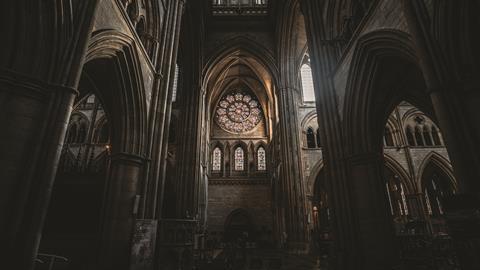
Could it be that many young men are now being drawn to forms of Christianity that have deliberately resisted the impulses of the seeker-sensitive movement? The Catholic Church, alongside Eastern Orthodoxy, has hardly reinvented itself for contemporary tastes. Its liturgies remain formal, its doctrines fixed, its practices demanding.
But for some, like Amar and Cashley, the lack of accommodation was not a barrier but the beginning of an answer. I met the 22-year-old friends at an event for young Catholics at St George’s Cathedral in Lambeth.
Cashley was baptised and brought up in a culturally Catholic Filipino family shaped more by customs than convictions. When he was eleven, however, his aunt (who also lived with them) became a born-again, non-denominational Christian. “I remember the day she took down all the iconography in my household, saying, ‘It’s idolatry, it’s pagan’.” Soon, his entire family followed suit and began attending Hillsong church.
By 16, he had begun to deconstruct his faith, immersing himself in philosophy and competing belief systems, trying to determine what could withstand scrutiny. Christianity still seemed the most plausible but he didn’t want to hold on to it out of cultural inheritance.
Amar was born into a Jamaican Pentecostal family and moved to west London when he was five years old. By adolescence, his confrontations with evil in the world left him asking: “OK, I see where Satan is. Where is God?”
Growing up in an area with a visible Islamic presence, he found himself comparing the two faiths seriously. Initially, he says: “I wanted Islam to win that internal debate I had.” To him, it possessed a coherence he struggled to find in church.
Amar’s objections to Christianity pushed Cashley deeper into study, which ultimately led him to the conviction that Christianity was true; Cashley’s insistence on defending the faith forced Amar to test whether his criticisms actually held. They describe eight-hour phone calls, comparing Islam and Christianity. Through that process, Amar conceded: “I was judging Christianity badly because of the people, not the actual doctrine.”
Cashley returned to church and Amar joined him, moving between Hillsong and other evangelical spaces with renewed fervour. “I wanted to get as involved as I possibly could,” he says. But the deeper he embedded himself, the more dissonance he encountered. In Bible studies and group discussions, Cashley encountered disagreement everywhere, which he came to see as rooted in a Church culture that treated theology as secondary to interpretive individualism.
“Everyone would disagree, and I was under the assumption that’s completely fine because the theology doesn’t matter, it’s about your relationship [with God], right? But then I started to realise: This doesn’t seem like how God would leave things. He wouldn’t leave His Church to be in error.”
Watching his friend’s struggle, Amar found himself pulled into the same reckoning. “Can Christ’s body disagree with itself?” he asked. “And when the body does disagree with itself, what do we call that in the modern day? Cancer.” If Christianity was objectively true, they reasoned, it could not also be negotiable. A Church established by God would not continually reshape itself according to cultural or individual interpretation.
“That’s not what Christianity is. Christ is anti-seeker, the Church is anti-seeker. We don’t…”
“…conform to the patterns of the world, Romans 12,” Cashley interjects.
“We conform to what God says,” Amar finishes.
The form of Christianity they were looking for would precede them, rather than reflect them; demand something of them, rather than accommodate them. “I want to get to know God and follow Him on His terms,” said Cashley. “I make an emphasis on His terms. People flip it and make it seem like you get to dictate the terms in this relationship.”
Thus, the Catholic Church’s claims to unity, continuity and authority began to present themselves as the solution to the problem they had encountered. And what they had begun to admire theologically, they would soon encounter liturgically.
Stillness and sacrifice
Amar and Cashley’s first experiences of Mass were not immediately comfortable. Amar remembers feeling like “a spectator”, as congregants stood, knelt and recited prayers, synchronised to a rhythm of worship he was a stranger to. “I felt like I wasn’t connected,” he said. “I was watching from a window; I wasn’t actually in it.” But still, he returned. “It gave me a sense of fortitude, just continuing to go to Mass and seeing past what I feel.”
Both men repeatedly return to this idea as central to their understanding of masculinity: the willingness and ability to bear discomfort. In the ancient liturgical traditions they came to admire, they say they found a form of Christian worship that cultivates resilience. “If you’re a young man who desires to be a father, one day you’ll watch your son struggle through push-ups, but you’ll be happy knowing he is trying to become better. That is the same perspective God has with us,” says Amar.
In a culture where young men routinely look to athletes for models of discipline, mental fortitude and excellence, Catholicism directs this instinct towards holiness instead
When Cashley first began attending traditional Latin Mass, he did not have a missal, the official liturgical book used in the Catholic Church, and could not follow every word. One phrase he encountered on Instagram stayed with him: the Latin Mass “puts you in your place”.
“At first, it was completely alien to me. But I would just sit there in awe,” he said, recalling veiled women and a congregation absorbed in silence. “That stillness, that contemplation of the presence of God, that’s where God finds us.”
Both men drew the contrast with the charismatic spaces they had known, which Cashley described as “dopamine induced” and defined by a “lack of stillness”.
This echoes a wider theory about why young men seem particularly drawn towards orthodox expressions of Christian faith. Jack Regan, director of youth services for the Catholic diocese of Lancaster, tells me that among the young men drawn to his church, there is a discernible appetite for practices built around silence, contemplation and sustained attention. “We’re seeing more men interested, and they’re more serious about their faith, more literate in their faith,” he said.
Citing disciplines such as adoration and lectio divina, a monastic practice of scripture reading, he says: “I’ve been in youth ministry for 25 years. It’s definitely easier now to sell teenagers on the idea of stillness and silence than it was when I was dealing with millennials and Gen X back in the 90s. There is that hunger there.”
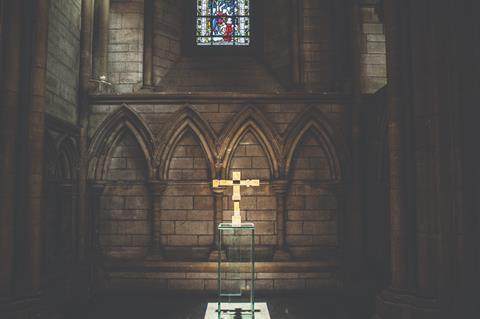
Regan reads this as a search for calm in a world of constant motion. Citing the motto of “hardcore contemplative religious” group, the Carthusians, Stat crux dum volvitur orbis – “the cross stands still while the world turns” – he said: “I think a lot of people want that. The cross is peaceful, it’s strong, it’s an anchor point in a world that’s very topsy-turvy.”
Stillness, then, is part of the appeal. But it is not the only way these older traditions are appeasing a spiritual hunger in young men. Alongside silence and contemplation, several of those I spoke to pointed to something more relational: the presence of fathers, mentors and figures to imitate.
The need for a father
Archbishop Angaelos, Coptic Orthodox Archbishop of London, says his own tradition has seen an increase in young adults, including men “predominantly between the ages of 25 and 35”, some arriving with “an incredible amount of knowledge” acquired through their own reading.
But for Archbishop Angaelos, the attraction is not merely intellectual. There is, in his view, a shortage of “real role models” and mentors for young men. According to the Office for National Statistics, around 2.5 million children in the UK are growing up without a father figure – that’s more than a million boys.
Many young men are being drawn to forms of Christianity that have deliberately resisted the impulses of the seeker- sensitive movement
His church tradition offers an answer to this through a model of spiritual fatherhood that is both intimate and demanding. “Within the Coptic Orthodox Church, everyone will have a father of confession, to whom he or she would confess,” he said. Alongside this, they also receive spiritual counsel. “We call [it] the spiritual canon, which means: ‘I want you to do this much fasting and this much prayer and do this much reading and focus on this, because this is a weakness.’ It’s very tailored to the individual.”
Archbishop Angaelos likens such guidance to having a “spiritual personal trainer”, someone “who works with you to…make you the person you really want to be.”
For 26-year-old James Gallagher, programme leader in the Catholic diocese of Lancaster’s youth service, that hunger for role models is also met in Catholicism’s reverence for the martyrs. “As a young man, it’s the most empowering thing – whether it’s Star Wars, whether it’s Harry Potter, you’re raised up on this [idea that] the hero dies for their friends.
“I say to the kids [in my youth group]: ‘Your favourite shows are based on Christ.’ It’s the one who died for the many. It’s the one who gave his life.”
Twenty-five-year-old Rodolfo describes a similar attraction to the Church’s saints. In a culture where young men routinely look to athletes for models of discipline, mental fortitude and excellence, Catholicism directs this instinct towards holiness instead. “Whether it’s athletes they look up to because of a certain mentality or the skill they have, men try to find a role model,” he said. “And if that’s true for sports, it’s also true for faith.
“We’re all trying to become saints,” he added. “Saints have achieved what we are hoping to achieve.” For Rodolfo, a saint may have overcome a struggle that mirrors his own or lived a vocation that feels familiar. “There’s something that relates to me,” he says, “and yet it was still possible for this person to become holy.”
Come as you are
There is no single explanation as to why young men are being drawn towards more structured, liturgical and disciplined expressions of Christianity. But the voices here may raise uncomfortable questions for churches that have spent decades trying to make faith more accessible and attractive. If Gen Z are searching for something greater than themselves, will they find it in a church that presents God (and relationship with Him) within the limits of what feels comfortable, familiar and immediately appealing?
It is important to acknowledge that the young men in this feature only represent one perspective. Among the fastest growing churches in the UK are Pentecostal denominations such as Elim and Redeemed Church of God (RCCG). Evangelical Alliance’s Changing Church report found that churches in its network also reported an average increase in attendance of 13% since January 2020.
However, while many young men (and women) enjoy the exuberant concert-like worship of evangelical churches, in Amar’s blunt phrasing, there are others who aren’t “down to jump around with smoke and LEDs going through their retinas”.
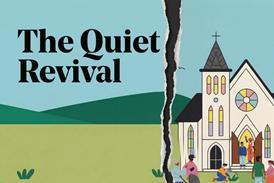
It may also be too early to draw hard conclusions from the numbers alone. Much of the recent conversation began with Bible Society’s Quiet Revival report, which has since been withdrawn after the survey data was revealed to have included fraudulent responses. That does not negate anecdotal reports of growth, but it does caution against building too much on statistics that are relatively fresh.
What we can be sure of is that some young men may be drawn to the warmth, informality and immediacy of evangelicalism. But others to silence, liturgy, structure and discipline. And mistakes may be made when seeker-sensitive models of church prioritise the former too heavily or fail to acknowledge the importance of the latter.
“Come as you are” has long been one of Christianity’s most familiar invitations. The young men I spoke to are asking that some evangelical churches take their own advice.

























No comments yet