












Immigration has become one of the defining political issues of our time. But how should followers of Jesus think about border control and biblical hospitality? Dr Krish Kandiah OBE and Rev Dr Nigel Scotland share their differing perspectives
‘The call to compassionate hospitality is not optional for Christians’

The immigration debate in the UK today is complex, emotive and often divisive, yet we cannot shy away from it. It matters enormously how Christians engage with it.
The way we treat one another is probably the most important way we live out our faith. In this we follow the example of Jesus, who took a controversial approach to welcome by helping and sharing hospitality with those others viewed as outsiders or deemed undeserving. His choice angered those who had political and religious power. But, while being extraordinarily kind to people that polite society had written off, He was also extraordinarily direct with those who opposed His welcome and should have known better. Each time Jesus was criticised by the Pharisees for eating with the wrong people, He challenged them for not doing more to help those society had demonised.
This is what it means to love your neighbour, a command Jesus places alongside loving God with all our heart, soul and mind, when He summarises more than 600 laws. He spells it out most clearly in the parable of the sheep and the goats in Matthew 25. When the king separates the righteous from the unrighteous, the criterion is not doctrine, ethnicity or cultural alignment. It is this: “I was hungry and you gave me food, I was thirsty and you gave me drink, I was a stranger and you welcomed me” (v35, ESV). Somehow, it is in meeting the basic needs of strangers that we reflect our genuine love for God and relationship with Jesus – or otherwise.
This should give every Christian pause. Whatever political views we hold, whatever conclusions we reach about specific policies, the call to compassionate hospitality is not optional. It is not a peripheral concern for justice-wired Christians with a particular personality type. Jesus says it is a mark of all those who belong to His kingdom.
Being compassionate and hospitable to strangers does not, however, negate the need for controlled borders. Those who frame the immigration debate as a simple choice between open borders and closed borders are being either reductionist or deliberately obfuscating. Completely open borders, like completely sealed borders, are neither achievable nor desirable. Imagine a front door was always open or always closed. Either way it ceases to be a door. It becomes a wall, or a hole.
I open my front door when I welcome in family members, guests, foster children and others in need. I close (and lock) my door at night – not because I feel hostility to the outside world, but because I have a duty of care to all those living under my roof. Knowing who is in the house and keeping them safe is part of what it means to be a good father, husband and host.
When you form your view on immigration, do you start with Jesus or the world?
Occasionally I get a call in the middle of the night from social services, asking us if we have space for a child who has been found neglected or abused and, if I possibly can, I welcome that child in. I believe compassion should be a priority, however inconvenient, uncomfortable and unpredictable. When I can’t help – because my bedrooms are already full, or I don’t have the resources – the social worker has to look elsewhere. Taking more children than I have capacity for would not be an act of generosity. It would be an act of chaos that undermines the care I am already giving to others.
Compassion and control are not opposites. They are partners. If our borders have control without compassion, they become a cold and heartless weapon. If they have compassion without control, they undermine the sanctuary and security they are responsible for. This is why controlled, compassionate, community-based immigration provides an excellent way forward.
When I was in Egypt as the first wave of Sudanese refugees fled across the border, I met a young man who had lost everything. He had only one anchor left to hold onto in life – his father, who was in England. He could not board a plane or ferry to the UK, because he had no visa and no way to get one. His only option was an illegal crossing in a small boat. That choice was not a failure of his character, but a failure of our system. If there had been a visa application or community sponsorship programme open to him, he would have chosen that route.
There is something going on in the discourse of some countries that I can only describe as a commandeering of Christian values to protect political power. It is uncomfortable to witness some politicians invoking the Christian faith as justification for a hardline polemical position against immigrants. Some argue that they are protecting our Judeo-Christian heritage from the mass migration of people from the Middle East. They appear to be unaware of the irony that Judaism and Christianity originated in exactly that part of the world.
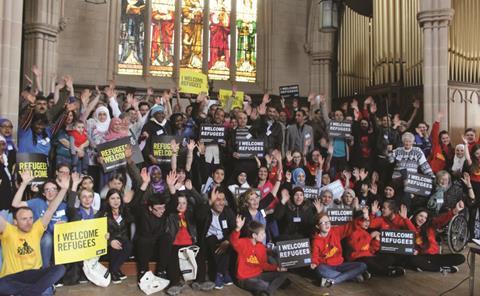
Others argue that by loving our international neighbours, we are somehow failing our local ones. This local calling is indeed vital; I am proud that the Church at its best is the most effective institution on the planet for serving the poor, the lonely and the hungry in its own community. Many Christians have been inspired by the Church to foster local children, work with local authorities and support local charities advocating for the homeless, poverty alleviation, job creation, debt counselling, mental health support and much more.
But we cannot restrict our empathy purely to our local calling. In the Great Commission (Matthew 28:18-20), Jesus did not tell His disciples to stay in Jerusalem and protect it from the pagan nations gathering at the gates. He didn’t say they could only leave Israel when the needs of everyone there had been met. Despite the poverty and the oppression many were suffering under, Jesus said: “Go and make disciples of all nations.”
The early Church crossed every border it encountered and welcomed people from all nations, because it understood that the gospel was for everyone. A missiology that suggests we pull up the drawbridge in the name of protecting the faith is not one I see in the Bible.
The questions I want to ask are these: when we form our views on immigration, are we starting with Jesus and working outward? Or are we being pressed into the mould of the world and looking for Bible verses to justify where we have already landed?
We live in a polarised, fearful, blame-driven world and it is no surprise that this seeps into the life of the Church. However, our gospel is supposed to help us resist this divisiveness and live out such lives of love that others are drawn to encounter God for themselves. This sort of love is not sentimental or naive but costly, courageous and countercultural. It draws us not just towards those we know and like, but towards the outsider and stranger – and, I believe, towards God Himself.
‘We have reached the point where enough is enough’

There is much in Krish Kandiah’s article that I agree with. He’s correct that Jesus welcomed all who came to Him, gladly eating with tax collectors and sinners – although it should be noted that He did not endorse every belief or behaviour; He also challenged and confronted people. It is also true that meeting the needs of strangers enables Christians to reflect God’s love. I agree that the call to compassionate hospitality is not optional, and I am grateful for his acknowledgement that “being compassionate and hospitable to strangers does not…negate the need for border control”.
To all this I would simply add that the UK immigration situation is out of hand and needs serious, urgent curtailment.
During His earthly ministry, Jesus dealt with people at the micro level – often talking to individuals or teaching small groups, such as the disciples. In such contexts, it was relatively easy for people to give welcome and share hospitality. However, when we look at the present immigration crisis in our country, Jesus’ teaching is considerably harder to apply. There have to be limits on how much an individual or a nation can sustain. It’s interesting that Jesus didn’t heal everyone, feed everyone, house everyone or give money to everyone. Even the Son of God placed limits on what He would do, for example stating that He “was sent only to the lost sheep of Israel” (Matthew 15:24).
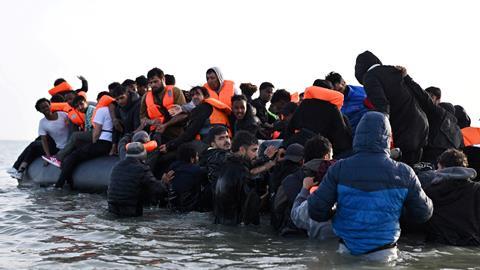
According to the Home Office, 36,816 migrants crossed the English Channel in small boats to arrive in Britain in 2024. In 2025, this rose to 41,472, the second-highest total since record-keeping began in 2018. We simply do not have the infrastructure or financial resources to meet the needs of every person landing on our shores.

The big problem that our country is currently facing is that there is no respect or protection for boundaries in France or in the UK. The French do little to stop illegal Channel crossings and Britain has proved unable to deter the small boats either. It should be said that Jesus emphasised, and was respectful of, the regulations set by the first-century Roman Empire and submitted to their laws. He acknowledged and adhered to provincial and territorial boundaries such as Samaria, Decapolis, Gadara and Gerasa. Strictly speaking, travellers in the EU are required to cross national boundaries only at established crossing points. Such places urgently need to be established – or re-established – in France, through which all immigrants must be processed. Those who cross in other ways must be taken back to these points, which should cause no problem because France is a safe country that has given them refuge.
Even the Son of God placed limits on what He would do
Jesus summarised His teaching as “Love the Lord your God with all your heart and with all your soul and with all your mind” and “Love your neighbour as yourself” (Matthew 22:37-39). There is a principle here that we should love ourselves first, in order to be able to love and care for others. The New Testament is also clear that “anyone who does not provide for their relatives, and especially for their own household, has denied the faith and is worse than an unbeliever” (1 Timothy 5:8). We provide for our own needs so that we can then care for others. The present immigration crisis has resulted in housing large numbers of asylum seekers in hotel or bed and breakfast accommodation, providing them with food and money. The total cost of this in 2024-25 was £4.76bn. In addition, the UK spent more than £15.8m on transport for asylum seekers, including journeys to a GP. As I write this, my wife has been offered an “urgent hospital appointment” – in 2027! The sums of money being spent on providing for immigrants are excessive. I would rather see budgets increased for other services such as our national health service.
All of this also comes at a time when Shelter estimates that the number of homeless people in the UK stands at more than 380,000. Many in Britain are now fearful of large groups of migrants being billeted near local schools and in rural areas where there is little security or police presence.
Under an agreement announced in April 2026, the UK will provide France with £500m upfront and a further £160m over the next three years (tied to results) to allegedly regain control of the French beaches. If the French and UK governments are both morally satisfied that preventing migrants leaving France, a safe country, is achievable and possible, it would make sense to immediately return those who make illegal Channel crossings. Once gang leaders and other profiteering agents see a regular flow of returnees, the number of small boat crossings would doubtless soon decrease. The diminution of migrants would provide more time to assess those who are genuinely fleeing war or in fear for their lives.
Meeting the needs of strangers enables Christians to reflect God’s love
In the long term, our aim should be to bring recovery and prosperity to the nations from which refugees are coming. Right now, we risk draining struggling nations of skilled and able people.
We absolutely need to be a compassionate nation, but when this is carried beyond obvious, reasonable limits, it leads to compassion fatigue, huge tax bills and unrest on all sides. Surely, we have already reached the point when enough is enough? The Bible tells us that “God is not a God of disorder but of peace” (1 Corinthians 14:33). He deals in ways that are just and straight.
Augustine’s view was that “a lesser evil” (in this instance preventing mass immigration) can be justified if it protects against a greater evil (in this case growing unrest in this nation). There is good reason to return undocumented migrants who are not in fear of their lives to the safety of France, or their own countries. It is the only sane, sensible and just way to deal with a major crisis.




















4 Readers' comments