


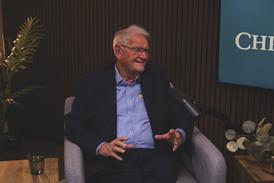


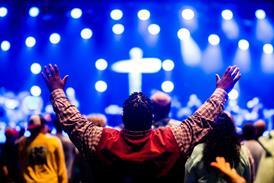





During a talk at Wildfires festival, the leader of 24-7 Prayer called Christians to pray for peace - but also for the UK Prime Minister to spend more on defence. Alan Storkey explains why he believes the two are not compatible
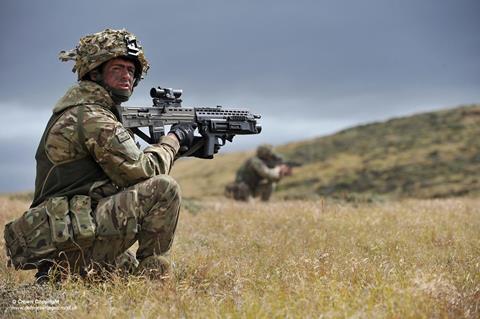
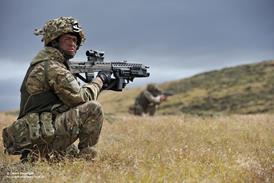
There has been a lot of discussion recently surrounding Pete Greig’s prophetic warning to “prepare for war”, delivered at this year’s Wildfires festival. Particularly controversial was his call for Christians to intercede “that defence would become a priority for Andy Burnham.”
Quoting an unnamed senior military official, Greig said: “What people don’t understand is this: if you’re not spending five percent of your GDP on defence, you do not have sufficient military hardware for those people to take your views seriously. If you’re just saying, ‘Hey, please be nice,’ they will totally ignore you unless you actually have the military hardware to stand up to evil.”
Accepting this might be “a little controversial”, Greig acknowledged that “you don’t normally hear things quite as political as that” at a Christian festival. While it came as part of a wider talk that also encouraged Christians to first pray for peace (the full talk - entitled ‘Prepare for war’ is available online), for many Christians, it was contentious to specifically mention increasing defence spending.
In response, Danielle Strickland, who also spoke at Wildfires, pointed out that preparing for war by increasing military expenditure hardly sounds like Jesus. Writing on Substack she said, “From a young age, I understood that the weapons of our warfare were NOT the weapons of this world.”
I agree with her. It was the Romans who said: “If you want peace, prepare for war” - and their way of peace included crucifixion. Perhaps Greig’s solution is, in fact, the problem.
Arming for battle
In the decade before the first world war, everybody prepared for war - and it came. As Sir Edward Grey, who was Foreign Secretary from 1905-1916 said: “The moral is obvious; it is that great armaments lead inevitably to war. If there are armaments on one side, there must be armaments on other sides.” From 1932-39 there was a massive expansion in arms everywhere and war followed. Arming generates distrust, threats and the preparation for wars which then come.
If it’s wrong to “prepare for war” by arming ourselves, then what should we do instead?
First, we listen to the astonishing occasion when Jesus insisted on preparing others for war. It occurred as he was staggering, lacerated and carrying a cross, through the streets of Jerusalem to Golgotha. Most of us would have been self-obsessed, yet Jesus stops and looks at the women weeping for him and says: “Do not weep for me; weep for yourselves and your children” (Luke 23:28) before warning them of conflict to come.
When Jerusalem fell to the Romans in AD70, Josephus reported that the streets in Jerusalem ran so thick with blood that it put out fires. It is estimated that perhaps a million people died, many corralled in the Temple. But many others did not die, perhaps including these women, because Jesus warned them of what was coming.
He quoted Hosea 10, pointing to how evil grows. “For if people do these things [the crucifixion] when the tree is green, what will they do when it is dry?” As Hosea puts it: “They sow the wind and reap the whirlwind” (v7).
If you sow weapons, you reap conflict. If you train for war, you will probably get it. Jesus confirms this logic in the biggest ever summary of human military history: “Those who take the sword will perish by the sword” (Matthew 26:52).
Weapons are made to kill. Countries that are heavily armed, like the US, are almost constantly at war. By contrast, if you want to prevent war, you disarm tensions. Beating swords into ploughshares (Isaiah 2:4) and learning war no more is not a vague hope, but a real, biblical policy.
Blessed are the peacemakers
In the Sermon on the Mount (Matthew 5), Jesus proclaims that God blesses the merciful (v7) and the peacemakers (v9). He pushes back from murder to say that even anger and disrespect are wrong (v22-26). He rules out retaliation and insists on loving our enemies (v38-47). This travels in the opposite direction from the foreign and military policy of most modern superpowers. Jesus sets out a different path to peace, and we should seek it again before it is too late.
If you sow weapons, you reap conflict. If you train for war, you will probably get it
Since 1945, we have listened to governments rather than Jesus. At the end of the second world war, the massive US weapons industry, expanded by war and centred on the new Pentagon (then the world’s biggest building) was on the point of collapsing with peace.
In response, America made the USSR into a necessary enemy, arming “against godless communism” to support its vast weapons machine. The Cold War drenched the world in weapons, and a steady stream of wars has followed ever since. Sold through bribery, to empower militias, to pay for oil, and to support US or USSR dominance; weapons have started wars on every continent and kept dozens of dictators in place.
Militaries and arms companies promote weapons, enemies and wars through fear, because that is their business. They need wars and rumours of wars to make money. Each year, before the Budget, the head of MI5 is dragged out to scare us. Europe has a military budget at least three times bigger than Russia’s, but we must still be frightened by them.
This propaganda is designed only to make money and, remarkably, we all fall for it. Perhaps Pete Greig, too, has listened to them, talking up the need to rearm. By contrast, Danielle Strickland sees the Christian battle, rightly, as a war against militarism, as swords into ploughshares and the healing of the nations.
We should reflect that NATO built a massive arms system to ‘deter’ Putin and that led to his invasion of Ukraine and the current war there. The cost of war is vast. The world’s superpowers are stuck in a highly destructive cycle. Military might is a false god that will fail. By contrast, we follow the Prince of Peace, the Lamb on the throne, and He has asked us to make and share peace.
Christians should quit playing the superpowers’ tune and put Christian peace on the table.























No comments yet