







What does justice have to do with beauty? Everything, says the lawyer and the artist who are harnessing their collective power to tackle poverty and prostitution in some of the poorest parts of the world
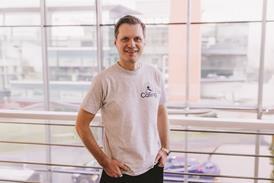
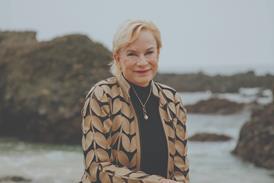
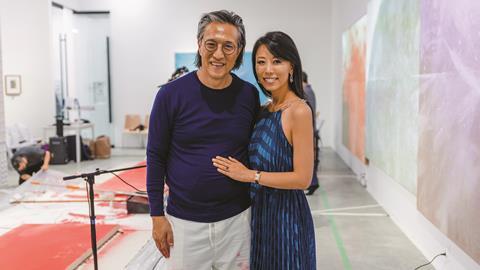
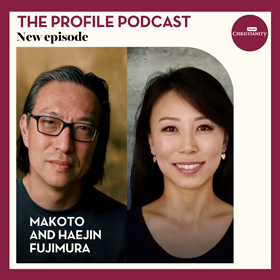
Haejin and Makoto Fujimura make a formidable couple.
One is a New York City lawyer and charity founder. The other, a prominent artist whose work can be found in galleries and museums around the world. Both are exceptional in their fields. But while you might assume that their spheres of interest and influence remain distinctly separate from one another, this could not be further from the truth. And that is exactly where their real power lies.
According to biblehub.com, power can be understood in the Christian context as “the God-given ability, strength, or authority to act, create and influence the physical and spiritual worlds”. In the truest and most winsome sense of the word, far away from power abuses, power grabs and power lunches, that is exactly what the Fujimuras have in spades.
In 1992, aged 32, Makoto Fujimura became the youngest-ever artist to have his work acquired by the Tokyo Museum of Contemporary Art. Born in Boston, USA to Japanese parents, he lived in Sweden and Japan before returning to the States in his teens. He found Jesus through art: “Even though I did not grow up in a Christian home, I had always thought that when I painted, something flowed through me that wasn’t mine. It was a gift from somewhere; I just couldn’t name it.” Finally, when studying William Blake’s poetry at university, he was “able to connect the dots”. He thought: “I know the name that called me to be an artist.”
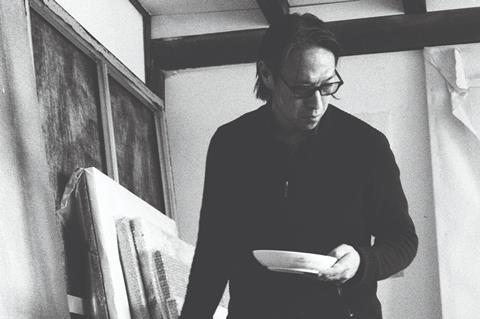
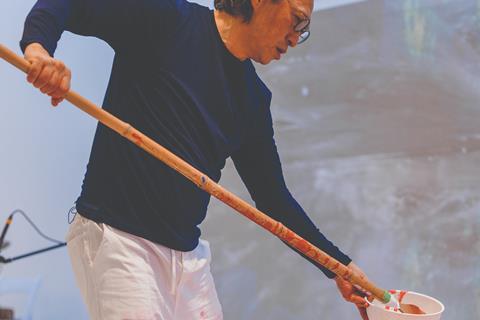
The Christian idea of being transformed by God “from glory to glory” (2 Corinthians 3:18, NKJV) is one that resonates with Makoto. A 9/11 survivor, he argues that art is about creating something beautiful from the mess of life. He calls it a “theology of making”. Yet speaking about beauty, even within the world of art, was not always easy. For Haejin, a high-powered lawyer, it was arguably even harder.
Born in South Korea, Haejin grew up in a Christian home. But it wasn’t until her early 20s, feeling lost and alone in New York City, that she accepted her life had intrinsic meaning and worth because of Jesus. From there, it “made sense”, she says, to turn her attention to the injustice that robbed others of that same dignity and hope.
Ultimately, the work of justice is the restoration of beauty
“Beauty is a manifestation of justice, and justice is a reflection of beauty,” Haejin says, as she explains their work together through Embers International, a charity that brings artists and advocates together to offer people trapped in poverty and prostitution a glimpse of what God’s purpose for their lives can look like.
Working to bring God’s kingdom to earth in the darkest of places takes grit, gratitude and a willingness to use what is in your hands, they tell me. And it’s exactly what they are doing together. It’s an approach that is guaranteed to change everyone involved.
As a lawyer and an artist, people might assume you inhabit very different worlds. Yet you’ve written a book together called Beauty and Justice (Baker). Why is that?
Haejin: Our missional calling is deeply rooted in Isaiah 61. We began to understand that beauty and justice are two sides of the same coin – God’s gospel work towards shalom. In essence, they are both rooted in the creativity – or imagination – of God. Without imagination, you cannot create. You look at the blank canvas or page and then you start writing or painting. Unless we can imagine a future of restoration and renewal, we cannot do the work of justice.
Beauty is a manifestation of justice, and justice is a reflection of beauty. When I look at a place, situation or relationship that has been damaged and requires justice, I am not only looking at it as a problem to solve – although it is, and we will solve it – it is actually a beauty to behold, a beauty that has been fractured. Ultimately, the work of justice is the restoration of beauty.
Makoto: I began my career in New York City in the mid-90s. The first presentation I did as an artist, I was trying to describe beauty – because beauty was so contested in the 90s. People were very suspicious of that word. It was seen as sentimental, imperialistic, subjective – forcing other people to embrace something that you think is beautiful.
Isaiah 61 tells us that there is a beauty which transcends our understanding of what it can mean to a society obsessed with cosmetic and superficial beauty. Beauty has a way of entering the very heart of darkness and brokenness, and it is one way that God imagines the world. This is not fantasy or sentiment. As human beings, the imagination of God, flowing into our fallenness, can redeem all that is broken. God is inviting us to co-create this new reality and, in some strange way, God waits until we act to bring that reality into being.
I didn’t know it, but there was a famous art critic in the room that day called Robert Kushner. He called me and said: “I was really startled when you quoted Isaiah 61, because I’m a Jewish Buddhist. I admire the fact that you were courageous enough to talk about beauty in that way.” He wrote an amazing review, and that’s how my career got started. So, Isaiah 61 has been my go-to scripture, and when I met Haejin, I found out that it was hers as well!
When you look at that passage, we see that God is not just a source of beauty, God is beauty. That reality encompasses everything that is fallen and broken. Through Jesus, God is restoring that to Himself and calling us to be a place where He can come home to. That reality is what I’m creating when I paint and when Haejin does her litigation work.
Has it become easier to talk about beauty and justice – and the Christian roots of those ideas – than it was 20 years ago at the height of New Atheism?
MF: I don’t think it’s any easier. The idols have just shifted. Now, beauty is back, but creativity and imagination are out. If you’re an artist today, you have to push back against the dehumanising forces of AI, power and art as an elite reality. The way to break that down is to go to the slums, the marginalised communities, to prisons and experience something authentic and real. Artists are always trying to grasp what is truthful about our world, and often we’re the ones who are courageous enough to articulate what is really happening.
In recent times, that has been co-opted by power struggles; the elitism of the art world has become this mechanism of consumption, especially with social media. And that means everything that is truthful, prophetic and healing about the arts has been submerged, or taken over by the metrics and algorithms. So, we have to change how we view ourselves and why we do what we do.
As people lay dying during the Black Plague, Fra Angelico painted and Shakespeare wrote. They did not stop when the world was corrupt, dangerous and sick. They pressed into beauty. I feel like that’s our call as artists today.

Makoto, you survived the 9/11 terrorist attack. Did that affect the way you approached your art, when you’ve experienced the worst of what humanity is capable of?
MF: Absolutely. I was trapped in the subway. I didn’t know what was going on. We lived three blocks away, and my children became Ground Zero children for the next ten years. But I am filled with gratitude because of the people they became: resilient, creative, community-minded. I see that moment as seminal for me: going to my studio, which is ten blocks north, and then coming back to Ground Zero every day. It became a form of liturgy for me – a liturgy of hope, because it forced me to ask: What is hope? Can I be grateful, even at this moment?
We’re not just fixing the problem but creating something even more beautiful and valuable than before
Everybody has their own Ground Zero. But Jesus is the God of Ground Zero. It can be a detonation point, but it’s also a Genesis moment. We can see the future differently because of the tragedy, the sacrifice and the suffering. We carry the weight of that. It’s taken me 20 years to call myself a survivor, because I never thought of myself as a survivor. Yes, I survived, but what did I do? It took somebody from Columbine High School [the site of a mass shooting in 1999 which was the deadliest in US history at the time] to remind me that I would find healing and restoration only when I understood the weight of that, not just for myself, but for my family and friends, too.
This is the reality we get to share. Hopefully it will help people in moments of desperation, facing their own Ground Zero, to know that they can find a way through to beauty and justice again. But it can only happen if we are fully cognisant of the weight of the realities we face – and the enormous grace that God pours into us so that we are recreated, in that sense, as God’s home.
Tell us about the work that you do together.
HF: I co-founded and serve as a CEO of Embers International, an anti-trafficking organisation that works in South Asia, in the red-light districts and slums.
An ember is a little flickering, dying seed of fire hidden under the ashes. That’s where we got the name, because we, as the co-founders, see ourselves as once-dying embers. Only when the life of Christ was breathed into us, through the Holy Spirit, did we revive. Now our call is to go into the darkest corners of the world and look for those hidden embers and share the breath of life with them.
When Embers was founded, God brought us to an abandoned former brothel next to a landfill, a snake temple and rows of active brothels. God asked us: “Can you see beauty behind the ashes? Can you see something that I could create behind this decay?” That was an incredibly powerful moment of God invoking our imagination.
We built a children’s centre that is beautiful in this place of decay because we knew that if we brought children into a place that looked like a brothel, their imagination was not going to be sparked. We have created a family restoration model that looks beyond the current survivors to the next generations.
We are helping the mums and their children – many of whom were born in brothels because their mum was trafficked as a young person and never rescued. We created a centre in this community to show these families that we’re here to stay. We’re not just providing short-term relief, we are going to do life with you, help you become independent, get you plugged into a healthy community where you can start a new life. Vocational training, education and counselling are part of that process. We’re not just there to give life, but to share the abundance God has given to us. Thank God that Jesus didn’t just save me when I was lost and aimless. He gave me so much of His extravagant love that I can think beyond myself and love my neighbours. That requires abundance.
Everybody has their own Ground Zero. But Jesus is the God of Ground Zero
Jesus talks about Satan coming to “steal and kill and destroy” [John 10:10]. But the antidote to this was [His promise]: “I came to give life, life in abundance.” We think: Somebody is doing something wrong, so we have to stop them and then the work is done. But the antidote to fractured relationships and a fractured creation is not to just stop it, hide it or even mend the fracture, it’s to give abundance over it. We use the metaphor of kintsugi [a Japanese art form that mends broken pottery using lacquer dusted with powdered gold]. We’re not just fixing the problem but creating something even more beautiful and more valuable than before.
The idea of not just doing the minimum to get someone out of crisis but to give them an abundant life is a beautiful philosophy of generosity – which is one of the ‘five Gs’ you talk about in the book. Would you tell us about the others?
HF: One is the ‘Genesis moment’: seeing a situation of failure or brokenness – like the slums – and going to that area to bring a new beginning.
MF: This is part of what I call ‘culture care’, giving artists agency to see themselves as part of the abundance of God. Whether you believe in Jesus or not this can help artists thrive, because every artist faces a blank canvas, an empty stage, a piece of paper that must be filled and, where there’s only darkness, they see possibilities. Most artists are not doing this for power or money or prestige. I tell artists: “You can lead in generosity [which is the second ‘G’], because you are able to generate something that is almost impossible to an ordinary person in an ordinary situation. The reason you paint or dance when there’s no funding for what you do is because you see something that requires generosity beyond yourself.” Artists become the most tenacious advocates because they’re built to create beauty in darkness, to get on that stage when nobody’s wanting or expecting them to. That tenacity leads to ‘grit’, which is the third ‘G’.
The fourth ‘G’ is ‘generational’, because we cannot complete our work in a single generation. That’s what we’re doing with Embers. We’re committed to staying with these children so that every child can have agency. Because of the decisions they make today, future generations will be blessed.
The last ‘G’ is ‘gratitude’. Thanks be to God. When we’re faced with the reality of darkness, we’re always on our knees. We can be frustrated, we can be tempted to give up, but even when we’re angry at the system, that thought is given to us as a gift. We need to be thankful.
Coram Deo – living every moment in the presence of God – is a must for justice advocates. But then I realised: What if artists thought this way? What if, in the impossibilities and challenges they face, they’re filled with gratitude? What would that do to their art and their expression?
Watch the full interview on YouTube or listen to ‘The Profile’ podcast

























No comments yet