











A priest in Ecuador has died during a church service after a large crucifix fell from the wall. In the face of inexplicable suffering, Kenny Kinglesmith writes an open letter to his friends who don’t believe, explaining why he still chooses to place his hope in Jesus
Dear Friends,
As someone who spent my entire life in the Church, do you want to know one of my greatest frustrations with Christians?
Sometimes we struggle to look at events that cause great suffering with honesty. Christians can be quick to explain away tragic stories. We find it easier to hide behind religious platitudes such as “everything happens for a reason” than to look at a gut-wrenching situation with sober eyes and honestly cry out: “God, this makes no sense. Why would you let this happen?”
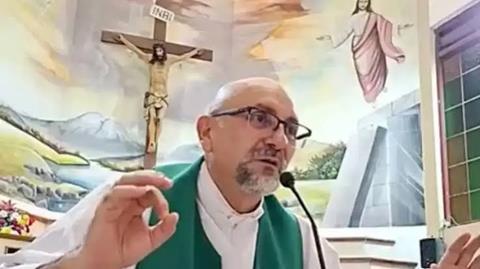
You may have seen the devastating story about a Catholic priest, Fr Patricio Sánchez Molinari, who was killed while conducting Mass when a giant crucifix inexplicably fell from the wall and crushed him. My immediate thought was: “How could someone without a faith read a headline like this and believe that a good and powerful God exists?”
Imagine yourself as a member of the priest’s family. That morning, he is leading God’s people in worship. Then, moments later, with his head bowed and his eyes closed, a statue of his Saviour ends his life. The irony is so thick that the story almost seems made up. But it happened.
As a Christian, I do not know why God would allow something like this to happen. I will not insult your intelligence and pretend like there is an easy answer. And I will not offer you a coffee cup slogan and call it theology.
Jesus’ resurrection gives me reason to believe that tragedy is never the end of the story.
So, you might ask, if I cannot explain why God would allow something like this to happen, why would I still believe He exists? Why would I still trust a God who could have prevented this tragedy but seemingly chose not to?
These are fair questions.
To start, sometimes Christian culture makes promises about God that the Bible does not. The Bible never promises that faithful, God-honouring people will be spared from experiencing terrible things. Consider Abel, Job, John the Baptist, the Apostles, even Jesus Christ himself.
Many of the heroes of the faith experienced devastating tragedy or awful, painful deaths. This does not answer the question of why this priest tragically lost his life, but it does mean that suffering itself isn’t necessarily evidence that God is not there or unable to act.
Additionally, the God of the Bible has a long track record as someone who enters into the suffering of His people. From Genesis 3 when sin entered the world, all the way to the end of the Bible in Revelation 22, God is working toward the ultimate end of all suffering.
There is a story in the Bible where Jesus is standing outside the tomb of his recently deceased friend, Lazarus. Jesus was about to literally reverse his death. Yet, before He does so, He looks around and sees all of Lazarus’s loved ones mourning. Instead of trying to convince them to stop crying, Jesus begins to weep, too. Why? Jesus does not treat their grief as something to rush past, immediately fix or explain away. He allows himself to feel first.
Then there is the cross of crucifixion itself. In Jesus, God entered into our suffering, bearing the weight of humanity’s sin so that its penalty could be paid. The cross is proof that God is not distant from our suffering. That He literally loves us to death.
Still, it doesn’t explain why this crucifix fell and killed the priest; and God’s nearness does not explain why He didn’t prevent the crucifix from falling. What keeps me tethered to my faith, even in the midst of the inexplicable, is a tomb in the Middle East that has been empty for 2,000 years.
Everything hinges on this.
Jesus’ resurrection gives me reason to believe that tragedy is never the end of the story. If the tomb is empty, I can live without answers to every question along the way, because I believe the ending is clear: death does not get the final word in Christ.
Yes, the crucifix fell, the priest tragically died, and I do not know why God did not intervene in that moment. But the Christian faith does not rest on the promise that the cross won’t fall; it rests on the claim that the crucified Christ rose again. And one day, He is coming back to wipe away every tear.
In the meantime, Fr Patricio Sánchez Molinari’s haunting words, spoken just before his death, remain true: “Dear brothers and sisters, one day all of us who are here will also die.”
One way to honour this priest’s life is by considering the God he spent his life proclaiming, and allowing the person of Jesus to challenge what you believe about life, death and what comes after.























No comments yet