


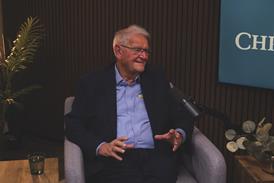









Beloved pastor, husband and father Robert Guanco died this weekend at Big Church Festival when a sign fell on him. Six other people were injured. When Amy Orr-Ewing’s 21-year-old godson asked her how God could let this happen at a Christian event, this is what she wrote back
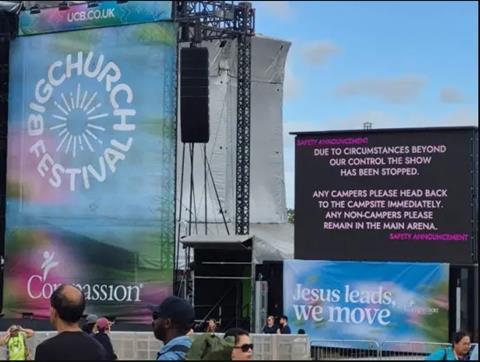
At Britain’s largest Christian festival, where 40,000 people had gathered for worship, disaster struck this weekend. A sign fell and killed 41-year-old Robert Guanco, pastor of Jesus Living Water Church in Eastbourne. He left behind a widow and young child. Six others were injured. This is utterly devastating for all involved and, as a wider community of Christians, we are shocked and reeling.
Meanwhile, mainstream media outlets have picked the story up and some of the comment sections are horrific as mockery focuses on the faith context of the incident with malice and cruelty.
When my Gen Z godson messaged to ask me for help in figuring out what to say and how to respond to his friends’ queries he said: “How could this happen at a Christian event specifically? How do you reconcile something like this with being a Christian?”
I wrote the below to help him think this through. I want to acknowledge that some of us just need to feel the hurt and process what has happened in our own way. But for those of us who have questions that feel important too, I am sharing what I wrote in case it is helpful to others.
Dear Fin,
When disaster strikes, it is completely natural to ask: How could God allow this to happen? Where was God? And who is to blame? These are not new questions. In fact, Jesus Himself was asked about horrifying and apparently senseless deaths.
In Luke 13:1–5, people come to Jesus with news of Galileans who had been violently killed by Pilate. Jesus then refers to another tragedy: 18 people who died when the tower of Siloam unexpectedly collapsed on them. He asks: “Do you think they were more guilty than all the others living in Jerusalem? I tell you, no!”
That is an extraordinarily important starting point. Jesus explicitly rejects the idea that tragedy proves that its victims were somehow worse people, less loved by God, or more deserving of suffering than everyone else. Violent crime and catastrophic accidents are not evidence that the victims were being singled out by God for punishment. Jesus will not allow us to blame the victims.
A world in which love is possible
The Bible frames human experience within the story of a good world that has become profoundly broken. Genesis 1 begins not with evil, suffering or death, but with goodness. God creates human beings in His own image, giving us remarkable capacities for relationship, moral responsibility, creativity and love.
But genuine love requires freedom. Love that is coerced is not really love. A friend of mine ran away from a forced marriage when she was 15. She did not need a degree in philosophy to understand that you cannot force someone to love you. Love has to be freely offered and freely received to be real.
The Christian answer to suffering is ultimately not an explanation shouted from a safe distance. It is a person: Jesus Christ, entering our suffering
Genesis 1 presents us with a loving God who creates a world in which love is possible. But the very freedom that makes love possible also makes its opposite possible. Human beings can use freedom to love, protect, create and serve; we can also use it to exploit, neglect, abuse and destroy.
Genesis 3 describes humanity turning away from God, and using our freedom to do this. Christians have traditionally called this “the Fall.” From that point onwards, the biblical story takes place in a world that is not as it should be.
We live downstream from countless human choices, stretching back through history, that have produced violence, injustice, dysfunction, negligence and suffering. This has also meant that we inhabit a physical world in which bodies become sick, structures fail, natural disasters occur and people die. Christianity does not ask us to pretend that this world is functioning exactly as God ultimately intends it to.
But why doesn’t God simply stop it?
This raises the obvious question: Why doesn’t God protect the people He loves from harm?
If God’s normal way of running the world were to intervene every time one human choice was about to cause another person harm, the interventions required would be almost infinite. Every dangerous decision would have to be overridden, every negligent action prevented, every violent intention restrained and every consequence miraculously suspended. A world of meaningful human agency would effectively disappear.
This does not answer every question raised by suffering. Following Jesus Christ does not offer us a neat philosophical formula that makes tragedy painless. But it does tell us something crucial: the promise of the Christian life has never been immunity from suffering.
Christian faith gives us every reason to take suffering with the utmost seriousness because every person affected possesses immeasurable value
Jesus never said: “Follow me and nothing terrible will happen to you.” The first Christians were imprisoned, beaten, persecuted, shipwrecked and killed. Christian faith offers something deeper than immunity: the presence of God within suffering, the redemption of suffering, and ultimately the defeat of suffering.
“The LORD is close to the broken-hearted and saves those who are crushed in spirit” (Psalm 34:18).
At the very centre of our faith is not a God who observes human suffering from a safe distance, but Jesus Christ, described as “a man of sorrows, and acquainted with grief” (Isaiah 53:3). Jesus willingly enters suffering Himself: “No one takes my life from me I lay it down of my own accord” (John 10:18).
The Christian claim is not that God keeps Himself away from suffering. It is that, astonishingly, God enters it and meets us here – in our questions and in our pain.
Death is not the end of the story
For Christians, disaster and death are to be primarily understood in the light of eternity. Christian hope is not simply that God will help us make the best of this life. It is that this life is not all there is.
The Bible ends with the extraordinary promise: “He will wipe every tear from their eyes. There will be no more death or mourning or crying or pain, for the old order of things has passed away” (Revelation 21:4)
Notice that Christian faith does not minimise the tears. God wipes them away. It does not call death insignificant. It promises that death itself will ultimately be destroyed. And perhaps the depth of our anguish when a human life is lost tells us something important about what we believe a human life actually is.
If a person is ultimately nothing more than a temporary arrangement of atoms - a biochemical organism that happens to be here by chance - why does the destruction of a human life strike us as possessing such profound moral and existential significance?
The Bible offers a radically different account of human value. Every human being is made “in the image of God” (Genesis 1:27). Psalm 139 describes us as “fearfully and wonderfully made,” known and seen by God even in the womb. Human beings possess a value that cannot be measured merely in productivity, longevity or physical matter.
Our anguish at the loss of human life is not evidence that life is meaningless. It may actually point towards the opposite: human life possesses an extraordinary value that death violently contradicts.
What Jesus says when the tower falls
This brings us back to Jesus and the tower of Siloam. When the tower falls, Jesus does not blame the victims. But neither does he treat the tragedy merely as an abstract philosophical puzzle. He turns the attention of those who remain alive towards their own lives. His message is essentially: You have seen how fragile life is. So think about how you are living yours.
Tragedy confronts us with questions we can usually postpone. What am I living for? What ultimately matters? Where is my hope? What happens when everything I assumed was secure suddenly isn’t?
Jesus invites us to live in the light of eternity. The blessing of God has never meant that Christians are exempt from suffering. Think of the apostles: flogged, imprisoned, persecuted, shipwrecked and, in several cases, killed for their faith. Yet they continued to speak about the goodness, faithfulness and love of God.
Our anguish at the loss of human life is not evidence that life is meaningless. It may actually point towards the opposite
So what does it mean for a Christian to pray for God’s protection?
It means we absolutely can ask God to protect us. We can thank Him for the countless dangers from which we may have been protected without ever knowing it. But our faith does not rest on the promise that nothing painful will happen to us. It rests on something stronger: that our lives belong to God, that our times are in His hands, that He will be with us whatever we face, and that even death cannot ultimately separate us from Him.
Christian hope is not: Nothing bad can happen to me. It is: Whatever happens to me, I belong to Christ—and death does not get the final word.
So how should Christians respond when disaster strikes?
First, with compassion. Christian faith gives us every reason to take suffering with the utmost seriousness because every person affected possesses immeasurable value. We grieve with those who grieve. We pray for those most deeply affected. We give generously to survivors and their families. And where suffering has resulted from negligence or wrongdoing, compassion also requires us to pursue truth, accountability, justice and restitution.
Second, with trust. Your life is precious to God and possesses eternal significance. That changes how we live now. We do not need to be paralysed by fear, nor do we need to pretend that we can control every risk. We can live courageously and wisely, trusting God with the things we cannot control.
The Christian answer to questions about suffering is ultimately not an explanation shouted from a safe distance. It is a person: Jesus Christ, entering our suffering, bearing wounds Himself, defeating death through His resurrection and promising that one day He will make all things new. So turn to Him and encourage others to consider Him, to encounter Him, to put their trust in Him.
Christians will grieve. Christians will ask difficult questions. Christians will pursue justice. Christians will help those who suffer.
But we do not grieve without hope. Because the tower falling is not the end of the story.
This article was originally published on Dr Amy Orr-Ewing’s substack and is re-printed with permission
























2 Readers' comments