











A new survey from Theos suggests the majority of Christian nationalists do not go to Church. But the findings also raise uncomfortable questions for regular churchgoers about how closely their political beliefs align with the teachings of Jesus, says Krish Kandiah

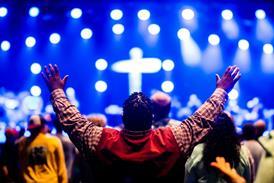
In September 2025, an estimated 150,000 people marched through central London at a rally called Unite the Kingdom, led by far-right activist Tommy Robinson. Bibles and wooden crosses were visible among the crowds, and a worship band performed on stage.
To an outside observer, it might have looked like a Christian event, but listening to some of the speeches (Elon Musk: “We must fight back or die”, or Éric Zemmour: “We are both subject to the same process of the Great Replacement of our European peoples”) there appeared to be a far darker agenda.
In recent weeks, Robinson’s former bodyguard, known as Danny Tommo, gathered hundreds of men dressed in black and wearing balaclavas. Carrying crosses and shouting “Christ is King”, they attempted to impede the RNLI’s rescue of asylum seekers and block buses transporting them to an assessment centre. Tommo is also facing criminal damage charges after filming himself cutting open an inflatable dinghy used by migrants.
Those drawn to Christian nationalism should not simply be vilified or written off
This is the new landscape of Christian nationalism: an ideology that seeks to fuse Christian identity with national identity, presenting the nation as fundamentally Christian and, in some forms, treating those who do not fit that vision as a threat.
But how Christian is Christian nationalism, really? A new survey from Christian think tank Theos, titled Beyond Christian nationalism: Measuring attitudes to Christianity and Britishness today, provides a much-needed snapshot of the wide range of opinions on how Christian faith relates to British identity and politics.
Interestingly, it shows that those who seem to align most closely with the Christian nationalism of Tommy Robinson are not be as Christian as we might imagine.
Five ways to connect
In April 2026, Theos surveyed 1,765 UK adults and found that “Christian nationalism” is too blunt a label for the different ways people connect faith and national identity. The largest group, Committed Separatists (34%), largely reject any link between Christianity and Britishness, while Cultural Separatists (16%) share that separation but are more nationalistic and hostile towards other cultural and religious identities, particularly Islam.
Values Integrationists (26%) see Christianity as the source of British values and want it protected, although few actively practise their faith. Belief Integrationists (13%), the most practising and ethnically diverse group, want Christianity to shape public life through its teachings, including welcoming asylum seekers and caring for the vulnerable. This is the group I most identify with.
Identity Integrationists (11%) are the last and smallest group and come closest to those commonly aligning with today’s Christian nationalism. Of this last group, although 81% identify as Christian, only 13% attend church weekly. While 90% believe defending Britain’s Christian heritage is important to being a Christian, just 19% agree that Christian values require us to welcome asylum seekers.
Following the way
The report’s author, Nick Spencer, points out that nobody chooses who sits beside them in church, which turns out to be a rather effective education in humanity. As Rt Rev Arun Arora, Bishop of Kirkstall, has observed, identity is cheap to display; discipleship on the other hand means denying yourself and following Jesus - a much harder commitment to carry down Whitehall. Not everyone carrying a cross at a march follows the way of the cross.
Jesus never made church attendance the measure of genuine faith: His teaching sets a far more demanding standard. In the Sermon on the Mount, He blesses the peacemakers, the meek and the merciful, and calls His followers to love their enemies. He concludes by warning that even those who prophesy and perform mighty works in His name may be turned away if they fail to do the will of His Father in heaven. The question is not simply whether we call ourselves Christians, attend church or are even involved in ministry, but whether our lives reflect the character and teaching of Jesus.
Although Christian nationalists may be a minority, the attitudes associated with it are not confined to the fringes
It may seem a rather inadequate measure of genuine faith to count how often someone attends church when Jesus sets the bar so much higher. Yet surveys need measurable indicators, and religious affiliation, belief in God and church attendance provide a practical way of exploring patterns across a population. They cannot tell us what is in an individual’s heart, still less determine who is or is not a genuine Christian. But they can help us understand how religious belief and practice relate to people’s attitudes and behaviour.
Theos’ findings suggest that, among those who want Christianity to play a role in national life, regular church attendance, prayer and belief in God are associated with more welcoming attitudes towards outsiders and refugees. This makes both theological and practical sense to me. It is difficult to spend time immersed in the life and teaching of Jesus - who healed the servant of a Roman centurion and reached across the social and religious boundaries of His day - while simultaneously promoting hatred and division against people seeking refuge.
Christian community, at its best, draws us into worship, challenges our prejudices and teaches us to live alongside people who are different from us. The more we encounter the Jesus revealed in the Gospels, and learn from others who seek to follow Him, the more we should be challenged to become like Him. Church attendance does not guarantee that transformation, but it can be an important part of it.
Shaped by scripture
But we who are committed to church and discipleship must be wary of congratulating ourselves too quickly. The same report shows that Belief Integrationists, the group most likely to be practising Christians (31% attend church weekly), hold deeply troubling views on a variety of issues.
37% say being white is important to being truly British. 54% say they are proud that Britain is “predominantly white” and 60% say Britain is too ethnically mixed. 62% say that we need ‘strongman’ political leaders who are prepared to break the rules.
Even more concerning for me is that 25% believe political violence is sometimes necessary and 66% have bought into the Great Replacement theory, arguing that the white population of Europe is being deliberately replaced by migrants from Muslim countries. That is second only to Identity Integrationists (82%) and well above the national average of 37%.
These findings should give us pause: are our political convictions genuinely being shaped by scripture, or are we allowing someone else’s agenda to shape our reading of the Christian faith? Although Christian nationalists may be a minority, the attitudes associated with it are not confined to the fringes. We must be alert to the danger of allowing cultural grievance, racial anxiety and hostility towards outsiders to distort our understanding of the gospel, even when these attitudes are expressed by people who identify as Christians.
At the same time, those drawn to Christian nationalism should not simply be vilified or written off. In my experience, some are outsiders themselves: people who feel ignored, abandoned or left behind by society. Some resent what they perceive as the welcome and support offered to asylum seekers because they also long for recognition, security and compassion. They find in the Christian nationalist movement the acceptance they are not finding in society or the Church.
Understanding these feelings does not excuse hateful language or actions, but it may help us respond more wisely. The Church must be willing to challenge racism, hostility and the misuse of Christian symbols, while also offering compassion to those who perpetuate them.
We are called neither to endorse exclusion nor to abandon those who feel excluded, but to invite all people into repentance and faith in Christ, which comes with inclusion in the family of God. Ultimately, the most convincing evidence of our Christian identity is not the flag we wave, the cross we carry or the heritage we claim, but the love we show.

























No comments yet