

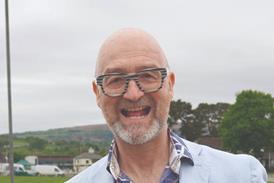

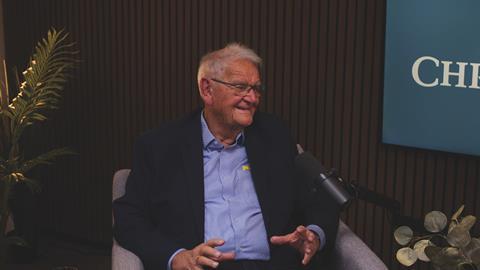

From a rebellious teenager to the founder of a global family of 5,000 churches, Terry Virgo’s story is inspiring. He reflects on why he’s still praying for revival, his infamous interactions with Mark Driscoll and why, when it comes to church growth, numbers don’t always tell the whole story
When the founder of Newfrontiers – a network of 5,000 churches across 80 nations – tells me: “I’ve never known how you build a movement,” I believe him. As a new biography of Terry Virgo makes clear, there was never a grand strategy behind what became one of the most successful church planting movements of the modern era. But there was a lot of prayer.
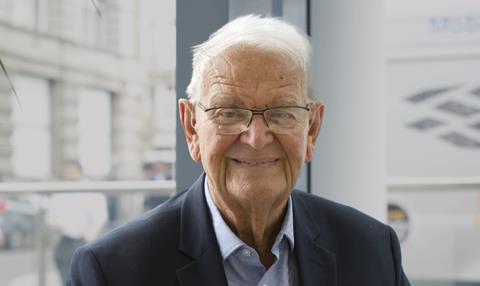
The 86-year-old is a gifted communicator with strong convictions. Those who’ve worked closely with Virgo often testify to his humility and gentleness. In some ways, he’s an unlikely leader – the son of a school caretaker whose first years of being a Christian were spent backsliding in dramatic fashion.
It’s appropriate that the book of Acts helped point him in the right direction. The young Virgo was captivated by these 28 chapters about the early Church and has spent the rest of his life trying to build faith communities based on that biblical model.
Newfrontiers churches emphasise both word and Spirit (they’re Reformed and charismatic, to use the jargon) and an understanding of the gospel that is rooted in grace. Terry’s ministry is centred around the principle of church as family – that belief might be common among evangelicals today, but it was a breath of fresh air in the largely formal Church world of the 60s and 70s.
The growth of Newfrontiers was organic – and fast. By the 1980s, Virgo was pastoring in Brighton and travelling to the USA, India, South Africa and beyond to raise up new leaders and church plants.
After much deliberation (and an unexpected challenge from controversial preacher Mark Driscoll), Virgo handed Newfrontiers on to a plurality of other leaders in 2011. Each has since created their own autonomous ‘apostolic sphere’ (the term comes from 2 Corinthians 10:13) – with many, such as New Ground, Relational Mission and Catalyst, maintaining a strong UK presence.
The new biography, Building God’s House (Malcolm Down), is written by Newfrontiers pastor Andy Johnston. Comprehensive and well-researched, it is largely uncritical of Virgo and dodges some of the more contentious issues associated with the Newfrontiers movement (their male-only eldership policy is merely a footnote).
Johnston says he writes as an “interested party and an admirer”. As a former Newfrontiers elder who also holds Virgo in very high regard, I too must ‘declare an interest’. Nevertheless, enquiring of a person’s mistakes as well as their triumphs will help us avoid the unhealthy excesses of celebrity culture in the Church.
Tell me about life growing up.
My parents didn’t go to church but as was common in those days, I was sent to a Church of England Sunday School. I never heard the gospel there; the guy who took our class just talked about football.
My work has been to lay foundations and give people an understanding of grace
My sister became a Christian after hearing Billy Graham in London. She said: “I’ve become a Christian.” I’d never ever heard anyone say that – I didn’t know you could “become a Christian”. I assumed I was a Christian because I was being raised in England.
Then she said: “I’ve been born again” and I thought: What on earth are you talking about? But that night, I got saved and born again.
The biography says, “Early Christian life for Terry was not all plain sailing. No sooner had he responded to the gospel…than Terry was backslidden, compromised, and half-baked.” What happened?!
I was ignorant – I had no example of what Christianity was like. I was tall for my age, so even though I was only 16, I easily got away with drinking in bars. My friends and I lived for the weekends and that was my life.
I’d joined a Baptist church and went every week. But my lifestyle was very ungodly. I was often drunk on a Saturday and in church the next day. I lived like that for four years.
What changed?
The preacher spoke on Galatians 5:7: “You were running a good race. Who cut in on you to keep you from obeying the truth?” I heard God say to me: “I want your life. I want it now, and I won’t speak to you about this again.” That absolutely terrified me. I knew the life I was living was wrong, so I pulled away and literally lost all my friends.
I recall my first Saturday night; I sat indoors rather than going to the jazz club. The people at church had said: “Christianity is life with a capital ‘L’.” I thought: Christianity is hell with a capital ‘H’! I remember picking up a Bible, which wasn’t my custom, and reading the book of Acts. I suddenly felt a bubble of hope. I thought: This isn’t boring. It’s pretty exciting!
What was your first experience of the Holy Spirit?
I knew a young man who I’d occasionally have lunch with. If he was ever late, it was always because he was witnessing to somebody – giving away tracts, talking – and he was a fun guy to be with. I thought: I’d like to be like you.
I heard God say to me: ‘I want your life’
One Sunday, I was on Brighton seafront, and I saw this crowd on the promenade. There were some elderly ladies holding up banners saying: “Repent”. People were laughing at them and throwing cigarette packets and apple cores – it was horrific. I felt God say to me: “What about you?” I thought: No, I will never do that! I couldn’t even admit to being a Christian in public – but I was ashamed of this.
I went straight home and [prayed]: “God, I’ve got to get an answer to this [why can’t I be bolder in my evangelism?].” So, I phoned my friend and asked: “What is it with you?” He said: “I’ve been filled with the Holy Spirit.” He was a Pentecostal and, in the early 60s, Pentecostals were seen as a weird group. He said: “Come to our church next Sunday and we’ll lay hands on you.” I did, and I felt the Holy Spirit come on me. I started speaking in tongues. It was wonderful.
Did you discover a new boldness in your preaching after that?
I went back to my Baptist church, but I didn’t know how this new wine would fit in the old wineskin. Church life was so formal – there were signs saying: “Do not speak in the sanctuary.” It was like a library. But I was praying for opportunities to share what I’ve found with my friends in the church.
During a retreat, the pastor suddenly turned to me and said: “Terry, what’s happened to you?” So, I told them about how the Pentecostals had laid hands on me. Everyone’s eyes were popping open, and there was total silence. This godly, humble pastor said: “You must lay hands on all these young people.” So, I did. Loads of them got filled with the Spirit.
On Sunday afternoons, we would go down to that spot where I saw those elderly ladies. Some of the girls played guitar and sang, people gave testimony and I stood on a box and preached. It was totally life-changing.
How did your time at London Bible College prepare you for what became Newfrontiers?
I went to a new church which met in an office near Charing Cross. I’d never been to meetings like it. It was supercharged with the presence of God. The worship was extraordinary and I thought: If I’m going to become a pastor, this is the kind of church I want. I can’t go back.
Later, I was invited to become the pastor of a free evangelical church in a town called Seaford. Gradually, the congregation became increasingly filled with the Spirit and by 1972, it was the only charismatic church I knew in south-east England.
Reading the book of Acts gave me a bubble of hope. I thought: This isn’t boring. It’s exciting!
A guy phoned me one day and said: “I have a Bible study in my home. Would you come and speak?” I was invited regularly and that meeting grew and grew, and his lounge filled, into the hallway and literally up the stairs! In fact, he extended his house, and it became a house church!
Gradually, that started happening all around Sussex. When I first went to Hastings, there was only about a dozen people. When they couldn’t meet in a home anymore, they met in a school. In the end, they bought a place called Boundaries, and hundreds went there. I said to [the leader]: “How many of your people work in Eastbourne?” He said: “About 24.” I said: “Why don’t you start a church in Eastbourne?” To my amazement, he came back to me within days and said: “I believe God spoke to me.” They met in a school, then bought a huge warehouse.
That’s how we got started. It was just one after another. There was no plan: “Let’s form a movement.” Nothing could have been further from my mind.
When you were experiencing the power of the Spirit and seeing new churches planted in the 1970s it was commonly thought that revival was on the way. The belief was: once the Church was restored, the whole nation would turn back to God. Was that theology wrong? The long promised revival never really came, did it?
That’s very well put. I think that unreality can come.
I wanted to see a massive revival. RT Kendall talks about the revival that’s coming, and I want to believe – I’m saying it that way – I want to believe for revival. I think there are promises that have come for revival.
Do you agree revival was predicted, but never happened?
I would agree it’s not happened.
But you’re also still praying and believing for it?
That’s right. I have a revival prayer meeting in my home every Thursday.
A prophetic word was given by Paul Cain that Newfrontiers would “change the expression of Christianity all over the world”. Do you think that prophecy came true?
It’s a very good question. What I believe has come to pass is that I can go to Mexico, Ukraine, Russia – we’re in over 80 nations now – and there are churches whose culture is like ours – it’s like a family; the grace message has transformed people and there’s openness to the Spirit and trying to stay clear on the Bible. I’ve heard people from different nations say: “It changed the expression of Christianity in our country.” Did it change the nation? No. Has it changed all of the Church? No.
Paul Cain’s ministry has been discredited in the eyes of many. Not just for alcoholism and practice of homosexuality, but because he resisted the subsequent restoration process and was even accused of faking prophecies. How do you handle that?
Yes, you think of Ravi Zacharias, and other people that have been honoured and respected [before scandals emerged] – Roy Clements and Mike [Pilavachi]. And you think: Wow, I don’t understand that. Some of these people I’ve known personally. It’s hard. It happens. But I don’t think [those moral failings] write off all that had happened before.
Newfrontiers has been described as an apostolic movement. What does it mean to be an apostle?
I became a friend of Arthur Wallis, who was a wonderful man of God and wrote some outstanding books on revival. When he introduced me, he said: “This is Terry Virgo. He’s doing apostolic work in the south of England.” I was shocked. I would never have said that, but he did, and I had huge respect for him.
I began to realise that I was no longer simply pastoring my church, I was helping start new churches and laying biblical foundations. Looking at Ephesians 4, I realised: I’m not a pastor, an evangelist or a prophet. I’m doing the work of an apostle.
I have a revival prayer meeting in my home every Thursday
In the end, I felt God say: “I want you to own this word.” So, I’ve accepted that my work has been to lay foundations and give people an understanding of grace. The New Testament apostle gets new revelation, but that’s not our calling [today]. It’s important to differentiate.
Newfrontiers has always held to a theology of male eldership. Have your convictions around complementarianism prevented you from working with other Christians?
I think we can fellowship with the whole body of Christ, and that’s always been my practice. We can partake in town-wide evangelistic endeavours, or whatever.
When I was asked to speak to the Evangelical Alliance (EA) in the early days there was a lot of hostility. There were three Anglicans in the front row. When I finished, this guy stood and said: “Who gave you the right to start a church?” I thought it was a perfectly valid question! I was about to answer it when Morgan Derham, then chair of the EA, said: “I’d rather belong to a church started by Terry Virgo than one started by Henry VIII.” The place rocked with laughter.
We were starting new churches and we said: “We’re going to be biblical. We will submit to scripture. We will welcome the Holy Spirit. We will baptise believers.” We had these 15 things that defined Newfrontiers.
Have there been issues you’ve changed your mind on theologically?
When we first started, we read: “If a woman prays or prophesies, she should have her head covered” [see 1 Corinthians 11:5]. And so we did that.
As time went by, we realised it’s so weird and we started asking more questions about it. We began to feel: No, this isn’t relevant in our generation. So we don’t require that anymore.
In 2008 you invited Mark Driscoll to speak at your leaders’ conference. He was already controversial, although this was before allegations of bullying, plagiarism and spiritual abuse (which he denies). With hindsight, would you still have invited him to speak?
It’s fascinating that on reflection, he was the only guy I put on one of our major platforms who I’d never met before.
I’d heard a series of teachings he’d done which were outstanding. And it was really on the strength of them that I invited him to come. Many things that he said at that seminar, I totally disagreed with.
Does this include his advice that pastors shouldn’t make friends with their fellow elders because it makes it harder to fire them?
That’s right. He even challenged the fact we used the word “family”. He said it was too sentimental and would hinder our mission.
Because we were willing to take on board whatever anyone says, I said to the guys: “Let’s think about this.” But we all came back and said: “The Bible’s full of family. This guy’s crazy!” He said horrific things in that seminar. I had to say: “We don’t accept this stuff.”
We want a church on a proper foundation, or we can’t build
But I felt peace from God when he spoke in the main session. He raised the issue [of me getting older and needing to hand Newfrontiers on]. I felt it was a God thing [that he challenged us on succession planning]. I embraced him and said: “I receive this word, and we will seriously ponder it.”
He’d visited our home before the meeting and saw a picture of my daughter’s wedding. He said Newfrontiers [was like] my daughter, to be handed on to another generation. We felt God was speaking to us in other ways. I have four sons and a daughter. When I die, one of those sons will not become the leader of the family. It’s not the way it works. They are now fathers of their own families.
And that’s why you handed over to a number of leaders who have continued the work in what are called ‘apostolic spheres’. What’s changed for you since handing over?
I was the leader, and I handed it over – I’m very peaceful about that. I’m invited in and out of the various spheres. Sometimes I don’t even remember which sphere I am in!
It’s strange sometimes when I see team leaders going off and me not being in the room, but it’s OK.
When you passed on the movement 15 years ago, there were around 900 churches, but today there’s 5,000. That’s phenomenal growth, isn’t it?
I don’t necessarily know that the same amount of involvement is happening like it was at the beginning.
When I was first invited to India, the church was very wobbly. The leadership was really out of step with one another. The leaders’ wives hated one another. It was really bad. After I visited, they said: “Can we come within your world [join Newfrontiers]?” I said: “If all the elders will resign, I will take responsibility.” They agreed, so one of our mature, older elders and his wife went out there for six months and raised up a fresh leadership.
We want a church on a proper foundation, or we can’t build. And I’m not sure that kind of carefully thorough “we want this on a proper foundation” is happening everywhere now. Sometimes people say: “We’ve 20 churches in Congo”, and I feel: Do they know you? Do you know them? Are they just taking on our name, or are they taking on our values? But I get challenged on it, because they tell me “no, we were there for two weeks. We spent ages in their homes. We talked.” And I say “Well, bless the Lord!”
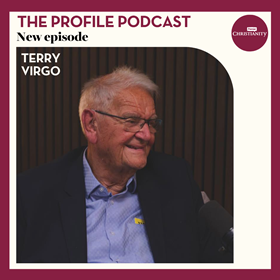
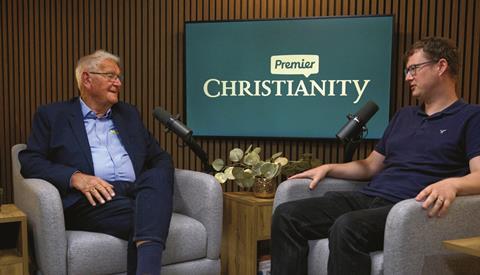
To hear the full interview listen to Premier Christian Radio at 8pm on Saturday 17 October or download The Profile podcast. It will also be available to watch on Premier’s YouTube channel.
Building God’s House: A Life of Terry Virgo by Andy Johnston (Malcolm Down) is out now and reviewed here.
























No comments yet