













The gun-toting hero of Lee Child’s bestselling thrillers has a simple approach to justice: shoot the bad guys. But as Malcolm Gladwell’s latest book considers America’s real-life epidemic of gun violence, could Christians offer a powerful alternative to the endless cycle of revenge?
Reader, I need to confess something. Like many men my age, with our fragile egos and desperate desire to appear intellectual, I have cultivated ‘bookcase credibility’. Meet me on Zoom, and the shelf behind my head will speak of my wide and impressive reading; theological heavyweights sit alongside lofty sociologists and philosophers. If you spot a fiction book, it’ll be a candidate for the Booker Prize. Drop one shelf lower however, safely out of the view of my laptop camera, and you’d find the dark truth about my real reading diet. Spine after spine bearing the same name: Lee Child.
A few years ago, someone I respected recommended that I pick up one of Child’s Jack Reacher novels. I was hooked immediately by the breakneck pace, thrilling plots and fascinating central protagonist. Reacher is America’s answer to James Bond; far too perfect, and inexplicably indestructible, but frankly that’s all part of the fun. Reacher is a discharged military policeman who drifts around, stumbling into the baddest bad guys and single-handedly defeating them.
The series (now at 31 books) is wildly popular, so far selling nearly 200 million copies worldwide. It has spawned two movie versions, fronted by Reacher superfan Tom Cruise, and been turned into an Amazon Prime TV show. In Reacher, the titular character is played by outspoken Christian actor, Alan Ritchson. The source material keeps coming, and the adaptations will surely continue to follow. Yet the story is almost always the same: Reacher accidentally happens across some truly awful men, meets (and beds) a beautiful woman who helps him figure out what’s going on, and then shoots almost everyone.
The first, last resort
Although Child is from Coventry, his Reacher novels exist in the only context that makes them remotely plausible: the USA. The stories are awash with gun violence. Every bad guy is armed to the teeth, and most of the other characters seem to have at least one gun in their bedside drawer. Reacher himself, despite only owning a single set of clothes and a toothbrush, is perpetually packing. Guns aren’t just a feature of the books; they’re the singular tool of plot resolution.
Has Child made America’s problem with gun violence even worse by glorifying it, or is he simply reflecting what he has observed?
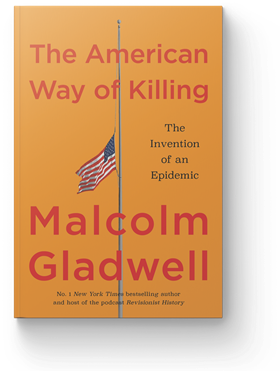
At the end of September, British Canadian journalist and author Malcolm Gladwell (also a Christian; also responsible for an entire shelf of my bookcase) published The American Way of Killing (Little, Brown and Company), an attempt to bring new thinking into the seemingly unsolvable discussion around America’s gun problem. Though he lives in New York, he shares the perspective held by many outside of the US: that the proliferation of guns in the country is one of its darkest and most urgent failures. No other developed nation has gun crime figures like America; nowhere else can boast more mass shootings than days of the year, or has to repeatedly process the national trauma of schoolchildren being massacred in their classrooms.
Rather than simplistically suggesting that guns should be outlawed, Gladwell argues that we’ve fundamentally misunderstood key elements of the debate around them. He explains how, by focusing on the banning of certain kinds of semi-automatic weapons, the more lethal impact of handguns is ignored. He delves into the dark origins of the oft-quoted Second Amendment to the US Constitution (the right to bear arms) and reveals its connection to protecting slave owners under threat of mutiny. Perhaps most disturbingly, he demonstrates how improvements in medical care are masking the impact of guns; the streets aren’t getting safer, but doctors are getting better at saving victims’ lives.
No other developed nation has gun crime figures like America
The heart of Gladwell’s argument isn’t about disarming the claims of the gun lobby, however. His most important point is that guns provide a lethal shortcut to disagreements which might otherwise be resolved differently. In one compelling example, he tells the story of an argument in a fast-food restaurant over ordering speed that escalated into physical and then fatal violence. In a world without guns, that story would have ended with a bloody nose; instead, one person died and another was condemned to life in prison. That this happened over a burger is crucial to Gladwell’s point: most gun violence isn’t committed by criminals with murderous intent but is what he terms “expressive”. The gun becomes a tool, too easily available when tensions and emotions run high. In a culture where the heroes once looked like John Wayne – and now look like Jack Reacher – it can be the first resort when it should be the last.
Disarming Jesus
What would Jesus say about guns? The answer doesn’t seem to be clear, especially among American Christians. Guns didn’t appear in any form until the tenth-century Chinese fire lance, so most verses quoted on either side of the argument refer to swords, or broader ideas of defence. Christian gun critics and apologists alike both draw on proof texts to theologise their views: In Luke 22:36, Jesus tells the disciples to arm themselves; 15 verses later, He rebukes them for using a weapon. The disagreement between believers on the issue seems as intractable as the wider version; the Christian gun-owner believes he is enacting his moral responsibility to protect life, and especially his family (Nehemiah 4:13-14); the reformer holds to the kingdom vision of beating “swords into ploughshares” (Isaiah 2:2-4). History suggests that this kind of argument will never be resolved.
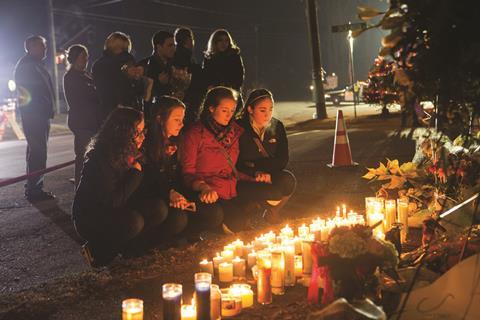
Although Gladwell is a Christian (he rediscovered his faith while writing David and Goliath in 2013), he doesn’t waste his time with proof texts. Instead, he suggests something much more theologically interesting: that there’s a bigger, more primal problem behind the gun epidemic, and it’s a problem with forgiveness. As well as expressive violence, which often takes place between people who know or are related to each other, a major reason behind American shootings is retaliation. Particularly in larger cities, an ongoing cycle of retribution between rival gangs or areas can lead to an unfathomable death toll. The American Way of Killing opens with the story of a Chicago trauma surgeon who has lost 15 close friends and family members to shootings. In a culture where murder is repaid with an endless loop of murder, the story is not exceptional.
Christian faith has more to say to the issue of revenge than it perhaps can ever meaningfully contribute to the gridlocked arguments around gun ownership. Though the Old Testament law legislated for a justice system that took an “eye for an eye” (Exodus 21:24, NLT), Jesus’ fulfilment of the law steers His followers towards mercy (Matthew 5:38-44). Perhaps the most specific and clear application of this comes in Matthew 18:21-22, when Peter asks Jesus: “Lord, how many times shall I forgive my brother or sister who sins against me? Up to seven times?” As ever, Peter is trying hard here, extending forgiveness to what appears to be a reasonable limit. Jesus surprises him with His answer: “I tell you, not seven times, but seventy-seven times.” That’s probably not a literal number, but an illustrative exaggeration; Jesus wants people to forgive and forgive…and forgive. This is the way of the kingdom, and the only path towards lasting peace between parties locked in a cycle of retaliation.
Has Child made America’s gun violence problem worse by glorifying it, or is he simply reflecting what he has observed?
Again, however, we should be wary of proof texts. Jesus’ conversation with Peter comes directly before the parable of the unmerciful servant, the story of a man who experiences forgiveness but then refuses to pass it on. For this man, Jesus says, there is no mercy – in fact there’s brutal torture ahead. This is where arguments get stuck. Jesus preaches peace and reconciliation, but He also warns that there are limits – and that some cases deserve punishment and retribution. Which Jesus should we listen to?
‘I couldn’t find any rope’
Reacher deals almost exclusively with unmerciful servants: people who have been given the gift of life and chosen to use it to hurt others in pursuit of wealth and power. The covers of many Child books include the same unattributed quote: “We all need Jack Reacher, a righteous avenger for our troubled times.” The character hunts down some of the worst villains imaginable and puts a stop to their evil schemes. In the context of novels, it is often the only course of action to protect others.
There are two side-effects from this, however, and as one of popular culture’s most influential ‘good’ guys, they speak directly into America’s gun violence problem. The first is that it suggests that guns are always the answer. There’s a telling scene in the third season of Reacher where the hero and his friends are sneaking into the bad guys’ lair by hijacking his truck. When they stop, Reacher tries to find some rope to tie up the driver but, when he can’t, he shoots the man dead. There’s even time for a joke about this with another character who questions his actions: “I couldn’t find any rope,” Reacher shrugs in justification. This is a dark illustration of Gladwell’s point. Reacher didn’t need to shoot the man, but doing so was a shortcut to resolving his problem.

The second issue is that the Reacher novels are very often about revenge. Remember that quote from the cover? These are stories driven by the idea that retribution is the only form of justice. In Child’s first novel, Killing Floor (Bantam), Reacher goes on the hunt for his brother’s killers and shoots them all. In Persuader (Penguin), on which the third TV season is based, he captures the monster who murdered his first protege. But instead of handing him over to the authorities, he blasts him with a shotgun instead. Guns solve your problems and revenge rights your wrongs. This is the gospel according to Reacher.
Our culture shapes us. The songs we hear on our Spotify playlists get stuck in our heads; when we play too much Candy Crush we start to see shapes forming in our peripheral vision. When a nation’s TV heroes live by these rules, is it really any wonder that its citizens start to absorb them?
A weapon of the Spirit
The American Way of Killing is Gladwell’s attempt to unlock the gun violence debate, and his arguments seem compelling to Brits like me. The problem is that the book arrives in a polarised landscape. The gun lobby will find holes and counterclaims. The reformers will argue back. Just like the murderous one between retaliating rivals in large American cities, this is another cycle that seems to have no end.
Yet, could Christians on both sides of the debate make a profound difference to that? Even if Jesus made mixed comments about the possession of weapons, He was clear about forgiveness. It’s an idea that is central to our faith, and to its most important moment: the cross. It should be a concept on which all Christians agree. Forgiveness might have limits, but it is the tool Jesus calls us to at least 77 times before we reach for an assault rifle. Whether a church leans right or left, it should be providing the counternarrative to a Jack Reacher worldview from its pulpit.
Even if Jesus made mixed comments about the possession of weapons, He was clear about forgiveness
The specific details of how Gladwell rediscovered his Christian faith are instructive here. During an interview with Wilma Derksen, a Mennonite Christian whose daughter was brutally murdered, Gladwell witnessed Derksen speaking of radical forgiveness, saying that she wanted to share love with the killer, a person who clearly had an absence of it. It changed the course of Gladwell’s life. He later referred to forgiveness as a “weapon of the Spirit” – and he’s right. It’s an idea from way beyond ourselves, and when we practise it, something transcendent occurs.
That isn’t to say forgiveness is easy. It’s nothing like as simple as, say, firing off a round of ammunition at a ‘bad’ man. Yet it’s the only thing that can break the endless patterns of violence; it’s the negotiating tool that can mean a gun stays holstered and lives remain unshattered. It is not just a virtue, it is the idea that we should be shouting most loudly and consistently into a world of cyclical violence, polarised arguments and warmongering leaders. Without forgiveness, violence repeats and repeats. When we choose it, tragedy is avoidable and transformation is possible.
America’s gun problem can feel impossible. Even the commentators are conflicted; remember earlier that I admitted my love for gun-toting Jack Reacher novels, and that I found them through the recommendation of a trusted voice? That voice was Gladwell’s: he loves Child’s books, too. Yet we shouldn’t allow the complexity of the debate to prevent us from recognising not only that there are solutions, but that the Church has a vital role to play in them. Reacher is wrong. Revenge is not the answer. Forgiveness is the most important subject for any sermon in this culture. It’s the only thing that can save us in these troubled times.

























No comments yet