





Creativity isn’t just for artists, musicians and writers. Dr Amy Orr-Ewing explains why creating is fundamental to what it means to be made in the image of God – whether you’re making dinner, solving problems or choosing a gift
The bestselling detective fiction writer and Christian intellectual Dorothy L Sayers wrote that “the hand of the creative artist…rocks the foundations of the world”. She cast a vision of a Christian life that held space for meaningful work and a sense of true vocation for people in every sphere that excited a generation of British followers of Jesus.
But if we are honest, today, the phrase ‘a theology of creativity’ is ripe for misunderstanding. Theology often conjures up images of abstract, rationalistic reflections about God, while creativity can sound like the preserve of professional artists, musicians or writers. But what if both assumptions are wrong? What if theology and creativity belong to every human being?
‘Theology’ simply means thinking and speaking about God. It comes from the Greek word theos, meaning ‘God’, and logos, meaning ‘word’, ‘discourse’ or ‘reason’. All our speaking, praying, arguing, wondering and reflecting about God is theology. And creativity is not confined to producing paintings, writing novels or conducting symphonies. Creativity is the human capacity to imagine, discover and make new possibilities from what has been given to us. Understood in this way, theology affects every sphere of our lives and creativity is everywhere. We create meals and businesses, friendships and families, institutions and gardens. We create arguments, solutions, technologies and environments. We create cultures within organisations and atmospheres within homes.
A teacher creatively finds a way to unlock an idea for a child; a scientist discovers a new possibility within the physical world; an entrepreneur imagines a business that does not yet exist; a leader creates conditions in which other people can flourish; a parent improvises their way through the constantly changing demands of family life. Creativity is not an optional extra for a particularly artistic minority. To be human is to be creative.
Creativity begins with God
The Bible gives us profound theological reasons for believing this and living it out. Scripture begins not with a theological argument for God, but with an act of creation: “In the beginning God created the heavens and the earth” (Genesis 1:1, my italics). Before we encounter God as lawgiver, judge, liberator or King, we meet Him as creator.
This is significant. Everything we know is contingent upon the original act of divine creativity. Matter, time, space, colour, sound, texture, physical laws, biological life and human consciousness are all received realities. Before any human being paints a picture, composes a melody or discovers a scientific principle, there is already a universe overflowing with possibility.
Genesis uses two important Hebrew verbs to describe God’s creative activity. Bara means ‘to create’ and is used in Genesis 1:1. In the Hebrew Bible, God is characteristically the subject of this verb. By contrast, asah has the broader meaning of making, doing or fashioning and can describe both divine and human activity. God is the creator making the universe out of nothing. Human creativity is responsive: we make and create from a world we first received.
“There is a profound need to rescue creativity from becoming the preserve of a narrowly defined typecast of ‘creative people’”
This is what gives the Judeo-Christian doctrine of creation its extraordinary power and resonance. In contrast to ancient polytheistic accounts in which the cosmos emerges from struggles between gods or from pre-existing divine realities, Genesis radically distinguishes God from creation. The sun is not a god. The sea is not a god. Fertility is not a god. Nature is neither ultimate nor divine. The one God creates freely and calls what He has made “good”.
The specifically Trinitarian identity of God deepens the picture further. Father, Son and Holy Spirit act inseparably in creation: the Father creates through His Word (the Son), while the Spirit is present in the divine life and action by which creation is ordered and sustained (Genesis 1:1-3; John 1:1-3). God does not create because He is lonely. There is no deficiency in God that the universe is required to fill. Before creation there is already eternal life, love and communion in the Trinity.
This means that Christian creativity arises from abundance rather than lack, from vibrant and loving community within the being of God. God does not create to have creatures to order around, or for a superior position in a hierarchical system; He creates out of the overflowing generosity of who He is. That informs our own motivations for creativity. We do not need to create to prove that we exist, justify our worth or make a name for ourselves. Instead, creativity is a gift: an overflow of love, delight, curiosity and generosity.
Made in His image
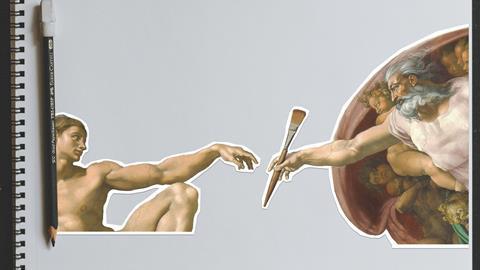
Genesis makes an extraordinary connection between divine creativity and human identity: “Let us make mankind in our image, in our likeness” (Genesis 1:26).
Human beings are made by a maker and commissioned to inhabit, cultivate and develop what He has made. Adam names the animals. Humanity is commanded to “fill the earth and subdue it” (Genesis 1:28). Genesis 2 speaks of working and keeping the garden. Human beings receive creation, but they do not merely observe it; they are invited to do something with it. This dramatically enlarges our understanding of the nature and potential of human creativity. The scientist discovering, the farmer cultivating, the parent nurturing and the architect designing are working in radically different fields. Yet each can participate in the fundamental human vocation of receiving God’s world and developing its possibilities for good.
A doctor diagnoses. A diplomat imagines a pathway through conflict. A host creates an atmosphere around a table that allows strangers to become friends. None of these things needs to be called “art” to be creative. Creativity is what happens whenever human beings take what has been given to them and faithfully imagine what might become of it.
Human beings are not automatons. God gives humans, made in His image, genuine agency. And agency creates possibility. Love cannot be coerced and still be love; obedience cannot be meaningful if disobedience is impossible.
Risk and restraint
Creativity requires space in which something genuinely fresh can be attempted.This means it involves risk. It requires imagination – the capacity to look at what is and conceive of what might be. Here the biblical contrast between creation and Babel is enlightening. In Genesis 11, humanity uses its extraordinary creative capacities to construct a city and tower: “Come, let us build ourselves a city…so that we may make a name for ourselves” (Genesis 11:4). The problem is not architecture; nor is technological sophistication inherently sinful. The problem is the purpose that human creativity has been directed towards: consolidation, control, domination and self-glorification.
“Much of life’s most important creativity occurs in places where nobody applauds or even notices”
Human beings can become so preoccupied with efficiency, optimisation and control that the means eventually begin to justify the end. The question changes from: “What is good?” to “What works?” or “What is most efficient?” The Bible refuses that reduction. Not everything that can be made, optimised or accelerated should be. This is precisely the conversation that is happening today in Silicon Valley. Three years ago, I was part of a conversation with a leader at one of the world’s largest tech companies. He shared that the company faced multiple dilemmas; they already knew how to do a number of things that competitors on the other side of the world were rolling out. These innovations were not illegal, and would certainly be profitable, but the leadership had decided not to go there, for the good of humanity. He, and several others in the room, were Christians. They described how leaders without a faith were looking to them to articulate an ethical stance that others intuitively or culturally agreed with but couldn’t put into words. This is a wonderful example of how a Christian theology of creativity must include a serious engagement with restraint. Human creativity is glorious precisely because it is not ultimate. We create in the flow of the Spirit and character of the God, the ultimate creator, and we work for the good of creation.
Recovering human creativity
Pentecost offers an intriguing counterimage to Babel. The Spirit does not eliminate human languages and replace them with one efficient, universal vernacular. People hear the wonders of God in their own tongues (Acts 2:5-11). Unity does not require uniformity. God’s Spirit makes communion across difference possible. Divine creativity seems remarkably hospitable to particularity.
One of the most beautiful pictures of creativity in scripture appears after Israel’s liberation from Egypt. Pharaoh’s Egypt had turned human beings into production units. Israel’s identity had been reduced to making bricks for someone else’s empire. Exodus describes a system obsessed with quotas, output and control. It is a chilling picture of humans being valued for what they produce.
What happens next is remarkable. God does not merely rescue Israel from slavery; He begins showing them what freedom is for. At the heart of this liberated community is an explosion of creativity. God says to Moses: “I have chosen Bezalel…and I have filled him with the Spirit of God, with wisdom, with understanding, with knowledge and with all kinds of skills” (Exodus 31:2-3). Bezalel works with gold and silver, bronze and stone, wood and fabric when he designs and crafts objects of extraordinary beauty for the tabernacle. This is the first example of someone being filled with the Spirit in the Bible.
We create meals and businesses, friendships and families, institutions and gardens
The contrast with Egypt could hardly be greater. The slaves who were forced to make identical bricks are now invited to make something beautiful. They are no longer building monuments to Pharaoh’s power; they are constructing a place for God’s presence. The individuals are named and they exercise specific gifts, skills and callings. The tabernacle is colourful, textured and fragrant. God’s liberation – and the filling of the Holy Spirit – restore imagination to His people. In the New Testament, being filled with the Holy Spirit is often accompanied by creative expression. In Ephesians 5:18-19, it says: “Be filled with the Spirit, speaking to one another with psalms, hymns, and songs from the Spirit.” The filling of the Holy Spirit brings forth an extraordinary flow of worship, poetry and song.
One of the most creative things that leaders can do is create space in which other Spirit-filled believers can become what God has gifted them to be. Creativity extends beyond writing songs or making objects – we can create cultures, opportunities, organisations and businesses in which people are trusted rather than controlled. We can make homes and communities in which children and adults feel safe enough to attach, learn and play. We can nurture churches in which gifts that have been previously overlooked are recognised, and build schools where young people reach their fullest potential.
There is also a profound need in the Church today to rescue creativity from becoming the sole preserve of a narrowly defined typecast of ‘creative people’. Music, painting, sculpture, photography, poetry, drama, architecture, film, fashion and literature are extraordinary manifestations of human creativity and deserve far more theological attention than Christians have sometimes given them. But creativity cannot be contained there. Much of life’s most important creativity occurs in places where nobody applauds or even notices.
Forgiveness can be creative because it refuses to allow the past to dictate the future. Reconciliation requires imagination because somebody needs to conceive of a relationship beyond the conflict that currently defines it. Parenting is endlessly creative because no formula can anticipate every situation.
Hope made visible
At the very centre of the Christian faith stands the ultimate expression of divine creativity: Jesus Christ. The Christian doctrine of creation reaches its astonishing climax in the incarnation, because the God who makes the world does not remain outside His creation; the Author writes Himself into the story. “The Word became flesh and made his dwelling among us” (John 1:14). The one through whom “all things were made” (John 1:3) enters the material world He created, taking flesh, inhabiting time and becoming visible, touchable and knowable.
“Creativity is the human capacity to imagine, discover and make new possibilities from what has been given to us”
And when He comes, Jesus Himself communicates with extraordinary creativity. He tells stories about farmers scattering seed, women searching for coins, fathers running down roads and merchants discovering pearls; He draws attention to lilies, birds, bread and vineyards, taking the ordinary materials of creation and revealing through them the invisible realities of God. He heals broken bodies, restores damaged lives and transforms water into wine – acts of re-creation, signs that the creator has entered His creation to make all things new. And then, supremely, at the cross and resurrection, God takes the darkest materials imaginable – sin, suffering, violence and death – and brings from them reconciliation and resurrection.
The biblical story begins in a garden and ends in a garden-city. In Revelation 21–22, the culmination of God’s purposes is not humanity escaping creation, but creation renewed. Intriguingly, “the glory and honour of the nations” are brought into the New Jerusalem (Revelation 21:26). The biblical trajectory doesn’t move from the Creation through the Fall to decay, abandonment and destruction, but through redemption towards a new creation.
Christians do not create because we believe human ingenuity will save the world. Nor because we think everything we produce will last. We create because the resurrection of Jesus Christ makes the hope of a final resurrection certain. Every act of faithful creativity is a small resistance; it sets a course of hope for those who believe towards the return of Christ and eternal life in the new creation.
We make beauty where there is ugliness, peace where there is hostility, community where there is loneliness, order where there is chaos and possibilities where there have been none because we are confident of our future eternal home. We write songs, paint pictures, take photographs and make beautiful things simply because beauty provides a glimpse of that future hope. A Christian theology of creativity is far more expansive than a theology of the arts; it is a theology of human vocation. It sits within a framework that has provided meaning and hope to millions for millennia.
When we create, we receive a created world overflowing with possibilities. As creatures made in the image of the creator, we are invited to respond – to discover, cultivate, combine, imagine, name, nurture, repair and make. If you are human, the question is not whether you are creative or not. The question is: What you have been given? And what, by the grace of God, might you make of it?


















No comments yet