









Rising house prices and a loneliness epidemic are among the reasons why more people than ever are considering communal living. But a new generation of Christians are rediscovering ancient spiritual reasons to embrace a different way of life, as Emma Fowle reports
You know that a trend has hit the mainstream when the Daily Mail notices. At the height of this year’s ‘nun girl summer’ (a viral internet term used to describe gen Z’s rejection of digital overload in favour of mindfulness and community), journalist Mimi Yates visited the Religious of Mary Immaculate (RMI) hostel in South Kensington.
In the video, which has since been viewed 1.4m times, young women wax lyrical about why they’ve chosen to live with nuns, despite strict curfews and a no-boys-in-your-bedroom rule. Obviously, there’s the draw of cheap accommodation in an otherwise expensive city (house prices are now nine times the average annual wage), but the video also reveals something deeper.
Despite only intending to stay temporarily, Sophia says she’s found friendship and safety in the religious community and has no plans to leave. Meanwhile Karen, who is training to be a burlesque dancer, says the nuns are non-judgmental, supportive and “100% like sisters” to her.
It may seem like an odd set-up, but the surprisingly sweet clip highlights the deeply human need for connection. Sister Maria explains that RMI is a worldwide order committed to sharing ordinary, everyday life with young women who are often far away from home. These nuns say hospitality is part of their calling and “nothing extraordinary”. And yet, in an increasingly individualistic world, perhaps it is.
Home alone
In 1604, Sir Edward Coke enshrined into law the immortal phrase: “For a man’s house is his castle, and each man’s home is his safest refuge.” The maxim, now as much a part of British culture as red telephone boxes and afternoon tea, started life as a legal ruling over an unpaid debt, and the rights – or otherwise – of the State to enter a private home. In the 400 years since, it has been quoted by prime ministers and playwrights, and over time, become shorthand for something else: the right to defend one’s property, and to enjoy the peace and privacy of your own home.
But these apparent virtues can come with a shadow side. After a landmark survey of people across 140 countries, the polling company Gallup declared that “almost a quarter of the world feels lonely”. The World Health Organization has warned that social isolation is as bad for your health as smoking 15 cigarettes a day. The Christian writer and broadcaster Sheridan Voysey says we’re living through a “friendship recession”. Society is more fragmented and divided than ever; and Christians are not immune to these pressures.
Alternative ways of living tend to emerge during times of social instability, says Lakshmi Piette-Walker, who visited more than 19 intentional Christian communities around the UK before writing a book about her experiences.
Just as communes arose from the hippie movement in the 1960s and 1970s – itself a rejection of capitalism, materialism and the twin threats of the Cold War and the Vietnam War – today, many young people feel let down by secularism, politics and the promises of our modern world. “When the status quo is no longer fulfilling people’s needs, these pockets come out,” says Lakshmi. “[People are saying]: ‘This isn’t working for us. What’s the alternative?’”
Ancient answers
Of course, while the modern drivers towards an alternative model for living may be new, the answer, Lakshmi says, is not. “Christians have been doing this for literally 2,000 years.” Acts 2 records the early Church living in a much more integrated faith community than many of us do today. Scripture says they had “everything in common” (v44), selling their “property and possessions to give to anyone who had need” (v45) and meeting together for worship and food every day. Their commitment to living life together asks hard questions of the way many Western Christians live today.
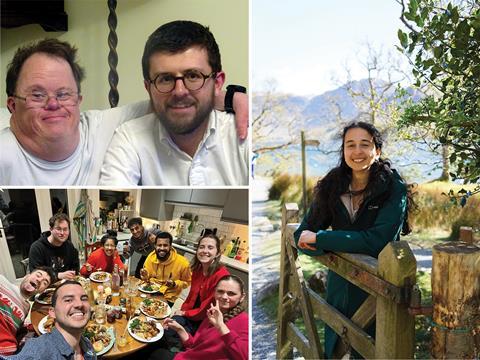
After graduating from university, Lakshmi found she missed the sense of community she had found there. At the suggestion of a friend, she applied to live at Lyn’s House, an intentional Christian community set up in 2013 to foster “life-enhancing friendship amongst people with, and people without, intellectual disabilities”. Initially, she had plenty of reservations. She had little experience of people with learning difficulties and was reticent about the regular rhythms of early morning prayer and meeting with a spiritual director. Yet, following the persistent tug of the Holy Spirit, she joined the community, and lived there for two years.
She now calls it “one of the most transformational experiences” of her life. “Heaven really became real for me there.” Choosing to live in close proximity to people who you otherwise wouldn’t “refines your personality and erodes your sharp edges”, she says, leaning into the sentiment behind Proverbs 27:17: “As iron sharpens iron, so one person sharpens another.”
Shared spaces
Elizabeth Oldfield is an author, speaker and the former director of Christian thinktank, Theos. Together with her husband and children, she moved into a shared home in south London with another couple during the Covid-19 pandemic. The “micro-community”, as they call it, is a long-term commitment; the two couples spent time getting to know one another before deciding to commit to a joint mortgage and a communal home. For Elizabeth, it felt like a natural way to lean into ancient biblical wisdom.
“My theory of fully aliveness is connection: with our own soul, with God, with each other and with the earth. In order to have that intimacy, we need to be seen and see each other; we need to know and be known,” she says. “In the West, we’ve been too shaped by high prosperity and high individualism. We’ve got our own little castles, and we see each other at church or home group, but we’re not in and out of each other’s lives.”
Being up close and personal with other human beings 24/7 is far more demanding than putting on your best Christian game face on a Sunday morning, she says. Talking about rhythms of prayer in church is one thing; getting up to pray with your housemates at 6am, because that is one of your rules of life, is another. “I have felt more discipled in three years of living in community than in the entire rest of my Christian life.”
Commitment to living life together asks hard questions of the way many Christians live today
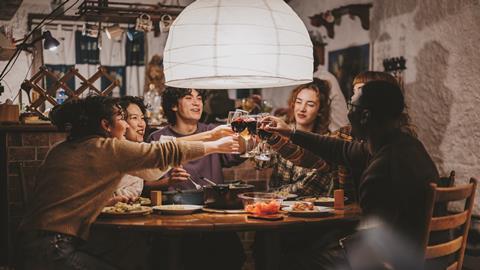
As well as morning prayer three times a week, there is also a weekly admin meeting, and a night for just hanging out and having fun together. Every fortnight they host an open table and, once a month, they take it in turns to plan a whole day together. It is a model of “mutual care and sharing what we have” that “takes the radical call of the New Testament seriously,” she says.
Christian hospitality
Three years ago, Joshua Tabti moved into a Christian community in north London. The house has five bedrooms and six paying residents. They split the bills equally and take turns sharing four rooms: two single and two shared. The rotation system enables them to keep the fifth room free for anyone in need. It’s like a “house tithe”, Joshua explains, and over the years, the room has provided temporary accommodation for reformed offenders and refugees. Each person cooks once a week and Wednesdays are ‘house night’: “we break bread together, share food, take turns to have a Bible study, sometimes something social or creative.”
For Joshua, the idea of providing accommodation for someone in need felt like an expression of radical hospitality. He’s lived with two Muslim refugees, allowing the housemates to demonstrate their Christian faith in action, even praying before meals. In return, he says the experience has made him kinder and more empathetic. “When you’re living with someone who’s escaped war and been on the brink of starvation, it puts things into perspective and makes you very grateful.
“Community is an essential part of our faith, and it can be a real blessing when we invite others into that, no matter who they are.”
Holistic faith
Choosing a different way of living that more closely aligns with your faith doesn’t have to involve a large community, however. Jack, 28, lives with just one other person. Through Christian charity, Care and Share, Jack homeshares with Christopher, who has Down’s syndrome. The arrangement provides sharers with low-cost accommodation in return for around 15 hours of support each week.
But Jack is keen to emphasise that it isn’t about the numbers. In September 2024, when a previous flatshare fell through, Jack began thinking more carefully about how he wanted to live his life. Working in the public sector and with a keen interest in politics, he wanted to live more intentionally. When the opportunity to share with Christopher arose, it felt like an extension of his calling. “Thinking about what community means from a faith perspective is something I’m very passionate about,” he says.
The way that we live is not helping us flourish
Jack talks about Christopher with obvious fondness; the two have bonded over shared interests and Jack appreciates the constant steadiness of their shared routines. There are, of course, the usual compromises that come with any relationship, and the humility of “recognising that I’m just slotting into someone’s whole life, really”.
But ultimately, Jack says that living with Christopher has built his faith. “I think he’s much more in tune with what I call the authentic, divine life. Because of his learning difficulties, he’s able to shine a spotlight on what it means to be human.”
A new way to be
As far back as 2021, mainstream publications including the BBC, The Guardian and The i Paper were reporting an increase in interest in communal living – and it’s not showing any signs of slowing down. From long-established retreat centres that also incorporate long-term communities such as Lee Abbey and Scargill House (once home to Adrian and Bridget Plass) to new co-housing developments such as Angel Yard in Norwich (where residents own homes but share communal spaces and activities), there are many different forms of intentional community that attempt to offer ancient answers to very modern problems.
“Society really only supports single people or nuclear families,” says Elizabeth. “People know that the way we live is not helping us flourish.”
The New Testament arguably hints at a different model – one that tackles inequality, provides fellowship and ensures that no one is left alone, vulnerable and unprovided for. As Elizabeth, Jack, Lakshmi and Joshua have found, the spiritual rewards that the early Church experienced are still available for us today, should we choose to live more openly, vulnerably and generously.
That may not require uprooting your entire life in order to move to a 15-bed mansion in Derbyshire, but it could mean opening your home to someone in need, sharing your table more regularly, or thinking again about your own spiritual rhythms and how you might be more present in your own church community. Wherever we live, and whoever shares our roof, there are small steps that all of us can take to live a whole-life faith that truly embodies Christ’s call to create a radical heaven-on-earth community of believers.























No comments yet