











Christopher Nolan’s latest blockbuster is a cinematic epic of monsters, battles and astonishing spectacle. But beneath it all are powerful themes of sin, sacrifice, redemption and a kingdom waiting for its king to return. Martin Saunders explores why The Odyssey has so much to say to Christians today
Good things are worth waiting for. The hype machine around Christopher Nolan’s cinematic epic The Odyssey, released in July, was running hot for a whole year after the original trailer dropped last summer. Excitement around the film barely dissipated from that point on; one reason, perhaps, that some of the world’s largest cinema screens were booked up months in advance.
Reviews have been almost universally terrific. A shower of awards will certainly follow. The Odyssey is that rare beast: a movie which actually lives up to the hype, delivers spectacularly on its promise and pleases the crowds that it draws in.
But what does the latest masterpiece from arguably the world’s greatest director have to say to Christians?
Timeless, timely and time-bending
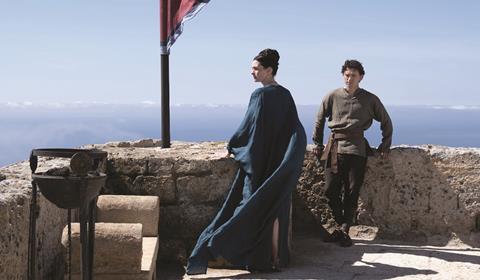
Like many of the films in Nolan’s mind-blowing back catalogue (Inception, Interstellar, Dunkirk and more), The Odyssey uses time as a storytelling device, weaving together narratives from past and present to adapt Homer’s seemingly unfilmable epic poem. In the first scene we’re thrust into the familiar middle of the story, with the infamous Trojan horse; in the second we’re with Telemachus, son of the source material’s semi-eponymous hero, Odysseus, king of Ithaca. Telemachus (Tom Holland) is waiting for his father’s heroic return from battle in Troy nearly two decades earlier, but while he clings to the hope that Odysseus is somehow still alive, much of the rest of this Greek island’s royal court has grown restless and seeks the hand of his mother, Penelope (Anne Hathaway).
The first of many themes in the movie that’ll preach is that of faithful waiting. Holland’s character is both steadfast son and watchman, looking out over the kingdom of which he is heir, and patiently awaiting the king’s return. There are echoes here of the biblical watchman, whether Ezekiel’s sentinel (Ezekiel 3) or Jesus’ doorkeeper in Mark 13. Telemachus is the one person standing between the kingdom and chaos. Fears are emerging that with no king on the throne, Ithaca is vulnerable to a legendary terror called “the people from the sea” (not mentioned in the source poem, and very possibly a nod from the British director to anti-immigration rhetoric in his birth country). As tensions rise, and a power-grab becomes more likely, the son sets off on a voyage of his own to find and bring back his father.
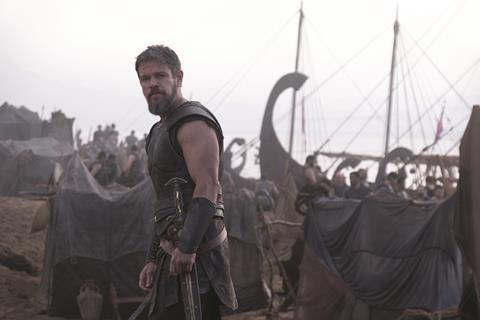
Soon we skip back in time and meet the king himself (Matt Damon), many years earlier. Victorious after a battle that Nolan deliberately saves for later, Odysseus is ready to return home. Yet while his commanding officer returns via the well-known sailing path, Odysseus believes he can both outrun the other boats and see more of the world by innovating a different route. It’s a hot-headed streak that shows up again and again, as his ill-conceived voyage leads him to battle and escape danger after danger in the quest to be reunited with his family and the once-loyal subjects of his kingdom.
Again, it all feels very sermon-friendly: a story that follows both the waiting child and the returning king.
Murderous messiah
This king is no Christ figure, however, even if on the face of things he appears to carry heroic traits. He honours his men, but he’s also directly responsible for many of them never making it home; he preaches courage but spends a significant portion of the film engaged in something approaching Monty-Python-esque ‘running away’. Inescapably, though, his life is defined by violence. He participates in and causes death and destruction wherever he goes, motivated by the shedding of others’ blood in the preservation of his own. He’s an inversion of Jesus in this sense.
Where he does seem to be entirely Christ-like, however, is through his advocacy of the Golden Rule, seen in scripture in Jesus’ command to “in everything, do to others what you would have them do to you, for this sums up the Law and the Prophets” (Matthew 7:12). This story is set around 1,200 years before Christ’s birth, of course, so it’s presented by Nolan – though interestingly not by Homer – as “Zeus’ Law”: an interpretation of the Ancient Greek rule of Xenia, by which a host will always treat their guests with the kindness and hospitality that they might wish to receive in return.
To what degree we can actually affirm this as Christian thinking is a matter of debate. Xenia predates Christianity by over a millennium, and a version of the Golden Rule shows up in Judaism, Islam, Hinduism, Buddhism and Confucianism. I don’t believe Nolan – not known for specifically Christian symbolism – is giving a nod to Jesus here. But The Odyssey does tell a story of what happens when people turn their back on an idea that just happens to be central to the Kingdom of God, and embrace selfishness instead. It asks what happens when a society stops measuring itself by the way it treats the vulnerable, and starts measuring itself by what it can take; when that defining signal of the health of any culture – how well it treats its weakest members – is stuttering and sickly. It’s a story about how easy it is to become the monster you’re trying to protect yourself from. In that respect, it couldn’t be more timely.
A history of violence
Like many movies set in a more brutal time period, the threat of violence is fairly constant throughout. There are daggers being drawn at home, as Odysseus’ family live under the shadow of a looming coup, while the rumours of “people from the sea” offer a chilling threat that mass destruction could arrive at any moment. Meanwhile, as Odysseus makes his long way home to Ithaca, he and his men find terrifying beasts, giants, witches and even the undead dotted along the route, each one carrying the threat of death or disaster. At the same time, some of the characters are clearly living with post-traumatic stress disorder (PTSD) from the truly horrific battle in Troy, which Nolan eventually allows us to see in its full awfulness in the final act. The soldiers meet almost every danger with devastating brute force, as they seek to batter their way to a kind of peace.
At first, The Odyssey appears to be unfolding as another entry in the catalogue of movies which reinforce the myth of redemptive violence – the idea that one blow of force can counteract and cancel out the impact of another. Whether that’s John Wick avenging the death of his beloved dog, or Maximus Decimus Meridius avenging his murdered family in Gladiator, the path is well-trod and acts as a kind of inversion of the Golden Rule: hurt those who have hurt you. This is, of course, the absolute antithesis of the gospel of grace.
Thankfully, it isn’t what’s going on here. Many – if not most – of the characters in The Odyssey are perpetrators of what we might call this Crimson Rule, but Nolan has the heroes acknowledge and renounce their awful mistake. As Odysseus finally returns to the family and the kingdom he left behind, he is forced to reflect on the horrors perpetrated at Troy, and the violence inflicted by his men on their journey home. They, it turns out, were the “people from the sea” all along, and although his reclamation of the throne involves a further battle, at its end there is also a necessary sacrifice; he can’t simply allow himself to hack and slash his way back to power.
It isn’t a film that promotes the myth of redemptive violence, therefore; it’s a myth that exposes the lie that violence alone can redeem, and that while atonement is sometimes necessary, forgiveness and reconciliation are what save us from the vicious cycle of sin. If the film has a talking point worth discussing in church, it’s surely this: while violence responds to sin by escalating the cycle, the cross breaks it.
A cinematic wonder
Despite weighing in at a buttock-numbing two hours and 52 minutes, The Odyssey is a spectacle worth seeing on the biggest screen possible. Shot specifically for IMAX, the larger, sound-boosted screens found in many multiplexes, it features some of the most awe-striking sights and sounds in recent cinematic memory. One scene, in which the crew of Odysseus’ ship battle a fearsome storm, is so overpowering that you may have to briefly close your eyes for respite; the depiction of some of the mythic monsters so visceral that they’ll likely recur in a few nightmares. Often, there’s such scale and ambition to Nolan’s sequences that jaws all across the theatre are left hanging open; in a world often a little caught in its own smallness, it’s a welcome workout for our sense of wonder.
As The Anxious Generation (Penguin) author Jonathan Haidt and others have pointed out, most of us have become much more prone to looking down than up, captivated as we are by the small screens we carry in our pockets. Nolan’s film draws us to the absolute opposite, and in so doing opens our minds to vast landscapes, wild and wondrous forces, and the powers that might lie behind them.
We hunger for stories that are bigger than ourselves, not merely because we want to be entertained, but because we want to know what our lives mean
Yet despite the Ancient Greek source material, the filmmaker offers only a gentle suggestion of the presence of true deities. There are certainly plenty of moments where incidents are ascribed to the will or actions of the ‘gods’, but nothing is presented as evidential. The opening caption of the whole film even says that what follows is set “In an age of supposed magic” (my emphasis). Nolan seems to be suggesting that while their polytheistic perspective allowed ancient civilisations to make sense of the world and even to justify behaviour, the gods themselves are just another mythic element of the story. Perhaps, though he’s clearly taken with themes of redemption and sacrifice, this is Nolan’s worldview overall.
Song of sins
There’s a moment in The Odyssey where the hot-headed hero asks to be tied to the mast of his ship while passing the island of the Sirens. The story is familiar in popular culture; any man who hears their enticing song is compelled by the insatiable desire to sail towards them (and their own doom). While the rest of the crew survives the journey by plugging their ears with wax, Odysseus passes through and hears the song in full – the only man to ever do so and survive – but is driven half-mad in the process.
When they are clear, and he is untied, his shipmates ask him what the song was like. Odysseus replies, shaking: “It told you what you most want is what you most can’t have…and that the most you can’t have is what you already had and lost. It was a song of all the promises I failed to keep. And it told me I don’t really want to go home.”
Again, this is nothing like Homer’s original. Nolan brings Odysseus to a devastating realisation: that by devoting himself to war, violence and ill-conceived quests, he has left behind the greatest things he could have ever won: love, family and a community that cares for everyone. Violence could never bring him this; nor has it even won it back for him. His problem isn’t simply that he has lost his way home. He has lost sight of what ‘home’ was for in the first place. Sin has got in between the man and everything he ever wanted. Once again, that’ll preach.
The quest for more
The Odyssey is full of themes and moments that will probably pepper sermons across the world for years to come. Above all, though, it’s the runaway success of the film which is perhaps most instructive. Cinema trips are an expensive luxury for most, and with a proliferation of media platforms available, so many of us have got out of the habit. Despite being based on a book that few have read, and set in an era long before superheroes and sci-fi epics were even imagined, it has already taken well over $1bn at the box office.
While violence responds to sin by escalating the cycle, the cross breaks it
Why? Partly because Nolan is now one of the most trusted directors in the world, and partly because he has assembled a phenomenal array of actors to tell his story (Jon Bernthal, Lupita Nyong’o, Robert Pattinson and Samantha Morton all deserve a mention in the superb supporting cast). Mainly, though, it’s because he has lifted our eyes with the promise of a genuine epic: a story full of awe and wonder, which tells us something enormous and important about what it is to live as human beings.
Perhaps that is the most important thing we can take from its success. We are creatures who were made to look up. We hunger for stories that are bigger than ourselves, not merely because we want to be entertained, but because we want to know what our lives mean.
Horrendously cliched as it might sound, the Christian faith has an epic story that does all that and much, much more. While we might have to wait for Christopher Nolan to turn his hand to an adaptation of the Bible, we can be inspired by his success to keep retelling our own great epic, to a culture ravenous for stories full of awe, meaning and hope.
The Odyssey is now showing in cinemas

























No comments yet