



The BBC and other legacy news organisations are often criticised – sometimes rightly. But Martin Saunders argues that Christians should be wary of abandoning trusted journalism for a digital world of AI-generated misinformation, biased influencers and echo chambers
Before 1978, most Americans rarely thought about the Holocaust. That might sound like an outrageous claim. How could the country with the largest Jewish population outside Israel have paid relatively little attention to the greatest atrocity ever committed against the Jewish people? Yet historians broadly agree that this was the case.
While the Nuremberg Trials became front-page news, and their findings made their way into history textbooks, most Americans didn’t dwell on this specific aspect of the second world war story. Survivors, traumatised by their experiences, were often unwilling to speak about them. After the war, many Americans preferred to look forward rather than back. Then, as the cold war loomed and brought fresh anxieties, memories of the Holocaust faded from public consciousness. There was no national day of remembrance and the Holocaust had not yet become the defining moral reference point that it is today. So, what changed?
In 1978, the TV miniseries Holocaust was broadcast by NBC (the National Broadcasting Company of the USA). Over nine and a half hours, a cast that included Meryl Streep dramatised the devastating story of Nazi atrocities through the eyes of a fictional Jewish family. It was a meticulously researched story that spared no details, made by one of America’s most trusted broadcasters. Each episode was almost two hours long and the series ran on consecutive evenings through a single week. But despite the gruelling run time and subject matter, unprecedented numbers of Americans tuned in. The series was watched by 120 million viewers, and in an era long before home recording or TV catch-up, they were largely all watching at the same time. An entire nation absorbed, wrestled with and cried over the same terrible but vital story. America’s dinner tables and watercoolers were dominated by the same singular topic. And after the dust began to settle, the country’s relationship with the Holocaust changed forever. The true, terrifying reality of what happened has now taken its rightful place in the public’s collective consciousness.
This is one of the unique strengths of mainstream media; the collection of mass-audience platforms which both reflect and help shape the beliefs of the general public. It has an ability to place important truths before the whole of society at once, creating a shared moral conversation that extends far beyond individual echo chambers.
Lamestream lies
Over the past decade, significant questions have been raised about the legitimacy of these platforms, especially those that receive public funding. There have been accusations of partiality, bias and elitism. There have been calls for greater and more diverse freedom of speech than they appear to allow. Many critics believe that the kind of cultural influence capable of changing a nation’s mind is simply too great to reside in a relatively small number of institutions.
Often, the battle is waged on the grounds of news media; traditionally constituted of newspapers, print magazines, radio and TV stations. In the UK, the BBC has been particularly targeted, with some even calling for the public broadcaster to be defunded. In the US, opponents have claimed that CNN is seeding a leftist conspiracy. There are loud and consistent calls for reform; cries to the general public to wake up and stop believing the ‘establishment lies‘ of these biased platforms, which many claim have an in-built, left-wing bias.
In today’s media economy, conviction often matters more than verification, certainty more than evidence and personality more than expertise
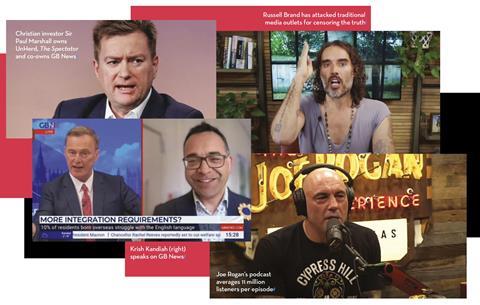
At the same time, we’ve seen an apparent democratisation of media and, significantly, news. It would be naive to suggest that these two phenomena aren’t connected; one might even argue that they‘re part of the same strategy. Prominent YouTubers and podcasters such as Joe Rogan and Russell Brand decry the ‘lies’ of the mainstream press, even as their own outlets soar in popularity and influence.
It would also be naive to suggest that mainstream media is above reproach. From the tabloid phone-hacking scandals to demonstrable biases among certain journalists and the influence of commercial pressures on whether a story runs or gets spiked, there are a myriad of ways to pick holes in the behaviour and output of mainstream platforms. It is also fair to expect a different standard from publicly funded broadcasters, and that standard is frequently unmet. The BBC has been criticised for both anti-Israel and anti-Arab bias; for hostility against Christianity; for harbouring the known abuser Jimmy Saville and a long list of other complaints.
There is no doubt that mainstream platforms are far from perfect. To their critics, however, they’re held against an impossible standard; one of total impartiality, balance and flawless judgement. Then, as criticism has mounted, the alternative has emerged: a multiplicity of new voices. Now, anyone with a camera and an internet connection can be a ‘news’ reporter or commentator, and anyone with a big enough donor base can set up their own multimedia news platform. Most mainstream news organisations still employ qualified journalists who operate within editorial structures designed to test claims, verify sources and correct mistakes. Those systems are imperfect, but they exist. By contrast, the barriers to becoming an online commentator are almost nonexistent. No training in media ethics or law needed. In today’s economy, conviction often matters more than verification, certainty more than evidence and personality more than expertise.
Faith in the news
The shifting of the media landscape has intersected with Christians and the Church in a range of ways. GB News, the right-leaning broadcaster which pitches itself as an alternative to the mainstream, is co-owned and funded by evangelical Christian, Sir Paul Marshall, who is also a key funder of the Church Revitalisation Trust and Holy Trinity Brompton (HTB). GB News has regularly conflated Christian and British values, for several years platforming the controversial clergyman Calvin Robinson who fronted a show titled Calvin’s Common Sense Crusade. However, it also features more mainstream Church figures, including Dr Krish Kandiah, and is felt by many to hold a generally sympathetic view towards people of faith – or, to be more accurate, Christian faith; it broadcasts a daily reflection which is exclusively Bible-based.
Contrast this with many people’s opinions on how the BBC treats the Church. While religious programming was once widespread, now it’s reduced to a handful of mainly local radio broadcasts, and half an hour of Songs of Praise. In dramatic content, Christians often complain that clergy are disproportionately portrayed as hypocritical, damaged or morally compromised. Positive portrayals are comparatively rare whereas other faiths are generally treated with respect. It’s perhaps understandable that some Christians feel the mainstream media doesn’t understand or support their faith, but this has now grown into a broader scepticism about the industry as a whole.
Elsewhere, the proliferation of voices enabled by social media has led some to prefer – and trust – seemingly more independent voices. Young Christian Instagram channel The Way UK, which is backed by the Church of England, provides viewers with a regular diet of unopposed Christian content, as do a number of bedroom-based, faith-filled influencers. There’s a big difference between the two, however: the first has a clear board of reference and oversight, while the latter is entirely independent and can say whatever they want. Yet the algorithm serves both to the users with the same weight and merit; as if they are equally well-researched and accountable.
Truth doesn’t move people to action; incendiary lies are much more motivating
In the same way, non-mainstream media are often happy to give airtime to any voice that agrees with their agenda. A qualified dermatologist and a skincare influencer are not the same, yet for the purposes of online content, their experience, skills and qualifications become flattened out. In this context, what‘s the difference between a trained New Testament theologian, and say, a 20-year-old Instagrammer offering his first thoughts on the Bible? In a sense, nothing at all.
The commander with a journalist’s instincts
There are obviously no references to the media in the Bible; as a concept it was well over 1,000 years away. But there are stories that speak to the importance of getting the facts right, and to the value of a trusted voice in authority.
In Acts 21, Paul arrived in Jerusalem and immediately stirred up a visceral reaction among the people. “The whole city was aroused, and the people came running from all directions” (v30). They seized Paul, dragged him from the temple and attempted to murder him. The Roman commander stepped in and put Paul in chains; but he also hit the brake pedal. Before allowing a man to be punished, he needed to establish the facts. Was it true, as the people claimed, that Paul had defiled the temple by bringing Greeks inside? Was he an Egyptian revolutionary, as another rumour suggested? Did he lead 4,000 terrorists into the wilderness?
Of course there was no truth to any of these stories, but that didn’t stop them from spreading like wildfire. All the influencers in Jerusalem were putting their own spin on who Paul was, and why he deserved to die. All of them omitted vital details: that he was actually a Roman citizen by birth, and formerly a Jewish teacher of the highest pedigree. Truth doesn’t move people to action, however; incendiary lies are much more motivating.
Thankfully, the commander had sober instincts. He tried to understand what was going on, but “could not get at the truth because of the uproar” (v34). So, he took Paul away for his own safety while the facts could be established. The commander listened to both sides and then assembled the chief priests and the Sanhedrin. Eventually, he decided that an even greater level of scrutiny and justice was required and, among escalating violence, sent Paul to Governor Felix to stand trial.
History shows that one of the easiest ways to consolidate power is to undermine confidence in independent institutions capable of scrutinising it
I’m sure you don’t need me to point out the parallels to the modern world. In a situation where rumour and demonisation were getting out of control, God used the trusted voice of authority to get to the facts with real judgement. Was the Roman commander a flawless man, or a representative of an unblemished institution? No – he was the pagan face of a violent, occupying empire. However, he was good at the job he had trained for, a wise negotiator and trying to practise justice. He represented an institution committed, however imperfectly, to investigating truth before delivering judgement. This is a good indicator of what we should prize when it comes to truth and information, and how we should attempt to ensure it is defended.
Behind the headlines
One key role of the media is to provide scrutiny to government and culture, and to help the population come to a fair understanding of what is true. That’s why, in 1978, it was used so importantly to rebalance America’s misconstrued grasp of the second world war’s greatest atrocity. It’s why so many rules are placed on our national broadcasters around national and local elections to ensure unbiased reporting. Yet ironically, it’s the issue of elections which may be driving the world’s departure from trusting the trusted voices.
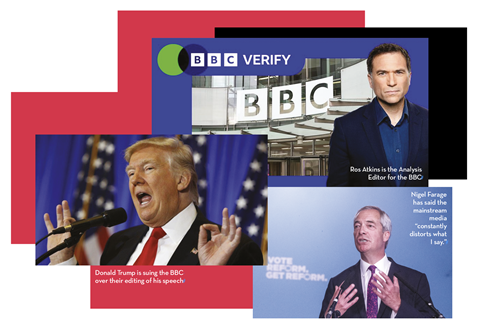
Since his first election campaign in 2015, US president Donald Trump has repeatedly criticised the mainstream media, often claiming that citizens everywhere are deserting them. According to his missives, CNN is dying, comedy show Saturday Night Live is losing viewers in droves because “there’s nothing funny about it”, and The New York Times is “failing”, “corrupt and unethical”. In fact, he finds the latter so reprehensible that he hit it with a $15bn lawsuit for damages last September – the latest move in his one-man war against what he has christened the “lamestream media”. A similar playbook has been used by Reform UK leader Nigel Farage, who recently posted a video on social media claiming: “The mainstream media constantly distorts what I say. You can no longer rely on them to report the truth.”
History repeatedly shows that one of the easiest ways to consolidate power is to undermine confidence in independent institutions capable of scrutinising it. What happens when those voices are quieted? The alternatives emerge. Unregulated influencers, self-proclaimed experts, news networks that don’t even pretend to offer balance and social media accounts that use AI-generated images to peddle a curated truth. Rather than helping the nation understand what is true, they push it towards bias. They are the crowd that surrounded Paul, making claims based on what they hoped was true, or on what best served their interests. In both contexts, we should thank God for the trained, trusted mediator, and those who value verification and accountability above convincingly-expressed opinion.
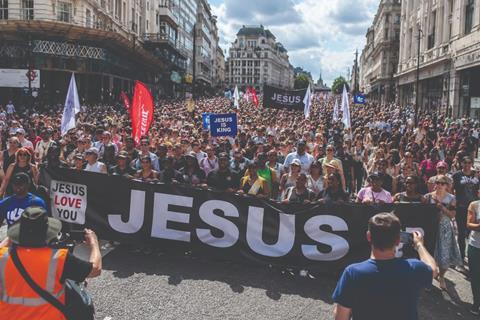
The intensity of fake and AI-generated reporting and images is growing by the day. When England were beaten by Argentina in the recent men’s FIFA World Cup semi-final, social media was awash with fabricated quotes from star player Jude Bellingham and manager Thomas Tuchel, seemingly aimed at stoking an imagined conflict between the two. The Church is not immune to this phenomenon either. After the Jesus March attracted a respectable number of people to the streets of London in May, online influencers shared ludicrous AI-generated images of a city brimming with a tide of excited believers. A BBC journalist might let their bias slip into their reporting, but they wouldn’t knowingly generate a fake image and pass it off as real. We have to be able to tell the difference.
If we are driven into silos by tailored content which confirms our biases, the consequences for society are terrifying
Christians have never believed that every voice carries equal authority; that’s why so many of us have deserted X (formerly Twitter). We distinguish – or at least try to – between false teachers and faithful ones, between wisdom and foolishness, gossip and testimony. We weigh and test things because truth matters. Journalism, at its best, shares our instincts here. It is not infallible, but it is accountable.
There are plenty of problems with the mainstream media. It should be held to a high standard, as it carries a cultural credibility that enables it to be trusted. Yet we must be realistic about the challenges of the alternative: the Wild West of self-proclaimed expertise, inviting us to trust its content, then generating it using AI. The issues are not the same, or even of the same order; the challenges of free-for-all media are deeper and much more dangerous. If we allow ourselves to be driven into silos by tailored content which confirms our biases and warps our perception of truth, the consequences for society and its cohesion are terrifying.
I might have concluded by imagining that, in 2048, a documentary airs that seeks to persuade a whole nation that the Holocaust was a hoax. Then I realised that various versions of that film already exist. For now, these reprehensible pieces of content remain well outside the mainstream. Yet, in a world without a trustworthy mainstream media, for how much longer?



















2 Readers' comments