











A quarter of a century after March for Jesus last filled central London with worshippers, the movement is being revived for a new generation. Organiser Henry George tells us the Jesus March is not political protest, but a hopeful public expression of faith at a moment when many believe spiritual openness is returning to Britain
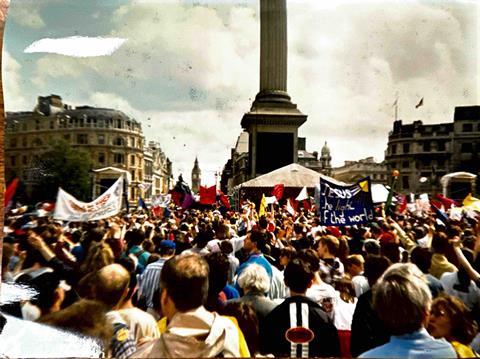
In two weeks’ time thousands of Christians are expected to take to the streets of central London for the Jesus March.
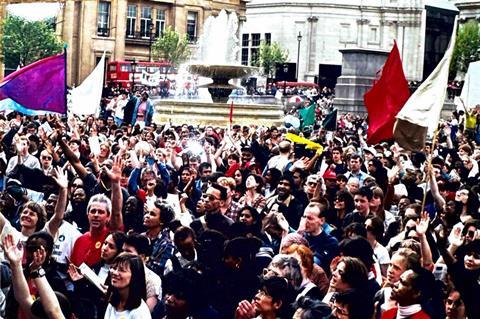
It’s the first time an event of this size has been planned in the capital since the year 2000. Back then, March for Jesus, as it was known, was becoming a global phenomenon with Christians in countless countries uniting to pray and worship in city streets.
The growth of March for Jesus had taken Icthus church leader Roger Forster and worship leader Graham Kendrick by surprise. They’d collaborated with YWAM and Pioneer to bring together Christians of different backgrounds for an afternoon of prayer and worship. None of them could have dreamed this march would spread to every time zone on earth and culminate with as many as 2 million Christians marching in São Paulo.
A generation on, Henry George has succeeded Forster at Icthus and March for Jesus is back, under a slightly revised name. I caught up with him to find out why he believes now is the time to relaunch the initiative.
March for Jesus began in 1987. Tell us how it came about.
There was lots of prayer walking, worshipping on the streets and marching happening around South London, where Ichthus was born, even back into the 70s. Often this would happen when a congregation was being planted somewhere.
The vision came from Matthew 5:16 where Jesus says, “Let your light shine before men so that they may see your good deeds and worship your Father, who is in heaven.” It also takes hold of Acts 2 where the church spills out of the building and shares the good news with those around them.
They were expecting a few thousand to be on the first march, but it ended up being closer to 15,000. It very quickly spread to other cities in the UK and then to other nations. Graham [Kendrick] was telling me how at one point towards the end of the 90s, there was a March for Jesus happening in every time zone around the whole world.
Why did it stop?
The movement was really growing throughout the 1990s and inspiring a beautiful amount of creativity. Coordinating it all under one banner and name became trickier and trickier. At March for Jesus in 2000, it was expressed as “March for Jesus is not over, but it’s over to you.” Take this model, take this passion, take these open doors and opportunities that God has given us. And lots of nations around the world did indeed carry it on.
Why are you bringing it back now?
During Covid, God started speaking to us about worship on the streets being something that we carry an anointing for. We began to feel the Lord pushing us [and saying]: “I want to move in London again”.
There has been a growing sense of worship on the streets in a lot of places. In fact, I think you guys did an article about worship on the streets and Christian buskers. There’s also a whole movement within London City Mission where worship leaders and teams are getting out on the streets and seeing incredible blessing and benefit, real fruitfulness through God at work.
Many of those who have got in touch with me, including people who weren’t even born in 2000 have been saying: “Can we do March for Jesus again?”
The policeman said: The crime rate goes down when you’re worshipping. Please, can you do it more?
The Talking Jesus research from 2022 really stirred and inspired us - there was a growing number of people who really want to hear about Jesus. There’s a sense of openness to God and the global March for Jesus movement has been regaining momentum. They’ve restarted in Belfast, Dublin, Paris, Amsterdam, across other cities and nations throughout Europe. So many of them are saying: “Look, it began with you guys in in London. When is it going to happen again?”
We did a tiny event in London between Palm Sunday and Good Friday. It was a worshipful prayer walk with probably about 100 of us. While we were worshipping in the street, this young man ran up to us. He looked about 16. He awkwardly raised his hands and tried to join in with the songs, but clearly didn’t know many of the words. We got talking to him, and he said: “I actually became a Christian really recently, just through hearing about Jesus on Tiktok. And this is the first time I’ve ever met Christians in real life.” It was the most amazing moment. Being God’s people on the streets is so precious.
The new London event is called the Jesus March. Why have you changed the name?
There are so many other marches in London at the moment. They are noisy and are making different connections and claims to Jesus, some on the extreme far right, some on the extreme far left. As we’ve thought and talked and prayed, one of the key things we felt was that we wanted to make this change to emphasise that it is Jesus who is moving. It is Jesus who is marching.
Are you concerned that calling it March for Jesus could result in misunderstandings? That you might be perceived as a far right group with particular views around immigration that some people would perceive as racist?
Yeah, you’ve hit the nail on the head there.
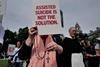
We’re not allowing anyone to bring political flags to this event or to wave national flags.
It’s not a protest, it’s not political, and it’s not a promotion of one particular ministry or church.
What safeguards are you putting in to ensure the event can’t be hijacked by people with different motives?
Our prayer target for this first march has been somewhere around 8,000-10,000 people. We’ve got a beautiful team of stewards and marshals who are going to be working carefully around the sides of the march as it moves through.
There is that sense of everyone moving to one beat and one drum and one heart step as it flows. The whole procession of praise is going to be constantly worshipping, constantly singing, constantly giving praise to Jesus. So that’s one way of safeguarding against people who may try to co-opt stuff.
When we get to Trafalgar Square, we’ll have another hour worshipping, praying, encouraging people to pray over the city, to celebrate Jesus, sharing testimonies of who He is and what He’s done.
The intergenerational dynamic is so powerful. We’re also choosing to do this on the Pentecost weekend, which marks the birthday of the Church. It says there were people from every nation on the earth, and that is what the London Church is like today. More than 50% is non-white and we want to celebrate that. There’s no division according to race. We are one as God’s people.

There seems to be a renewed sense of confidence across the Church in recent years. Sales of Bibles have increased and Gen Z seem to be particularly interested in church. The tide of secularism made a lot of Christians quite despondent for some time, but now it seems there’s a new era of openness towards the Christian faith. To what extent is Jesus March able to ride off the back of that?
You’re bang on - that is exactly what God is doing. There is a confidence and a courage on every side around who Jesus is and around the beauty of the gospel. It’s the best thing ever. In many ways, we want this Jesus March to demonstrate what is already going on. So here’s a truck, here’s a worship team, here’s some stewards. Let’s express what is in all of our hearts. Jesus is the way, the truth and the life.
We’re not allowing anyone to bring political flags to this event or to wave national flags
In some ways the march is a pushback against the hopeless narrative that a lot of people have felt for a long time. It’s pushing back against fear, anxiety, division and despair.
Is it revival? Is it pre-revival? I don’t mind. But certainly God is on the move. Certainly God is stirring his Church. And again, here’s a moment; here’s an event for the Lord to do more, to breathe more of that confidence into us.
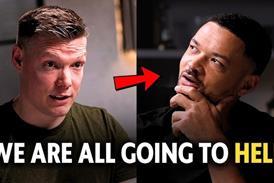
Some Christians might be thinking, I’ve seen street evangelism done before. It’s someone in the town centre with a megaphone telling people they’re going to go to hell. I’m not on board with that. What would be your response to someone who has those sorts of concerns about Jesus March?
I’m so glad you’ve asked that, because I think it’s really, really important. There are models and shapes and caricatures of the street preachers that are really heartbreaking, because they often involve people wanting to prompt salvation by preaching fear, preaching hellfire. There are people who still operate in that way. And it really does break my heart because it’s not what we see in the New Testament. It’s not what we see in the Gospels.
To those who want to see a gospel advance through fear, I would say, “Let’s get our eyes fixed on Jesus again.” We’re not trying to give people a ticket to heaven when they die, but to see something of heaven come to earth. That is what the day of Pentecost is about. That is what the whole incarnation of God in Christ is all about.
When God’s people are out there and are serving and carrying his presence, amazing things can happen. One time when we were worshipping on the streets, there was about 20 of us in an area called Belvedere. I had my guitar and two policemen came up to me. I thought: Oh, dear, I might be in trouble. I haven’t got permission to be here. He said: “You’ve been doing this quite a lot, haven’t you?” I said, “Oh, yeah, you know, we do this once a month. We love worshipping out here on the streets.” And he said, “We’re so grateful that you do this. We’re so grateful whenever you come to sing and to worship on the streets, everyone in the neighbourhood feels safe. The atmosphere changes. The crime rate goes down when you’re worshipping. Please, can we help you to do it more?”
It totally blew me away. So in a sense, I think that would be some of my answer to those who might be worried - it is amazing what God can do when we’re worshipping on the streets.
Jesus March is taking place on Saturday 23 May. For more information visit jesusmarch.org
























No comments yet