












Explosive headlines claim Noah’s Ark has been found under a mountain range in Turkey. But Chris Sinkinson says Christians need to stick to the facts
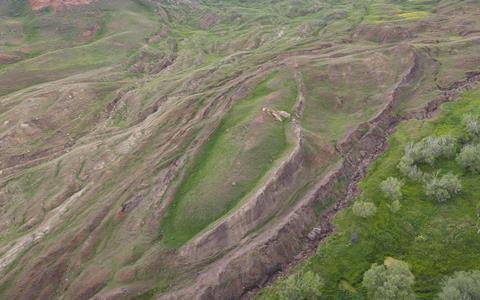
The resting place of Noah’s Ark has been “100% confirmed” according to countless headlines circulating on social media and across some tabloid newspapers.
Even celebrities such as Bear Grylls have been caught up in the sensational claims. Anyone who questions the findings is quickly denounced online as a “mocker” or “evolutionist”.
But Noah’s Ark has not been found. And for those of us who have experience in archaeology, we have very good reasons to believe the latest headlines are wrong.
Noah’s Ark could still be found. It’s also possible that a well known geological formation in Turkey (pictured, above) has been misidentified. Almost anything is possible. But Christians should maintain healthy, godly, critical thinking whether they are listening to a sermon, a lecture, a podcast or a documentary. This latest news story is a cautionary tale for Christian credibility.
The story begins…
In 1959, a Turkish army captain, Ilhan Durupinar, brought some aerial photographs of a volcanic area in the region of Ararat to the world’s attention. He had spotted a ship-like shape among the mountain folds. This was followed by some studies that concluded the shape was a natural geological feature and not man made. But the Durupinar formation, now named after its discoverer, continued to capture people’s imagination.
In the 1970s a Seventh Day Adventist from the USA, Ron Wyatt, would spend holidays around the region of the Holy Land collecting evidence for Bible events. He claimed to discover the Ark of the Covenant, the lost cities of Sodom and Gomorrah, ancient Egyptian chariot wheels at the depths of the Red Sea and even blood from the site of the crucifixion of Jesus that he had DNA tested to prove the virgin birth. Not one of these claims has ever been confirmed by archaeologists. That hasn’t stopped grainy footage and confident claims continuing to circulate online.
Ron Wyatt revived interest in the Durupinar site by claiming to have found petrified wood, iron brackets, large anchor stones and cavities in the formation. He worked with salvage expert David Fasold to publish a book in 1988 claiming that they had found the remains of Noah’s Ark.
Wyatt’s claims have never been accepted by mainstream archaeologists or geologists. Even David Fasold came to reject them and wrote a later retraction calling it ‘bogus’. Creationist geologist Andrew Snelling carried out his own survey and confirmed it is a natural formation. Even Ken Ham, of Answers in Genesis, has distanced himself from the claims about Durupinar.
This is not a debate about whether there was a flood as described in Genesis or a historical Ark built by Noah. This is a debate about what counts as evidence and how we should use the scientific method. This is where the latest renewal of interest in Durupinar is seriously problematic for Christians.
The evidence explained
Geological surveys can explain the site. Volcanic activity and mudflow shaped the rocks and some large areas do appear like ships (more than one!). What looks like petrified wood is rock. Supposed iron brackets are evidence of volcanic activity. Underground cavities are normal in fractured rock formations. Claims concerning carbon in the soil samples from the site are hardly sensational – the soil in your local park is rich in carbon.
The latest research at Durupinar involves Sivas Cumhuriyet University in Turkey and US based “Noah’s Ark Scans”. The latter organisation is raising $600,000 for the project through crowdfunding and also offering $3,500 tours of the site. So far, they have revealed nothing new in their drilling but sent samples to be tested. Stories of carbon in soil, rock that could be petrified wood, lumps of iron, broken drill bits and stolen equipment are widely circulating but results of the tests are still awaited.
To overturn 70 years of geological surveys will require carefully scrutinised test results. Until peer reviewed evidence has been given that level of scrutiny there is no reason to consider Durupinar anything other than a natural formation. So my unease is to ask why are Christians so quick to back such sensational claims and so quick to deflect any criticism as mockery?
An issue of integrity
Given decades of research, if a geological formation turns out to be the remains of a ship then it has enormous implications. If wood, anchors, chambers and rivets are found then there will be profound questions for geology, biology, archaeology and possibly theology. But that’s how science works – evidence can challenge our theories. However, what is going viral on social media right now is not science. Conclusions are being stated before the evidence has been analysed and exaggerated claims are being asserted as facts.
For Christians caught up in this we need to ask serious questions about integrity and our use of science.
Consider the young person impressed by these claims shared by a church leader. What happens in a few years’ time? As that young person grows in wider experience and critical thinking they may feel like they were sold a scam regarding Noah’s Ark. Might they not question the other stories they also heard while growing up? If you can’t trust a church leader’s use of evidence in one area, does it not tarnish every other area in which they spoke with authority?

























No comments yet