








Thanks to the power of AI, you can now listen to the whole Bible sung in the style of a sea shanty, hard rock or a Gregorian chant. It’s not to everyone’s taste, says Daniel Johnson, but its heart is in the right place
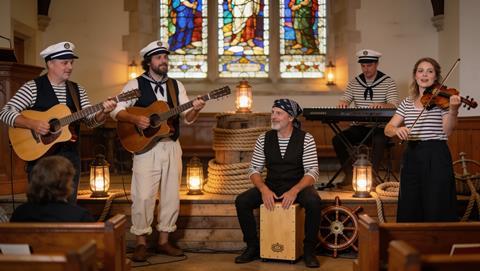
Have you ever wondered what the words of Deuteronomy would sound like if they were sung in the style of a sea shanty? Or perhaps you’d like a modern country version of Philemon? Maybe a hip hop rendition of Lamentations? What about a heavy metal performance of Proverbs?
Well, wonder no more. Thesinging.bible is a new website “created to help people experience scripture in a fresh, engaging, and memorable way – through song!”
Powered by AI, The Singing Bible aims to “make the Bible available everywhere through music to people of different ages, backgrounds, cultures and musical preferences.” They continue: “We believe Scripture should be heard everywhere—in quiet moments and joyful gatherings, by children and adults, by lifelong Bible readers and by those encountering its message for the first time.”
Only the word
So, how does it work? The process is simple: select a piece of scripture, a language (currently either English or Spanish) and a male or female voice. Then choose from one of 20 musical styles.
Usually, when we set scripture to music, some changes are made: a synonym to make things rhyme, a new metaphor to continue the lyrical sense, or even a hermeneutical lens to read the portion of scripture through the panorama of salvation history.
If you enjoy the music variety that this offers, it could be a new way of engaging with God’s word
A famous example of this would be ‘Joy to the world’, by Isaac Watts. Taken from Psalm 98 to celebrate the second coming of Christ, the famous hymn is singing scripture…ish. Thesinging.bible doesn’t do any of this. The words (taken from the Berean Standard Bible) are unvarnished, unedited and unchanged. That’s commendable.
While I doubt you could use any of these pieces in congregational worship - they lack any sense of structure or melody to make them accessible - they could be used for personal devotions.
If you enjoy the music variety that this offers, it could be a new way of engaging with God’s word. Choose a book of the Bible and a musical style, and you could spend a very happy hour listening to an AI Barbershop quartet sing the whole of 2 Corinthians to you, or the life of Joseph sung as an opera (arguably, this is at least closer to the Bible than other music-based tellings of the life of Joseph). If that is a blessing to you, go for it.
A theology of music
The Singing Bible does raise the issue of how we view music as means of doing theology. Jesus never disputes that the rocks can praise him – or indeed the mountains, rivers and stars – but He does make it clear the songs of His people are the ones He really loves.
Contemporary worship music has trained us to believe that certain sounds, tones and tempos equate to “worship music”. To a point, that’s OK. A friend of mine used to joke that you never hear someone playing Boogie Woogie piano at an altar call; we’ve somehow learned that soft padded keyboards and reverb-laden guitars playing in major keys are the only way to encounter God.
Yet historically, the Church has created all kinds of music, from the Gregorian chants of the medieval Church to the exuberance of Gospel music. No one style has a monopoly on being sacred or holy. The Singing Bible reminds us of that.
However, music as theology must be used wisely and skilfully. AI can only imitate; it cannot create. An AI simulation of a heavy rock performance of Psalm 13 jars with the agony and hope that the words contain; a wise and skilful musician could apply all sorts of musical genres to truly communicate the meaning of those words through music.
Choose to create
AI, like musical tastes, can be a polarising issue. Your favourite song might make me want to block my ears with cement, and vice versa. Some of us use ChatGPT, Gemini, or CoPilot throughout our days, and others reject any form of generative AI. I have friends who have really enjoyed The Singing Bible, and others who think that Frodo needs to take it to Mount Doom, along with the One Ring.
Personally, I can’t get past the AI-generated music. I wouldn’t choose to use this and truthfully, I’ve found it to be more of a gimmick than a meaningful devotional tool. But The Singing Bible does present believers with an invitation.
Jesus never disputes that the rocks can praise him – but He makes it clear the songs of His people are the ones He really loves
Firstly, it invites us into God’s word. Secondly, it is an invitation for the Church to equip, release and value the musicians, composers, poets, producers, singers and songsmiths to use their God-given talents, honed by hundreds of hours of diligence and practice, to really let the truths of God’s word sing.
As the website says, the number of hours it would take to produce every chapter of scripture in all these different genres would make doing so impossible. But just as we want our preachers to be saturated in scripture without necessarily needing to preach every chapter of the Bible so, too, our musicians can at least make a start.
Composers, try setting a chapter of the Bible to music. Songwriters, try to stick as closely to the text as possible. Poets, see if you can versify God’s word in a way that truly expresses its meaning. Worship leaders and church musicians, what if The Singing Bible set the high bar for how wide and deep your biblical truths and musical expressions need to go as you lead God’s people in His praises?
Cynics (of which I am one) might want to dismiss The Singing Bible. But perhaps we should accept the challenge it presents. Let’s not let the rocks cry out in praise while we stay silent.






















No comments yet