




Bob Dylan’s choice of outfit for his recent meeting with Pope Leo has drawn criticism, but what do we know about the religious beliefs of one of the most famous singer-songwriters on earth? Derek Walker explores Dylan’s miraculous conversion, evolving faith and the influence it has had on his music
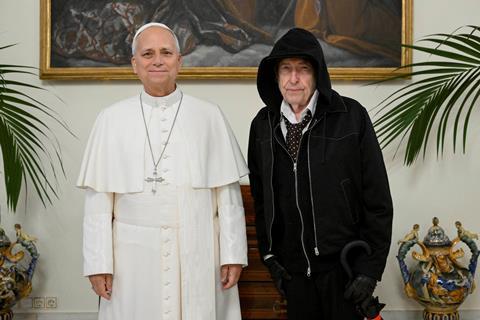
Bob Dylan made headlines last week when he met Pope Leo – not least because of his choice of outfit. Dylan has previously met - and even performed for - the pontiff’s predecessors. He even penned a song called ‘I dreamed I saw Augustine’ which name-checks the saint who formed Pope Leo’s order.
And it appears that the affection between folk singer and faith leader is mutual; Antonio Spadaro, the Vatican culture ministry official who arranged the meeting, said: “Artists like Bob Dylan… have antennae; they can be prophetic and express what they perceive about the world faster than politicians. The Pope listens and asks questions.”
Early years and Jewish roots
Born Robert Zimmerman to Jewish parents, Bob Dylan grew up in Minnesota. He spent his summers at the Herzl Camp in Wisconsin, where he formed his first band, The Jokers. While his Jewish roots led to biblical characters frequenting his songs, his musical influences were primarily folk heroes such as Woody Guthrie and Pete Seeger. In the early 1960s, he was singing protest songs such as ‘With God on our side’, which railed against religious nationalism.
Dylan celebrated his 30th birthday in Jerusalem and photographs of him wearing a skullcap at the Western Wall appeared in Israeli and American newspapers, leading to rumours that he was taking his Jewish faith more seriously.
Writers from The Dylan Centre observed: “If you look at his draft lyrics, you can see he was exploring themes of faith…It had always been present in his work.”
Christianity calling
In 1975, Dylan embarked on the Rolling Thunder Revue tour, featuring several artists who were – or were about to become – Christians. Guitarist Stephen Soles and violinist David Mansfield were also on his gruelling 1978 world tour - and Soles was particularly persistent in discussing the importance of God.
The tour took its toll physically on Dylan, while negative reviews and a divorce from his first wife, Sara, left him anxious. At the end of the San Diego show, someone threw a small silver cross on stage. Dylan picked it up and kept it in his pocket.
In an interview the following year, Dylan said: “I brought it with me to Arizona…I was feeling even worse than I’d felt in San Diego. I said: ‘I need something tonight that I didn’t have before.’ And I looked in my pocket and I had this cross.”
His music exuded a sense of joy and relief at the change he had experienced, and he was bursting to let the world know
His description of what happened next is oft quoted: “There was a presence in the room that couldn’t have been anybody but Jesus. Jesus put his hand on me; it was a physical thing…I felt it all over me. I felt my whole body tremble. The glory of the Lord knocked me down and picked me up.”
Dylan’s then-girlfriend, Mary Alice Artes had recently recommitted to her Christian faith after becoming involved with the Vineyard Church in California. Many musicians were caught up in the Jesus People Movement and began meeting together, with a more relaxed style of worship. Artes felt that living with Dylan compromised her faith, so she moved out. Her commitment impressed Dylan and added to the groundwork that others had laid.
Al Kasha, who hosted a Vineyard Bible study in his home, recalled how Dylan would stay “until three or four o’clock in the morning,” after everyone else had left. “He had 150 questions.” During that time, Dylan also attended a three-month Bible school, even turning down gigs to learn more about the Bible.
New material
The effect of Dylan’s newfound Christian faith on his music was seismic. The album that emerged was Slow Train Coming - and its reception from fans and critics alike was severe.
Many of his listeners viewed Dylan as an icon of counter-culture and saw his commitment to the institution of Christianity as a betrayal. It was the biggest shock to his fans since he plugged in a Fender Stratocaster at the 1965 Newport Folk Festival and went electric.
The lyrics’ judgemental tone didn’t help Dylan’s cause. From the first track, he preached a stark choice: “It may be the devil / Or it may be the Lord / But you’re gonna have to serve somebody.”
With significant contributions by guitarist Mark Knopfler and the celebrated Muscle Shoals Horns, Slow Train was one of the most sumptuous-sounding albums Dylan ever made. But it was not enough to stem the tide of negative reactions. Dylan had gained respect for the almost mystical style of his lyrics, but here there was no nuance; he was plain Bible-thumping.
His 1980 follow-up Saved demonstrated a softening. While it ended on a note of warning: “Are you ready to meet Jesus? / Are you where you ought to be? / Will He know you when He sees you / Or will He say, ‘Depart from Me’?”), even that has a warmer last line: “I hope you’re ready”.
The dominant feel is of a gospel celebration. The songs are melody-rich, oozing passion and dedication, wonderful for a Christian audience; but perhaps leaving the non-believer feeling like an outsider looking in.
Finding the balance
When Dylan resumed touring, he started in San Francisco – not the most forgiving audience for a new Christian – and disenfranchised the fans by omitting everything he had recorded before Slow Train Coming. Music critic Joel Selvin famously wrote: “Anaesthetised by his new beliefs, Dylan has written some of the most banal, uninspired and inventionless songs of his career for his Jesus phase.” The headline was: “Bob Dylan’s God-Awful Gospel”.
Dylan largely preferred to let the songs do the talking on stage, but he spoke a lot on this tour. His music exuded a sense of joy and relief at the change he had experienced, and he was bursting to let the world know. At one point he said: “Satan’s called the god of this world, and it’s such a wonderful feeling when you’re delivered from that.”
Ironically, many fans had looked to Dylan for answers, but when he finally found it, they didn’t want to hear. Dylan didn’t help his cause by ranting about end times with words heavily influenced by evangelical author Hal Lindsey’s The Late, Great Planet Earth (Study Resources).
There was a presence in the room that couldn’t have been anybody but Jesus
While loudly heckled, he asked, “You see how much trouble the world is in, madmen running loose everywhere… we know this world is going to be destroyed. Christ will set up his kingdom for 1,000 years in Jerusalem, where the lion will lie down with the lamb. We know this is true.
“I read the Bible a lot… It tells you a lot of specific things in the book of Daniel and the book of Revelation, which just might apply to these times here, because Russia is going to come down and attack the Middle East. It says this in the Bible.”
This was not the wisest, most accurate, nor most appropriate place to start with your hostile audience – and not what they had paid to hear. Many walked out.
In time, Dylan would reassess such statements and separate them from the core events of his conversion. He also began to re-integrate earlier songs back into his live sets, and write about subjects that were not directly related to Christianity.
By the third album of his ‘Christian trilogy’, Shot of Love, some fans began to question whether his faith was wavering. But ‘Property of Jesus’ asserts his beliefs beyond doubt.
The album ends with ‘Every grain of sand’, generally considered to be one of his greatest songs. It is written in his own style: conversational, personal and with biblical references. His love for Jesus is still evident, but his faith was maturing.
Infidels and Judaism
Nonetheless, rumours about Dylan’s return to Judaism persisted. The song ‘Neighborhood bully’ on 1983’s Infidels, covers Israel’s right to exist, referencing many events from its history and culture.
That year, he visited Israel, held his son Jesse’s bar mitzvah at the Western Wall and was photographed wearing a yarmulkah, Jewish phylacteries and tallith. Infidels’ inner sleeve included an image of Dylan touching the ground outside Jerusalem. Around the same time, he studied with Chabad-Lubavitch, an ultra-Orthodox Hasidic Jewish movement, and made appearances on their annual telethon fundraiser.
So where does Dylan’s faith stand now? Most recently, during an interview with the Wall Street Journal, Dylan actively turned the conversation to faith, saying: “I’m a religious person. I read the scriptures a lot, meditate and pray, light candles in church. I believe in damnation and salvation, as well as predestination. The Five Books of Moses, Pauline Epistles, Invocation of the Saints, all of it.”
Taken at face value, Dylan seems committed to his Christian faith, while acknowledging his Jewish roots. Some say that Judaism has taken over, but it is hard to believe that he has suddenly forgotten the moment when “a presence” entered the room, and he felt the hand of Jesus on him.

















No comments yet