








50 years after the release of the first punk record in the UK, Alex Rose celebrates a creative, revolutionary movement that gathered those at the margins. If the Church is to buck the trend of long-term decline, it needs to get a lot more radical, she says
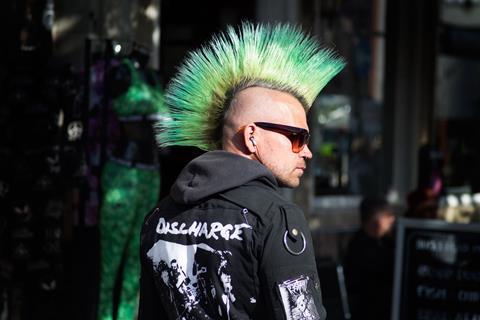
I’ve heard some random things described as ‘punk’ recently, among them: libraries, cats, childbirth, the early Church, Jesus. In 2026, to say something is ‘punk’ is to affirm its edgy authenticity or allude to some primal quality it possesses.
‘Punk’ is the ability to think differently. It is having the courage of one’s convictions and backing that up with action; questioning authority and speaking out against injustice. It is compassionate and resists dehumanisation in all its forms; making change happen, whatever it takes.
All notions of what it means to be ‘punk’ are rooted in punk music, which can be traced back to the UK’s first punk single, released 50 years ago today on 22 October 1976.
The Damned’s ‘New rose’ represented an underground music scene born in the garages, community halls and other makeshift spaces of London, before quickly spreading. When the Sex Pistols appeared on TV later that year, punk exploded into the public consciousness.
Punk provocateur Malcolm McLaren, together with fashion designer Vivienne Westwood, and artist Jamie Reid came to define the cultural moment that segued into a socio-political movement, permeating society and changing the UK forever.
Punk thrived in the gaps, provoking the Establishment with its irreverent music, outlandish fashion and mash-up art. Punk bands such as the Pistols took aim at the Monarchy and agitated those in power; they aired the complaints of people who felt kept down, standing with minority groups and those whom society overlooked.
Established atrophy
Always at the heart of punk was its DIY ethos, reminding people of their inherent creativity, sense of agency and resourcefulness. It galvanised people to do something themselves - they didn’t need anyone’s permission. Punk gave them confidence, and a way forward that didn’t rely on institutions caught up with their own survival.
But in some ways, it never gained the traction it deserved. By definition, it was fundamentally anti-establishment and therefore threatening to the status quo. When punk became established, it therefore ceased to be punk.
So, what on earth does punk have to do with the Church? In many ways, the established Church is just another institution trying to survive. Over the last 18 months, many Christian leaders have suggested we are on the brink of revival. But what does that really mean?
A wholly Christlike Christianity resists becoming established - and is even anti-Establishment
There may be signs, but perhaps revival would also prove that the Church isn’t really in long-term decline; that our time and efforts are worthwhile. Or perhaps it would recapture a lost identity, recreating a nostalgic idyll where Christianity is indivisible from British life.
Speaking on Times Radio recently, journalist AN Wilson lamented that the Church of England “doesn’t believe in itself anymore”, nor has it deployed £50 billion that could revive parishes around the country. I know these frustrations first-hand. As a layperson, I ran a failing parish church from 2024-25 and, with others, fought successfully for it to stay open.
If we want to see revival in the Church, I’m convinced that we need to do something decidedly more ‘punk’; we need a whole new way of doing things.
When we try to preserve the status quo instead of reckoning with decline, we fail to face reality. Walter Brueggemann explored this in The Prophetic Imagination (Fortress Books). We are all, in our way, subject to what he calls “the royal consciousness”, the totalism of a status quo that cannot countenance its own decline or death.
Instead, it insulates itself against intervention, preventing anything genuinely new from being born. Facing reality would invoke grief but, out of this, hope can finally emerge in the form of an “alternative consciousness”; a new thing of God that returns us to our most essential selves.
Christlike Christianity
Our identity as Christians is not underpinned by institutions but by Jesus. We were never meant to be part of an earthly Establishment. An established Christianity has often been propagated by the powerful; emperors, leaders and monarchs who utilised its ‘religion’ to ratify their nation-building goals and imperialistic endeavours; a tool of statecraft, if not subjugation. Ultimately this version of Christianity atrophies and ceases to be wholly Christlike. Instead, it becomes just another opiate for the masses.
Arguably, a wholly Christlike Christianity resists becoming established - and is even anti-Establishment. It is instead, most essentially, ‘punk’. It diffuses through society, going to the edges and gathering those in the gaps; traversing sacred and secular.
If we want to see revival in the Church, I’m convinced that we need to do something decidedly more ‘punk’
What’s more, it thrives as a movement that doesn’t require people to leave their communities or subcultures behind and join an institution. Instead, Jesus ignites their faith in situ. This Christianity is agile, supple, self-multiplying and participatory. It is what Jesus describes in Luke 17:21 as a Kingdom “in your midst” (or “within you” in other Bible translations).
If the body of Christ is to do more than survive, there is a strong case for Christians rediscovering their earliest ‘Punk’ mode and adopting a more DIY approach. And for that, we don’t need anyone’s permission.





















No comments yet