





Christians have disagreed over theology for centuries, says Stefan Tijanić. While some of those differences are substantial, many of them are rooted in misunderstanding. He explains what Orthodox Christians actually believe
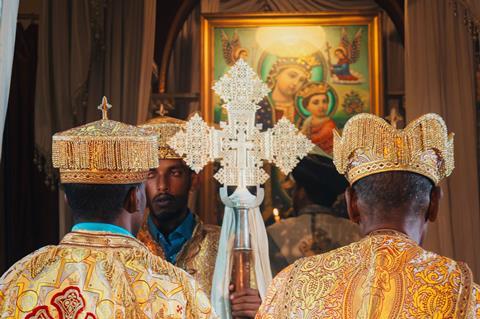
When an evangelical Christian walks into an Orthodox church, much of what they see can feel unfamiliar. The walls are covered with icons. Worshippers kiss them, light candles and ask for the prayers of saints. The service is long, liturgical and filled with ancient prayers. The priest wears vestments, incense is used, and the Virgin Mary is mentioned far more often than in most Protestant churches.
Questions therefore arise quickly. Do Orthodox Christians place tradition above scripture? Do they pray to Mary instead of Christ? Are icons a form of idolatry? Do they believe that human beings earn salvation through good works? And where, in all of this, is a personal relationship with Jesus Christ?
These are legitimate questions. Some differences between Orthodoxy and evangelical Christianity are real and should not be disguised. But some of the most common criticisms arise because Orthodox beliefs are interpreted through categories that the Orthodox Church itself does not use.
The aim, then, is not to persuade an evangelical reader to agree with every Orthodox doctrine. A useful first step is simply to understand what Orthodox Christians actually believe – and why.
Why do Orthodox Christians need tradition?
When many evangelical Christians hear Orthodox believers speak about tradition, they imagine two competing sources of authority: the Bible on one side, and on the other a collection of later Church customs gradually added to the Christian faith.
Orthodoxy does not understand itself in that way.
For an Orthodox Christian, scripture is not opposed to tradition. It stands at the heart of it. The apostolic faith was preached and lived before all the books of the New Testament had been written, gathered and recognised as the Church’s canon. This is why St Paul can tell Christians to “stand firm and hold fast to the traditions” they were taught, “whether by word of mouth or by letter” (2 Thessalonians 2:15).
This does not mean that every custom which appeared in Church history carries the same authority. Orthodoxy distinguishes holy tradition – the apostolic life and faith of the Church – from local customs, cultural habits and later historical practices.
Put simply, tradition means the living faith received from the apostles, within which the Church reads scripture.
An evangelical Christian may still believe that the Orthodox view gives the Church too large a role in interpreting the Bible. That is a genuine theological disagreement. But it would be mistaken to conclude that Orthodox Christians regard scripture as secondary or unimportant. Orthodox worship, prayers and liturgical texts are saturated with biblical language.
Why do Orthodox Christians pray to saints and to Mary?
Perhaps no subject creates more suspicion among evangelical Christians.
Orthodox Christians speak frequently of the Mother of God, kiss her icon and address her in the language of prayer. They do something similar with other saints. To an evangelical reader, this can look as though something belonging to Christ has been transferred to other human beings.
Orthodox theology, however, makes a clear distinction between worship, which belongs to God alone, and veneration or honour, which may be given to the saints.
When an Orthodox Christian says, “Saint Nicholas, pray to God for us,” the idea is not that St Nicholas replaces Christ, or that he possesses some independent divine power. The idea is more similar to one Christian saying to another, “Please pray for me.”
The difference is that Orthodoxy does not believe that the communion of the Church is broken by death. If, as St Paul says, the Church is the body of Christ, then those who have died in Christ have not ceased to belong to that body. God “is not the God of the dead, but of the living” (Mark 12:27).
Mary’s unique place arises above all from Christology. Orthodox Christians do not honour her apart from Christ, but precisely because of Christ. The title Theotokos – usually translated “Mother of God” or “God-bearer” – was defended in the early Church because it says something crucial about Jesus: the one born from Mary was not merely a human being later joined to divinity, but the eternal Son of God who truly became human.
An evangelical Christian may still conclude that asking the saints for their prayers lacks sufficiently explicit biblical warrant. That is a legitimate point of disagreement. But Orthodox Christians do not understand the saints as competitors with Christ. Whatever the saints are, they are so only because of Christ.
Aren’t icons a form of idolatry?
If the Ten Commandments forbid idols, why are Orthodox churches full of sacred images? The Orthodox answer begins with the Incarnation.
Christianity confesses that the invisible God became visible in Jesus Christ. “The Word became flesh and made his dwelling among us” (John 1:14). The Son of God did not merely appear to be human; he became a real human being who could be seen, touched and described in history.
For that reason, the question of icons is connected to another question: did God truly enter the material world?
An icon is not understood as a god, nor as an object possessing independent supernatural power. In the eighth century, the Seventh Ecumenical Council distinguished between the worship due to God alone and the honour shown to a sacred image. The honour given to an icon is directed towards the person represented in it.
That argument may still fail to convince a Protestant reader. But it is important to understand what the argument actually is. Orthodox Christians are not saying, “The commandment against idolatry no longer matters.” They are saying that an icon is not an idol because the material object is not worshipped as God.
At the heart of the theology of icons is the claim that the material world can bear witness to God because God himself has entered it.
Do Orthodox Christians believe they are saved by works?
This may be the most important question for an evangelical reader.
If there is one conviction evangelical Christianity has emphasised with particular force, it is that salvation comes by the grace of God, not by human merit. Orthodoxy fully agrees with the first half of that statement.
Human beings cannot save themselves. No number of fasts, prayers, acts of charity or moral achievements can purchase reconciliation with God. Salvation begins in God, comes from God and is possible only through the grace of God revealed in Jesus Christ.
The difference appears in the way Orthodoxy describes the human response to that grace.
Orthodox theology often uses the word ‘synergy’ – or cooperation. This does not mean that God does half the work of salvation and the human being does the other half. God is the source and initiator of salvation. But grace does not abolish human freedom. Each person is called to respond through faith, repentance, love and obedience.
Dialogue between traditions becomes possible when each side describes the other in terms they can recognise as fair
St Paul can say that we are saved by grace through faith, “not by works” (Ephesians 2:8-9), and then immediately add that we are created in Christ Jesus “to do good works” (2:10). Good works, then, are not the price of salvation. They are the fruit of a life being transformed by grace.
This leads to another important Orthodox concept: theosis, often translated as ‘deification’ or participation in the divine life.
It does not mean that a human being becomes God by nature. It means that the goal of salvation is deeper than a legal release from guilt: the person is called to be healed, transformed and drawn into communion with God. The Second Letter of Peter speaks of believers becoming “participants in the divine nature” (2 Peter 1:4).
For Orthodoxy, salvation is therefore not only the question, “How can I be declared righteous?” It is also the question, “How can a sinful human being be restored to the image of God?”
There are serious theological differences between Orthodoxy and various Protestant traditions, especially in the understanding of justification. But the claim that Orthodox Christians simply believe in “salvation by works” does not accurately represent Orthodox teaching.
Where is the personal relationship with Jesus?
An Orthodox Liturgy can appear highly formal to an evangelical visitor. Most of the prayers are prescribed. The priest has a distinctive role. There is a fixed order, together with hymns, gestures, incense and symbols.
Where is spontaneity? Where is personal faith? The Orthodox answer would be that liturgical faith and personal faith are not opposites.
Christ teaches his disciples personal prayer, but he also gives them a shared prayer: “Our Father”. The first Christians “devoted themselves to the apostles’ teaching and to fellowship, to the breaking of bread and to prayer” (Acts 2:42).
The Liturgy challenges the idea that Christianity is only a private relationship between Jesus and me. A Christian is a member of Christ’s body. He or she prays with others, receives the Eucharist with others and enters a life larger than any individual’s passing emotions.
This does not mean that inward or personal faith is unimportant. Quite the opposite. Orthodox spirituality places great emphasis on repentance, personal prayer, fasting, the reading of scripture and the continual remembrance of God.
The problem comes when outward form is separated from inward faith. The Orthodox tradition is well aware of this danger. A person can attend the Liturgy, light candles and keep the fasts, yet remain spiritually cold.
The Liturgy is not a substitute for encounter with Christ. It is meant to be one of its deepest expressions.
What about nationalism and politics?
There is another issue Orthodox Christians should not simply dismiss as a Western prejudice.
Orthodoxy often appears in the media alongside national identity, state politics or geopolitical conflict. Serbian, Russian, Greek, Romanian and other national labels frequently stand beside the name of an Orthodox Church.
A Western observer may therefore conclude that Orthodoxy is primarily the religious expression of a particular ethnic group.
There are historical reasons why the bond between Church and national identity became very strong in many Orthodox societies. At different points in history, the Church helped preserve language, culture and communal identity through foreign rule, persecution and major political upheaval.
But historical explanation does not mean that every alliance between religion and nationalism is theologically justified. At the deepest level of its self-understanding, Orthodoxy is not intended to be the faith of one nation. In Christ there is “neither Jew nor Gentile” (Galatians 3:28). The Church understands itself as a universal communion that transcends ethnic boundaries.
When national identity takes the place of the gospel, that is not the fulfilment of Orthodox theology but a distortion of it.
Understanding before agreement
Orthodox and evangelical Christians will not resolve centuries of theological difference overnight. Nor should serious dialogue depend on pretending those differences do not exist.
Questions about authority in the Church, tradition, the saints, Mary, icons, justification, the sacraments and the nature of the Church are real. But dialogue becomes possible only when each side describes the other in terms they can recognise as fair.
An Orthodox Christian need not expect an evangelical reader, after one article, to begin kissing icons or asking for the prayers of saints. An evangelical Christian, for their part, need not abandon their questions.
Perhaps a sufficient first step is to be able to say: “I may not agree with everything, but I now understand much better what Orthodox Christians actually believe – and why.”
In a time when Christians of different traditions often know one another more through caricatures than genuine conversation, even that is no small beginning.

















No comments yet