









As BBC’s feel-good faith series returns for its eighth installment, AJ Gomez reviews Pilgrimage discovering that while dramatic conversions may not feature, watching strangers search for something greater than themselves – and love one another along the way – can be just as compelling
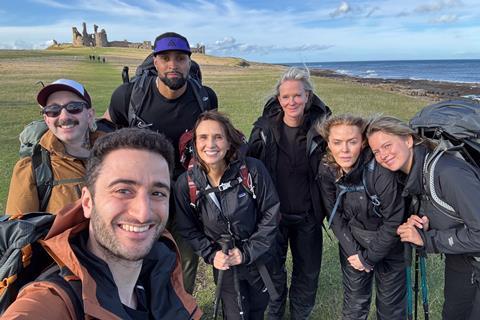
“A Jew, a Muslim and a Christian walk into a pod,” jests Hasan Al-Habib, as he and two of his fellow pilgrims, Ashley Banjo and Ashley Blake, enter the accommodation where they’ll stop for the night along their 390km journey.
At a premiere screening of the eighth season of BBC Two’s Pilgrimage at the Garden Cinema in London, it drew the biggest laugh of the season’s first episode. But in its own unserious way, it serves as an unintentionally fitting summary of what the show sets out to do.
The format remains familiar. Seven well-known personalities of differing backgrounds and beliefs set off together on a shared journey, check marking locations of Christian significance along the way.
This year’s pilgrimage unfolds over 12 days, covering 390km by foot and bus along the north-eastern coast of England and through Northumberland, before culminating at Lindisfarne, a tidal island said to be the holiest place in the country.
Visually, the series leans heavily on the natural beauty of the region – and understandably so. Northumberland offers the kind of landscape that does much of the work for you.
Every shot is a breath-taking one. Lingering frames capture the pilgrims tracing cliffside paths that cut through vast, evidently untampered-with fields, while aerial shots reveal a jagged coastline where deep blue water meets land. Interspersed are glimpses of the ancient buildings that inspired some of the Celtic Christian heritage the cast of pilgrims were exploring.
The cast are first brought together south of Whitby Abbey, the starting point of their journey. From there, the episode breaks away into a series of segments that momentarily interrupt the forward motion of the pilgrimage to sketch out who these semi-famous figures are, what they do, what they believe, and why.
It made, for me, some of the most compelling moments in the episode. Not because the stories are extraordinary in themselves, but because of how they reveal the personal histories underpinning each pilgrim’s own relationship with faith and how they interacted with it on the journey.
Ashley Banjo stands the one pilgrim who holds firmly to a defined Christian faith. He recalled having a “personal, life-changing” encounter with the Holy Spirit on the pilgrimage in an “internal, upward conversation” with God.
The others, however, reflect a more fragmented or reconfigured spirituality.
Patsy Kensit describes herself as a kind of à la carte Catholic, shaped as much by the loss of her devout Catholic mother as by tradition. Hermione Norris’ worldview, too, is marked by loss. Having lost someone to suicide at a young age, she found herself unable to reconcile that grief with Christian frameworks perceived to assign eternal consequences, like hell or purgatory, to such deaths. Walking alongside Jayne Middlemiss in the infant stages of their trail, she speaks openly about her discomfort with dogma, instead identifying as a pantheist, a belief system that equates reality with divinity.
Jayne Middlemiss, a radio presenter, was raised in the Church of England in Northumberland — the very landscape the group now traverses — she later turned towards Eastern spiritual practices, spending years in Asia exploring Hinduism and Buddhism.
Then there is Ashley Blaker. “I reckon I was in the top three most religious Jews in the world,” he jokes in the post-screeening Q&A. He speaks candidly about a once-intense devotion to Orthodox Judaism, something he now understands to have been a hyperfixation following a later diagnosis of autism and ADHD. That realisation that has since led him towards agnosticism.
Hasan Al-Habib, also a comedian, is a practising Muslim. He shared how humour has functioned both as shield and bridge, helping him navigate life growing up in the shadow of 9/11 and the Iraq war. Meanwhile, Tasha Ghouri approaches the journey from an explicitly atheist perspective, though she appears to be the most open to exploring spirituality and engaging with the beliefs of others.
One of the most striking sequences comes as the group make their way towards Durham Cathedral, climbing the 224 steep and uneven steps known locally as ‘the Steps of Doom’, before being met with their first full view of the cathedral.
The strongest point of the show is how simply, yet powerfully it displays a picture of differences that don’t have to harden into division.
The moment is visually spectacular, but it is the dynamic between the pilgrims that gives it weight. In what is the most physically taxing part of the episode, they laugh, encourage one another, and at points walk with arms linked. It is simple but it is real.
Later in the episode, a visit to Durham University offers a wholesome display of interfaith encounter. When Hasan Al-Habib heads to a campus prayer room, he extends an open invitation for others to join him. Ashley Banjo is nominated and respectfully accepts, as does Ghouri, seemingly out of openness and curiosity above all else. They simply sit quietly, watch and observe as Hasan and another woman pray.
This is perhaps the strongest point of the show. How simply, yet powerfully it displays a picture of differences that don’t have to harden into division.
Hermione Norris spoke on the verge of tears about the friendships formed over the course of the journey, describing them as among the most meaningful aspects of the experience. “Just to be in an environment where all of us felt safe enough to explore and share our beliefs, very differing beliefs, particularly in today’s climate is an incredibly humbling experience and so necessary.”
If you come to Pilgrimage expecting dramatic conversions or clear-cut moments of transformation, this may not be the series for you. It is far less interested in the conclusion than it is in process.
But in a cultural landscape where so much of what entertains is built on negativity, there is something subtly refreshing about watching a group of, at best, faint acquaintances set out in search of something greater than themselves, and choose, along the way, to love one another.
Whether or not each of them finds the truth they are knowingly or unknowingly looking for remains to be seen. But in the space they create for one another there is, perhaps, a hint of heaven that is thoroughly enjoyable to watch.
The first two episodes of Pilgrimage are now available on BBC iPlayer, with the final episode airing at 9pm on 7 April on BBC Two.