












What needs to change when a person decides to follow Christ? David Instone-Brewer looks at four ways the first Christians answered the question and the implications for us today
The commitment and zeal of missionaries in the 19th century left a remarkable legacy; today, the vast majority of Christians live in countries once considered foreign mission fields. Nevertheless, it’s clear that mistakes were made, including their desire to teach new converts British rules of etiquette along with the gospel. In the minds of some missionaries, these were inseparable. Even today, maxims such as “cleanliness is next to godliness” or “manners maketh man” are mistakenly thought to come from the Bible. A similar situation existed in the first century when the gospel was shared with Gentiles. Many Jewish believers wanted to teach them all the rules of Judaism along with the good news about the Jewish Messiah.
Some Pharisees who were converted said that in order to join the kingdom, Gentile believers must be circumcised and submit to all the other laws of Jewish ceremony and cleanliness (Acts 15:5). Paul had many arguments with them, which undoubtedly included some strong language at times. He was so frustrated by their insistence that Gentile converts be circumcised that he even wrote that he wished they’d “go the whole way and emasculate themselves!” (Galatians 5:12).
Christian change
But although the first-century Jewish believers and Victorian missionaries should have been more tolerant regarding dress, eating habits and etiquette, some pagan customs definitely had to change. And this has always been a fundamental question Christians have grappled with – what exactly must change when a person decides to follow Christ?
African converts in the 19th century had to stop eating enemy captives, and in India they had to stop burning widows on their husband’s funeral pyre. In the first century, Gentile Christians had to abandon three customs in particular.
The first was worshipping the gods, a practice that was foundational to Greek and Roman society. In fact, impiety – disrespecting the gods – was a crime punished by legal exile. Second, many new Gentile Christians had to change their sexual practices. Roman morality was permissive, openly allowing mistresses and even encouraging boys to visit brothels from about age 14 for the sake of their health. Third, converts had to stop attending violent spectacles at the Roman circus where the crowds enjoyed watching the gory execution of criminals, disobedient slaves and war captives. This was considered murder by Jews and Christians, who believed that even those guilty of capital crimes should be executed by ‘proper’ methods.
These activities broke the Jewish laws against idolatry, promiscuity and bloodshed, which were considered the most serious sins in Judaism. Unlike other commands, they were ‘mortal sins’ that could not be overruled even if there was danger to life.
Mortal sins
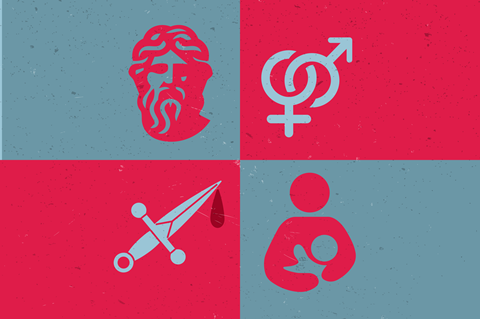
The first Jerusalem Council, which met around AD 48-50, officially decided that Gentiles could be Christians without becoming Jews, but they required four changes in lifestyle. In a letter to the Gentile believers in Antioch, Syria and Cilicia, the council summarised these minimum standards (see Acts 15:6-20) as four memorable words: “idol-offerings” (eidōlothutōn), “blood” (haima), “smothering” (pnikton) and “promiscuity” (porneian) (see Acts 15:20,29; 21:25). These are similar to the three Jewish ‘mortal sins’ with the addition of “smothering”.
Traditionally the four words have all been understood as referring to food laws: prohibitions against food sacrificed to idols, food containing blood, animals that were strangled instead of being bled and participation in post-banquet promiscuity. However, there are two big problems with this interpretation.
Even today, maxims such as “cleanliness is next to godliness” or “manners maketh man” are mistakenly thought to come from the Bible
First, Paul, who attended the council and promoted their conclusions, wasn’t concerned about eating food that might have been offered to idols, as long as believers knew that “an idol is nothing” (see 1 Corinthians 8:4-31; 10:25-32). Second, animals weren’t strangled. Imagine strangling a sheep or a cow! It was much easier to slit its throat or hit it hard on the head. Also, the word translated “strangled” (pniktos) never had this meaning in Greek literature except in later Christian writings. In fact, a computer search through all of ancient Greek literature found this word to be very rare (see here). When it does occur, it is used in engineering works to describe a ‘smothered’ air-tight joint or, occasionally, to describe a method of killing: smothering a newborn.
Gather the little children
In the ancient world, surgical abortions were too dangerous to perform, so unwanted babies were killed at birth. In a traditional Roman family, every newborn infant was placed at the feet of the pater familias – the male head of the household. He would either pick it up or walk away. If he walked away, the unwanted baby was ‘exposed’ – that is, abandoned in a remote place to die or be taken in by others. But Roman cities were not rural idylls where shepherds found and adopted newborn babies. Ancient writers such as Philo tell us what ‘exposed’ meant in practice: these infants were quietly smothered.
The new Jewish Church was so outraged by this practice that they added the fourth law – a prohibition on “smothering”. Rather than teaching the new Gentile converts Jewish food laws, they concentrated on the four fundamental laws forbidding idolatry, sexual immorality, bloodshed and infanticide.
The broad consensus among both secular sociologists and Christian missiologists is that historical missionaries focused unduly on bringing Western civilisation to different cultures, believing it to be a necessary foundation for a Christian life. But if the Church, through the centuries, had understood these four fundamental changes required of Gentile converts, the emphasis on what to teach new Christians would have shifted dramatically…And what a different world might now exist.

























No comments yet