











God tells us to “be fruitful and multiply”, yet birth rates are falling and starting a family is becoming increasingly difficult for many people. Lois McLatchie-Miller explains why she believes the Church has a vital role to play in helping families flourish
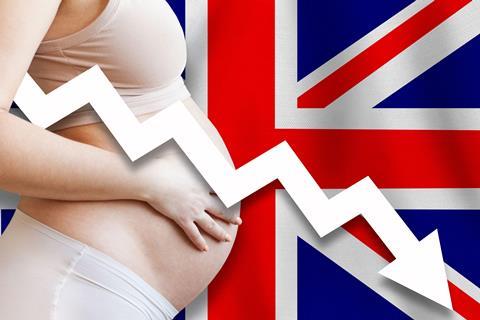
Research reported in The Times this month found that almost two in five British women become mothers later than they would have wished - on average, waiting six years longer than hoped.
The study also noted that women have fewer children than they want – desiring an average of 2.4 children, yet having just 1.6. Financial pressures, workplace demands and difficulty finding the right partner were among the reasons women gave for delaying motherhood.
Religion has always been associated with higher fertility, with Christians tending to have more children and start families earlier. Yet research from think tank Logos Scotland reveals a gap even within Christian communities. Its Faith and Family in Society survey found that Scottish Christians considered an average of 2.8 children necessary for a family to flourish, but reported having just 1.8 themselves.
It’s no wonder, then, that the national birth rate has plummeted. Scotland recorded just 45,067 births in 2025, the lowest annual total since records began in 1855. With 61,726 deaths, the country experienced more deaths than births for the eleventh consecutive year. That trend now exists across the whole UK. The Centre for Social Justice estimates that around three million British women aged 16 to 45 could remain childless under current trends.
Some couples marry young and experience infertility anyway. Other people want to settle down but can’t find the right partner. In modern society, many are encouraged to substitute children for a career, or extend adolescence into their thirties before realising time is running out within their reproductive window. The culture we swim in enforces the message that parenthood is a choice that can be discarded in young adulthood and picked up much later with IVF treatment or other technological measures – with few reading the small print that such interventions carry excessive price tags, troubling ethical quandaries, and much lower success rates than one might expect.
Why should Christians care?
First, because God tells us to. “Be fruitful and multiply” is the command of Genesis 1:28. God’s commands are not arbitrary restrictions on human freedom; Christians believe they reflect what is good for us. Looking around, we can see the impact of falling fertility has been harmful on our friends and neighbours.
Look firstly at the societal macro-impact. An ageing population with fewer workers supporting more pensioners places mounting pressure on the tax base, the NHS and social care. Migration can help address labour shortages, but cannot eliminate the challenges of an increasingly top-heavy demographic structure where the population has more dependent needs than can feasibly be met. Christians should care because the poor and vulnerable will bear the brunt of the consequences. Most of us don’t want to be cared for in old age by ChatGPT.
A society that takes women seriously must take fertility seriously too
There is a more individual reason, too. Human beings are made for relationships of mutual care: nurturing children, supporting one another through adulthood and caring for the elderly. Isolation is already having a dark social impact. Roughly 1 in 3 households are single-occupant. About 3.5 million UK adults report feeling lonely often or always. Logos Scotland reports that those aged 16-34 now report higher levels of loneliness than older generations.
If women want to become mothers but find that the opportunity slips away, something is broken in the way society enables people to build their lives. Too often, society celebrates the declining birth rate as a victory for “choice” - but the data repeatedly shows childlessness is coming not through choice, but through circumstance.
At least some of the blame lies in the constructed conveyor belt of 21st century life. For most of us, a certain expectation of timing and sequencing is drilled into us from school: education comes first, career second, financial security third, and children only when everything else is in place. But life rarely offers such perfect conditions. Finding a perfect partner cannot be scheduled; and with the reality of the job market, housing and financial stability are more elusive for the young than for generations past. Waiting until we are truly “ready” could push us well into our forties.
That schooling also fails us when it comes to understanding our own biology. Sex education classes teach us how to not get pregnant. Few are told that fertility begins to noticeably decline around the age of 30, before hitting a steep drop around age 35.
Young people deserve positive, realistic education about relationships, fertility and family formation. What if instead of just handing us a sparse leaflet about birth control, schools taught us how to date wisely, recognise healthy relationships, marry well and understand the biological realities of postponing parenthood?
A better attitude to family education, and a societal recognition that most women (and men!) actually do want children, would set up a far more empowering and supportive society for us to realise our aspirations. The Church has a role to play here in modelling excellence in community life, rallying around young families with support. Providing a meal train for new mums; a playgroup for toddlers; a network for young parents and welcoming even the loudest crying babies into church spaces can make a big difference. A society that takes women seriously must take fertility seriously too. A country where families can flourish is one where individuals and communities can, too.
























No comments yet