


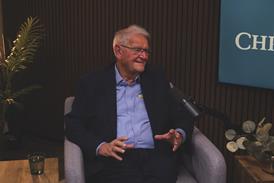


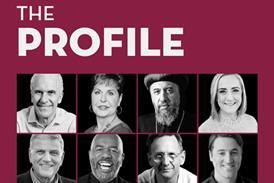

Dr Andrew Ollerton, theologian, author and the mind behind The Bible Course, sits down with Sam Hailes to reflect on his call to make scripture accessible, his friendship with Bear Grylls, and why the church must seize a once-in-a-generation moment of spiritual openness
It could be argued that leading a small group has never been easier, what with the plethora of resources available to use. We’re spoilt for choice.
One of the most notable in recent years is The Bible Course, an eight-session visual guide to the big story of the Bible. It’s produced by The Bible Society with Dr Andrew Ollerton, a theologian whose passion is to make sense of the Bible for ordinary people. Andrew is also the author of several popular books, including God’s Book: An honest look at the Bible’s seven toughest topics (Hodder & Stoughton).
We chatted with Andrew to discover how his relationship with God and scripture has developed, what Cornwall had to do with the birth of The Bible Course, how he got to know Bear Grylls, and how the church can respond to society’s growing interest in Christianity.
*Please note that this interview was recorded before the withdrawal of The Quiet Revival report by the Bible Society.
You join us at a time where the Bible is all over the news, with reports suggesting a 34% increase in sales since 2019. Are you seeing evidence of this in your own life and ministry?
Absolutely. I was chatting to a guy who has come to faith recently. He’s a recovering alcoholic, doing the 12-step recovery programme with Alcoholics Anonymous. He wondered who this “Higher Power” that is mentioned was. He bought a Bible and joined an Alpha course.
Many young people, especially young men, are buying Bibles and starting at the beginning, deep in the Old Testament. I find it amazing how far they’re getting and what they’re learning.
There’s also an incredible graph of Google searches about the Bible – it flatlines up until 2020 and then suddenly it skyrockets.
Where did your Christian faith first emerge?
I was brought up in a Christian home. My mum used to read the Bible to me at bedtime. Aged seven or eight, I remember driving over the old Severn Bridge between England and Wales. It was a stormy night and the bridge swayed a bit in the wind. I thought I was going to die. The next morning at church, our Sunday school teacher got us to recite John 3:16 as a memory verse for a Mars Bar. I can remember losing interest in the Mars Bar as I recited the verse, realising that this verse, in some way, answered my fears.
It didn’t exactly go from strength to strength from there. Despite the opportunities I had, and the good influence of my parents, I was pretty ashamed of my faith as a teenager. I was living a contradiction, telling lies about what I was doing on the weekend to cover my tracks, to avoid the stigma of being a Christian. I look back with a lot of regret.
What changed that for you?
My father was leading a church at the time and I remember listening to him preach one Sunday and, for the first time, actually hearing the message. Jesus said, “Whoever has ears, let them hear.” (Matthew 13:9) Until then, I had ears and I couldn’t hear. But God, in His grace, unlocked my ears and I heard.
Aged 16 or 17, I got baptised in water to say that I’m going to own this; I’m not going to be the coward any longer. I was filled with the Holy Spirit, and that released me from a lot of this fear to impress others.
One of my A-level subjects was Economics. It was the end of term and my teacher, having had a few beers the night before, didn’t have a lesson planned. He invited everyone to say one thing that they’d like everyone else to know.
I said, “I want everyone to know about Jesus.”
In the end, no one else got a hearing. It was the first sermon I ever preached – in an economics class, where I ended up at the front of the class drawing on the whiteboard diagrams about the cross, because people were interested. A couple of those friends came to faith, not there and then, but subsequently.
You studied Geography but Theology came later. Looking back, can you see a love for scripture beginning to develop?
During my A levels, when I got baptised and was filled with the Holy Spirit, I got my appetite for the Bible. That’s grown into all that I do today.
With the tools we have today – not just books, but the internet and podcasts – if you’ve got an appetite for scripture, there’s a lot of progress you can make by yourself.
These young people who are buying Bibles illustrate the same point that I experienced – that the naked text of scripture, with the help of the Holy Spirit, is powerful. It’s not a riddle, it’s revelation.
Can you tell me about your PhD, but in a way that I can understand?!
To backtrack a little, the first degree I did was Geography. I’m really glad about that, because facing some of the dilemmas about science and scripture was really helpful.
Then I did a degree in Theology, followed by a master’s in Theology. My dissertation was on the slightly obscure subject of deification, which looks at this idea that the Son of God became the Son of man so that sons of men might become sons of God, adopted into God’s family. I was gripped by that. It’s such a beautiful and compelling vision of salvation – the idea that one day we will see Christ and be like Him, and somehow our journey in this life is towards that vision.
What God wants to draw us into is much fuller than we dare to imagine. Paul says we’ve been predestined to be conformed to the likeness of His son (Romans 8:29), and those who are adopted through the Spirit are heirs of God and co-heirs with Christ (Romans 8:17).
In some mysterious way, I have as much right to God’s glory and kingdom as Jesus, because I am co-heirs with him. That’s because what He is by nature, what He has had from all eternity, He stooped down to give us as a gift.
Much of your work since then – from writing books to presenting series on the Bible – is unpacking the Bible for people and making it applicable to them. Is that what you felt called to since doing your studies?
I spent a few years leading churches in Cornwall. I’d moved there having done my degrees and been very successful [academically], but people there had absolutely no time for that. After one of my first sermons, which I was obviously very impressed with, one of the pastoral workers, such a gracious woman, said: “Andrew, I don’t think they understand what you’re on about.”
It was what I needed to hear, because I was trying to impress them and sound clever. They converted me to a way of communicating that didn’t dumb down; making complex ideas simple, accessible and relevant.
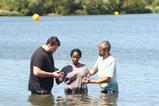
When we were in Cornwall, we saw quite a lot of people become Christians, and we used to baptise them in the sea and give them a Bible. I remember one Easter Sunday handing out Bibles and I could see the look in their eyes. These people, many of whom were not from a church background, were very grateful but also overwhelmed. I said: “Let me give you a crash course in the Bible.” Basically, one thing led to another, with The Bible Course evolving from helping ordinary people who were hungry, but didn’t have a head start.
The Bible Course aims to give an overview of the whole sweep of scripture. It’s saying, “Why is that there at that point, in that context, and how does it fit into the grand narrative of scripture?” And you visualise that throughout the course.
I think two things are probably endemic to me that come through in it: one is seeing the big picture, and the other is being visual. I put those together and came up with this storyline shape from Genesis to Revelation, and then found a way to load all of the books from the library of scripture onto that structure. That’s the USP and the gift that keeps giving. We’ve recreated that four times, but at its heart every time is this big picture, visual approach. It all came from the beaches of Cornwall.
What are some of the common mistakes Christians make when engaging with scripture?
One of them is you isolate too much of the text. Your reading of scripture is too fragmented, piecemeal. You’re not seeing the biggest story. God can speak through a word or a phrase – it’s all inspired. But God has inspired a grand narrative that centres on His son. You have to see the leaning, anticipating nature of the Old Testament.
The famous verse in Jeremiah 29:11 is a great verse, but the context is Jeremiah writing to the exiles. They’ll be there for 70 years. He’s saying they should put down roots and bless the place. When you reframe it with that context, it is still a brilliant promise, but it’s not the promise of: Trust in me and I’m going to make your life easy; it’s: Trust in me, and you’ll be in exile, you’ll feel like life is hard sometimes, but you’ve got a great purpose in the struggle. The context often reframes the verse – and in a way that illuminates it more.
Another issue is reading the Bible alone as an individual. God has ordained it that you won’t understand the Bible in its fullest sense on your own. It’s to be understood in community. The letters of the New Testament are written to communities of Christians for a reason.
Do you ever wish that God had been clearer? How is it that we can read the same text and come to completely opposite conclusions on things like female bishops, creation, evolution…?
I would push back on how much the text is the source of the division, and how much is actually the human heart.
I think God, in his wisdom, has left latent meaning in scripture that will roll out like a scroll, its meaning unfolding over time. In a sense, it’s a process of discovery, that every generation has to dig in for themselves, because the whole thing’s not just given as a download. It rolls out to those who lean in.
Some of the differences are because one generation stands on the shoulders of another and sees further. You could argue that the abolitionist movement was seeing more of the meaning of scripture on emancipation and freedom than previous generations, for example.
There’s also a hierarchy of order in the Bible. Not everything is as important as anything else. I’ve often illustrated this with the closed hand, open hand idea. There are some doctrines in the closed hand; we’ve got to hold on to these and be united on these, like the great truths of the incarnation, crucifixion, resurrection and the return of Jesus. Then there are these other issues that can sit in the open hand, which actually teach us humility and brings a different form of unity.
Bear Grylls has been very open about his Christian faith lately, and you’ve been doing some work with him. I’d love to hear a bit more about that.
When I wrote my first book on the Bible – The Bible: A story that makes sense of life (Hodder & Stoughton) – a mutual friend sent it to Bear, who kindly endorsed it. He then reached out and invited me to go on a trip to Israel to film a TV series. When we returned, he talked about writing a book, which led to The Greatest Story Ever Told (Hodder & Stoughton).
What goes into a project like that in order to be biblically faithful?
Bear was really clear from the beginning that we’ve got to put the words of Jesus from scripture in the mouth of Jesus. We’re not putting any words in Jesus’ mouth. We also decided that we would build in micro stories that aren’t in the gospels, but only to turn what is in the gospels into a 3D experience, if you like. We would only fill out the backstory with the micro details to make it come alive. The net effect is the greatest story ever told is effectively a very close reading of the Bible, or what would be called a harmonisation.
Do you think Bear’s openness is indicative of the new culture we’re in, where there is this greater receptivity to Christianity?
There is a vibe shift. At one level, it began in the pandemic years, and with the likes of Jordan Peterson and Tom Holland. Now, it’s most clearly expressed in popular culture. There are elite Premier League footballers, whom so many young people look up to, and they are so proud of their faith. You have my son, who plays academy football, and his teammate wants a Bible for his birthday. Why does he want a Bible when he has nothing to do with church? Well, probably because of Bukayo Saka, who he’s seen on Ballers in God.
Tell me a bit more about your own experience of this vibe shift, or what has been termed the Quiet Revival*. How do churches respond to it?
It’s a contested moment. The slight risk of the word “revival” is it sounds like an inevitable march of everything culturally back to Christianity. I don’t think it is. I think it’s the collapse. Primarily, it’s the collapse of an old narrative – the secular humanist, new atheist narrative. But from that, people are bleeding out in all sorts of directions. Crystals and manifesting are having a quiet revival. New stoicism is having a quiet revival.
How do we respond? One thing is to be much more confident about using online channels – not just as public notice boards to tell people about the in-person events we’re having, but as channels for communicating the gospel, because people are listening. For every one person who’s brave enough to turn up at church, we’ve got to be thinking that there’s 100 out there looking at Christian content. If you could cast a spiritual heat map over your neighbourhood that detected where people are reading the Bible or watching stuff online or listening to the Joe Rogan podcast about Christianity, I think we’d be amazed at where there’s interest.
We’ve also got to be a lot more ready for the people who turn up, because what we don’t want them to feel is that we’re caught napping. I’ve had a couple of instances where young men have said they went to a church full of questions, having read the whole Bible, and when they got there no one could help.
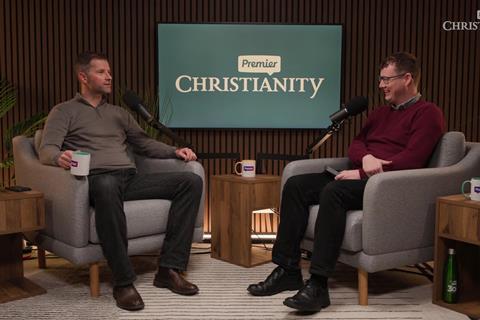
Listen to the full interview on The Profile podcast or watch on our YouTube channel.
This article was produced with editorial support from Tim Bechervaise






















1 Reader's comment