



Christians are being prosecuted for silent prayer and preaching the gospel, says Lois McLatchie-Miller. Now even passionate pro-choice campaigners are warning that abortion buffer zones have gone too far
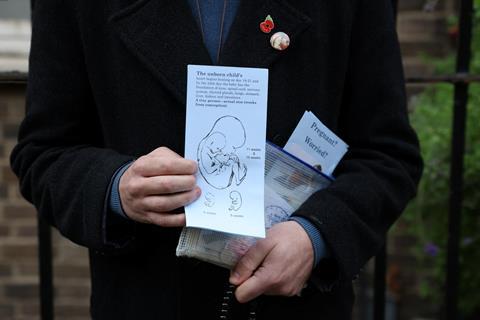
An arrest over a silent prayer. A trial over a John 3:16 gospel message. Warnings that street preachers continue to be arrested across the country.
The frequency of news stories about discrimination against Christians in the UK shows no sign of slowing. And as momentum has grown, even the UK’s most ardent pro-abortion voices have begun to recognise there’s a serious problem.
Writing in The Telegraph recently, Ella Whelan – a leading voice in the campaign for decriminalising abortion up to birth who describes herself as “passionately pro-choice” - argued that abortion buffer zone laws have in fact gone too far. These laws prohibit any form of “influence” within 150m of an abortion facility (or 200m in Scotland). They have been the main trigger for the arrest, trial and conviction of Christians across the UK who hold pro-life beliefs and enter the zone.
Ella’s point was not that abortion is wrong - she is still firm on her views - but by logical extension of her own argument, she claims that if one really believes in women’s autonomy, we should be wary of laws that criminalise peaceful expression simply because we dislike its content. “If we want to win the battle of ideas for women’s freedom, autonomy for me and not for thee just won’t wash”, she quipped.
Ella’s public acknowledgement of the fact that buffer zones are unfairly censorial is a welcome intervention at a time where restrictions on faith in certain public areas are tightening more than ever. A few weeks ago, the Northern Ireland Policing Service published guidelines on “buffer zones” which said that carrying a Bible through a public space in a hospital, or simply praying with a sick patient, could be a crime – if somebody was to oversee this expression of faith and be “influenced” about an unconnected decision to have an abortion. This puts clergy who want to minister to ill congregants in their time of need in a difficult spot.
These scenarios are a far cry from the original stated intention of the law. “Buffer zones” were brought in to allegedly prevent harassment and violence from campaigners outside of abortion facilities. Of course, all Christians would condemn such activity, and rightly so. But violence outside of abortion clinics was never an issue in the UK. A 2017 Home Office review on the situation confirmed it to be “rare”. And even if an incident were to occur, justice would have been swiftly executed using already existing laws against such crimes.
Indeed, though several years have passed since the first introduction of “buffer zones”, it doesn’t seem that the law has ever been used to actually target violence. All reported cases seem to feature peaceful Christians who happen to be in the area, but exist peacefully, and don’t even voice an opinion about abortion.
The latest case is that of Clive Johnston, a 78-year-old retired pastor from Northern Ireland. In July 2024, Johnston held a small open-air Sunday service near Causeway Hospital in Coleraine. He preached from John 3:16 - “For God so loved the world” - and did not mention anything to do with abortion. There were no graphic posters, no shouting at women, no blocking of entrances and no harassment of anyone at all.
Yet because the Christian service took place on the fringes of an abortion buffer zone, Johnston was prosecuted. He was apparently convicted and fined on the basis that somebody walking past may have seen that he was a Christian, inferred his beliefs on this specific matter, and been influenced about an abortion decision. He is now appealing, with support from The Christian Institute.
Johnston is not the first Christian to be unfairly accused of committing “influence”. Isabel Vaughan-Spruce was arrested twice after silently praying on a street near a Birmingham abortion clinic. She didn’t even utter a word out loud – just stood quietly and peacefully on her own. Though previously acquitted, Isabel has been charged yet again and will face trial for her thoughts in an incredulous moment for the British legal system. In Bournemouth, an army veteran, Adam Smith-Connor, has already been convicted for praying silently for a few minutes across a road from a clinic, about the loss of his own child. Even if one were to think abortion morally permissible, it is difficult to see how standing quietly, thinking, should attract criminal punishment.
The idea that women are so vulnerable that they should be immune to absolutely all “influences” is deeply patronising
The apparent crime is not even expressing a faith-based opinion, but expressing faith in and of itself. The crucial word in the criminal law is “influence”. It sounds innocuous until you ask what it actually means. The implications also have an impact beyond Christians. Could a mother asking her daughter, “Are you sure?” be influencing her? Could two friends have a consensual conversation about abortion before an appointment?
The idea that women are so vulnerable that they should be immune to absolutely all “influences” is deeply patronising. We all influence each other every day, either directly or indirectly, every time we communicate. We all have the ability to act on the information that we receive, or to ignore it. Why is the government so adamant that women seeking abortions must not be allowed to freely change their minds?
Ella Wheelan acknowledges this point herself. It is paradoxical for a “pro-choice” movement to present abortion as “empowering”, yet at the same time, claim women seeking abortions are so vulnerable to changing their mind that they cannot catch a glimpse of anyone who may disagree. “This is hardly the empowering mantra we need for an argument for women determining their own destinies,” she writes.
freedom of speech should not depend on which side of an argument you are on
I don’t believe abortion is empowering. Basic scientific facts about human life in the womb, plus research about the adverse impact abortion can have on women, show that it’s a harmful and heartbreaking blight on society that results in the death of 1 out of every 3 British babies conceived. But the encouraging thing about Ella Whelan’s intervention is that it reminds us that freedom of speech should not depend on which side of an argument you are on.
Today it is Christians whose prayers and sermons are treated as suspect; tomorrow it could be someone else’s deeply held conviction. In a democracy, we all have the right to “influence”, and to decide, in turn, if we are going to be responsive to that “influence” or not. And when it comes to matters of life and death, that freedom to communicate freely in grace and truth is more important than ever.















1 Reader's comment